CRG-MENA-INT-0926/1: The Mecca Architecture
03/09/26 13:02
The Mecca Architecture
Iran and the Emergence of a Post-American Security Order
Document: CRG-MENA-INT-0926/1
Title: The Mecca Architecture
Subtitle: Iran and the Emergence of a Post-American Security Order
Classification: UNCLASSIFIED
Date: 3 September 2026
Publisher: Condor Research Group (CRG)
The emerging defence relationship between Türkiye, Saudi Arabia and Pakistan has been described in some quarters as the beginning of a new regional security architecture — potentially one less dependent on the United States and eventually capable of accommodating additional regional powers.
CRG’s assessment is more cautious.
The agreement is real, politically significant and potentially institutionalising. It includes an Article 5-style collective-defence formulation and is accompanied by defence-industrial, intelligence, training and interoperability ambitions. What it does not yet possess is equally important: there is no integrated force, no joint command, no defined automatic trigger mechanism and no published nuclear component. CRG-MENA-INT-0926-1(4).pdf
The most defensible interpretation at present is therefore not the emergence of a fully autonomous post-American security system, but the institutionalisation of strategic hedging and burden-sharing inside the existing US-centred order.
That distinction matters.
The architecture may eventually evolve into something considerably more independent. But that outcome depends upon developments that have not yet occurred: meaningful institutionalisation, a shared external threat, further accessions and, above all, the future level of US engagement in the region. CRG-MENA-INT-0926-1(4).pdf
⸻
Key Judgments
1. The agreement is politically significant but operationally thin.
A genuine trilateral defence arrangement now exists. However, treaty language should not be confused with operational military integration. The absence of a joint command, standing integrated force, defined automatic response mechanism and explicit nuclear guarantee significantly limits the agreement’s immediate military meaning. CRG-MENA-INT-0926-1(4).pdf
2. The “post-American architecture” interpretation is premature.
The three participants continue to operate within extensive relationships with Washington and the wider Western security system. CRG therefore assesses the present architecture primarily as a means of increasing strategic autonomy and spreading risk rather than replacing the United States outright. CRG-MENA-INT-0926-1(4).pdf
3. The most consequential effects may initially be political rather than military.
The arrangement provides Saudi Arabia with an additional pathway toward strategic autonomy and potentially nuclear hedging without making Israeli normalisation the sole route toward enhanced security guarantees. The result could prove more consequential for the regional political order than the pact’s immediate military capability. CRG-MENA-INT-0926-1(4).pdf
4. Iran’s exclusion currently helps hold the arrangement together.
Iranian participation is not presently the natural next step. On the contrary, Iran’s absence removes several political contradictions that would become much harder to manage if Tehran were brought formally inside the structure. CRG-MENA-INT-0926-1(4).pdf
⸻
Will Iran Join?
The short answer is:
Probably not — at least not formally and not soon.
CRG assesses formal Iranian accession as unlikely under present conditions. The more plausible trajectory is some form of functional accommodation in which Iran remains outside the formal organisation while cooperating with its members on specific regional security issues.
The distinction between accession and accommodation is important.
Iranian accommodation could take forms such as maritime security cooperation, indirect security coordination, participation in regional forums or issue-specific cooperation involving the Gulf and Strait of Hormuz.
Formal membership would require a much deeper political transformation.
Iran would have to accept a non-bloc, issue-based structure rather than interpret participation as entry into a Sunni-led security alliance. Saudi Arabia would need sufficient strategic confidence to tolerate Iranian participation. Türkiye and Pakistan would need to conclude that Tehran’s inclusion improved rather than complicated their own security calculations.
The outcome of the current war is therefore central.
CRG assesses that Iranian participation becomes simultaneously rational for Iran, Saudi Arabia, Türkiye and Pakistan only under a conjunction of conditions: the war ends without regime change or Iranian nuclear breakout; Saudi Arabia obtains sufficient nuclear or strategic-security credibility without an unavoidable Israel-normalisation requirement; Pakistan avoids a major India crisis; and the arrangement preserves its non-bloc character. CRG-MENA-INT-0926-1(4).pdf
CRG Probability Assessment
Functional Iranian accommodation by 2030: approximately 15–25%
Formal Iranian accession by 2030: below 10%
These are analytical probability judgments rather than predictive measurements. CRG-MENA-INT-0926-1(4).pdf
⸻
The Israeli Strategic Inversion
One of the most important implications of the emerging architecture is that its effect on Israel could reverse over time.
In the short term, the arrangement is not a major military threat to Israel.
It lacks integrated command structures, standing forces and a strong common incentive among its members to confront Israel directly. At the same time, a broader regional security web may constrain Iranian behaviour and therefore produce some indirect benefit for Israel.
The longer-term picture is different.
Israel could face a progressively more difficult strategic environment if the arrangement:
A regional architecture incorporating Saudi Arabia, Türkiye and Pakistan while simultaneously reaching accommodation with Iran would remove one of the structural divisions that has historically benefited Israel: the Saudi-Iranian rivalry. CRG-MENA-INT-0926-1(4).pdf
CRG therefore reaches a counter-intuitive judgment:
Iranian inclusion is simultaneously the least likely and potentially the most dangerous development for Israel.
A security structure that contains Iran is one thing.
A security structure that eventually reconciles with Iran is something entirely different. CRG-MENA-INT-0926-1(4).pdf
⸻
⸻
The Pakistani Nuclear Question
Pakistan’s nuclear arsenal inevitably changes how the agreement is perceived.
That does not, however, mean that Pakistan has extended a nuclear guarantee to Saudi Arabia or Türkiye.
CRG finds no evidence of an explicit or de facto Pakistani nuclear umbrella. Pakistan has previously denied that such a guarantee exists, and the 2026 arrangement does not publicly establish a doctrine of extended nuclear deterrence. CRG-MENA-INT-0926-1(4).pdf
The more important issue is ambiguity.
Pakistan’s nuclear status adds signalling value to the arrangement even if the weapons themselves remain principally directed toward Pakistan’s strategic competition with India.
That ambiguity may deter.
It may also destabilise.
A Pakistan-India crisis remains one of the most dangerous events for the Mecca framework because it could force Saudi Arabia and Türkiye to decide whether collective-defence language applies to a conflict they never intended to join.
The principal nuclear danger is therefore not necessarily an organised nuclear umbrella.
It is miscalculation and chain-ganging. CRG-MENA-INT-0926-1(4).pdf
⸻
The 6–60 Month Outlook
CRG models several possible trajectories rather than relying upon a single forecast.
The baseline through the next 12–24 months remains consolidation without major expansion, overlaid by a substantial possibility that the arrangement remains politically important while operationally limited.
The principal variable capable of driving the organisation toward a more autonomous regional-security role is US retrenchment.
Iranian accommodation remains primarily a longer-horizon scenario dependent upon the outcome of the current war. CRG-MENA-INT-0926-1(4).pdf
⸻
CRG Scenario Assessment — The Mecca Architecture
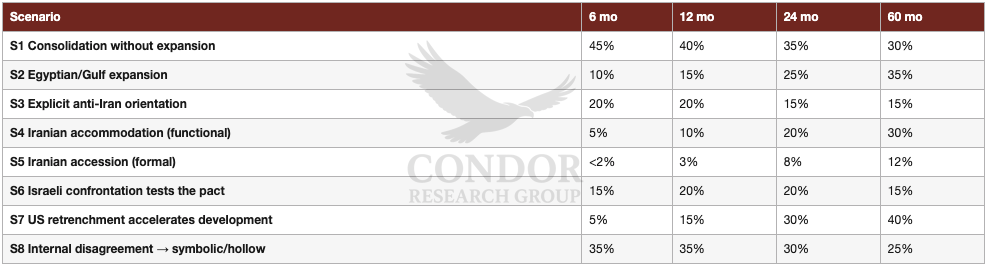
Probability ranges represent analytical judgments and scenarios are not mutually exclusive.
⸻
What Would Change the Assessment?
The current assessment is not static.
Several observable developments would provide much stronger evidence that the Mecca arrangement is evolving from political signalling toward a genuine regional-security institution.
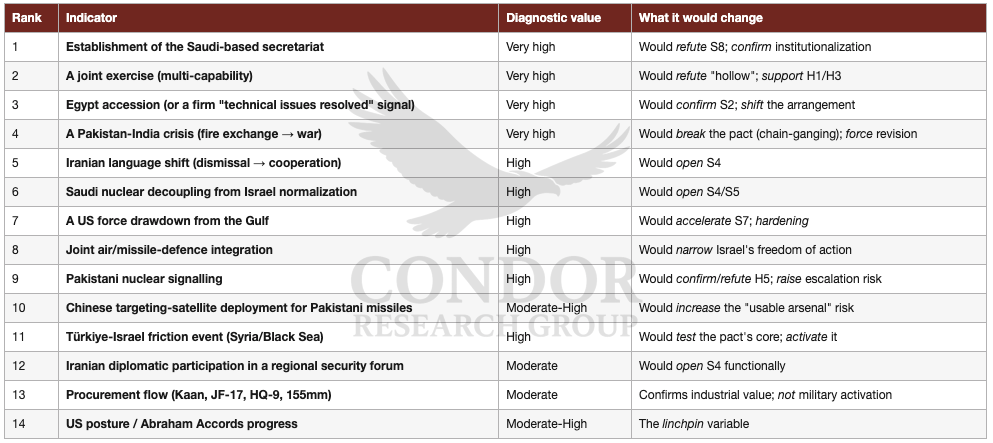
CRG considers the following among the most diagnostically important indicators:
Establishment of the Saudi-based secretariat.
This would provide concrete evidence that institutionalisation is occurring rather than remaining aspirational.
A genuine multi-capability joint military exercise.
Exercises involving several services and participating states would materially weaken the “hollow alliance” interpretation.
Egyptian accession.
Egypt would add military mass, geography and political legitimacy that smaller prospective entrants cannot provide.
A Pakistan-India military crisis.
This would constitute one of the strongest possible stress tests of the agreement. Refusal by Saudi Arabia or Türkiye to become involved would expose the limits of collective-defence language.
A change in Iranian diplomatic behaviour.
Movement from rhetorical distance toward structured cooperation, regional-security dialogue or joint maritime arrangements would significantly increase the probability of functional Iranian accommodation. CRG-MENA-INT-0926-1(4).pdf
Additional high-value indicators include Saudi nuclear-policy changes, a significant US Gulf force drawdown, integrated air- or missile-defence programmes and any Pakistani nuclear signalling explicitly associated with the pact. CRG-MENA-INT-0926-1(4).pdf
⸻
CRG Watchpoints
⸻
What the Agreement Is — and Is Not
The Mecca arrangement should not presently be understood as a Middle Eastern NATO.
Nor should it be dismissed as meaningless.
Its immediate military capability may be limited, but its political and industrial significance is real. It provides a platform through which Türkiye, Saudi Arabia and Pakistan can deepen defence-industrial cooperation, expand intelligence and military coordination and increase their individual leverage within the wider international system.
That may ultimately matter more than the treaty language itself. The question is therefore not simply whether the pact already constitutes an alternative regional order.
It does not.
The more important question is whether a mechanism currently operating inside the existing order can gradually accumulate enough military, industrial and political autonomy to function outside it if circumstances change.
CRG’s current answer is:
Possibly — but the decisive conditions have not yet emerged.
The architecture is presently best understood as a political-industrial hedging framework with latent collective-defence potential, compatible with the US security system but capable of moving toward greater independence if US involvement declines and a sufficiently powerful common threat emerges. CRG-MENA-INT-0926-1(4).pdf
⸻
Assessment Boundary
Important uncertainties remain.
The full text of the agreement has not been publicly released. The analysis therefore relies upon the joint statement, official statements and publicly available reporting.
Probability ranges used by CRG are analytical judgments expressing uncertainty rather than statistical measurements.
The scenarios presented above are conditional pathways, not predictions.
The single most important unknown remains the outcome of the current US/Israel–Iran conflict. That outcome will strongly influence whether the Mecca framework remains a politically useful but operationally thin arrangement, develops into a more autonomous security system, or eventually creates space for some form of Iranian participation. CRG-MENA-INT-0926-1(4).pdf
⸻
FULL CRG ASSESSMENT
CRG-MENA-INT-0926/1
The Mecca Architecture: Iran and the Emergence of a Post-American Security Order
26-page analytical assessment.
The complete report includes:
⸻
DOCUMENT INFORMATION
Document: CRG-MENA-INT-0926/1: The Mecca Architecture – Iran and the Emergence of a Post-American Security Order
Classification: Strategic Intelligence Assessment (Regional Security Architecture Analysis)
Distribution: Public Release
Revision Status: Final — Approved for internal CRG circulation, external academic reference, and web publication
Authorized By: Condor Research Group (CRG)
Division: Geopolitical & Strategic Intelligence Division
Original Draft Date: September 2026
Release Date: 3 September 2026
Version: CRG-INT-VER-A1-FINAL
Keywords: Mecca Architecture, Mecca Defence Pact, Middle East, Regional Security Architecture, Saudi Arabia, Türkiye, Pakistan, Iran, Israel, United States, China, Russia, NATO, Egypt, Gulf States, Strategic Autonomy, Collective Defence, Defence Cooperation, Defence-Industrial Cooperation, Nuclear Deterrence, Pakistani Nuclear Weapons, Extended Deterrence, Iranian Accommodation, Iranian Accession, Abraham Accords, Saudi Nuclear Programme, US Retrenchment, Strategic Hedging, Burden-Sharing, Regional Order, Post-American Security Order, Gulf Security, Strait of Hormuz, Scenario Analysis, Strategic Indicators
Source Report: The Mecca Architecture: Iran and the Emergence of a Post-American Security Order
Publication Note: Published on the Condor Research Group website as part of the CRG Strategic Intelligence Assessment series. This assessment examines the emerging Türkiye–Saudi Arabia–Pakistan defence arrangement, its institutional and operational development, its relationship to the existing US-centred regional security order, and the conditions under which it could evolve toward a more autonomous security architecture. Particular attention is given to Iranian accommodation and potential accession, implications for Israel, the role of Pakistani nuclear capability, prospective expansion, US retrenchment, and the distinction between political signalling and credible collective-defence capacity. Probability ranges, scenario pathways and confidence classifications represent comparative analytical judgments under uncertainty and do not constitute predictions of future state behaviour or military action.
Iran and the Emergence of a Post-American Security Order
Document: CRG-MENA-INT-0926/1
Title: The Mecca Architecture
Subtitle: Iran and the Emergence of a Post-American Security Order
Classification: UNCLASSIFIED
Date: 3 September 2026
Publisher: Condor Research Group (CRG)
The emerging defence relationship between Türkiye, Saudi Arabia and Pakistan has been described in some quarters as the beginning of a new regional security architecture — potentially one less dependent on the United States and eventually capable of accommodating additional regional powers.
CRG’s assessment is more cautious.
The agreement is real, politically significant and potentially institutionalising. It includes an Article 5-style collective-defence formulation and is accompanied by defence-industrial, intelligence, training and interoperability ambitions. What it does not yet possess is equally important: there is no integrated force, no joint command, no defined automatic trigger mechanism and no published nuclear component. CRG-MENA-INT-0926-1(4).pdf
The most defensible interpretation at present is therefore not the emergence of a fully autonomous post-American security system, but the institutionalisation of strategic hedging and burden-sharing inside the existing US-centred order.
That distinction matters.
The architecture may eventually evolve into something considerably more independent. But that outcome depends upon developments that have not yet occurred: meaningful institutionalisation, a shared external threat, further accessions and, above all, the future level of US engagement in the region. CRG-MENA-INT-0926-1(4).pdf
⸻
Key Judgments
1. The agreement is politically significant but operationally thin.
A genuine trilateral defence arrangement now exists. However, treaty language should not be confused with operational military integration. The absence of a joint command, standing integrated force, defined automatic response mechanism and explicit nuclear guarantee significantly limits the agreement’s immediate military meaning. CRG-MENA-INT-0926-1(4).pdf
2. The “post-American architecture” interpretation is premature.
The three participants continue to operate within extensive relationships with Washington and the wider Western security system. CRG therefore assesses the present architecture primarily as a means of increasing strategic autonomy and spreading risk rather than replacing the United States outright. CRG-MENA-INT-0926-1(4).pdf
3. The most consequential effects may initially be political rather than military.
The arrangement provides Saudi Arabia with an additional pathway toward strategic autonomy and potentially nuclear hedging without making Israeli normalisation the sole route toward enhanced security guarantees. The result could prove more consequential for the regional political order than the pact’s immediate military capability. CRG-MENA-INT-0926-1(4).pdf
4. Iran’s exclusion currently helps hold the arrangement together.
Iranian participation is not presently the natural next step. On the contrary, Iran’s absence removes several political contradictions that would become much harder to manage if Tehran were brought formally inside the structure. CRG-MENA-INT-0926-1(4).pdf
⸻
Will Iran Join?
The short answer is:
Probably not — at least not formally and not soon.
CRG assesses formal Iranian accession as unlikely under present conditions. The more plausible trajectory is some form of functional accommodation in which Iran remains outside the formal organisation while cooperating with its members on specific regional security issues.
The distinction between accession and accommodation is important.
Iranian accommodation could take forms such as maritime security cooperation, indirect security coordination, participation in regional forums or issue-specific cooperation involving the Gulf and Strait of Hormuz.
Formal membership would require a much deeper political transformation.
Iran would have to accept a non-bloc, issue-based structure rather than interpret participation as entry into a Sunni-led security alliance. Saudi Arabia would need sufficient strategic confidence to tolerate Iranian participation. Türkiye and Pakistan would need to conclude that Tehran’s inclusion improved rather than complicated their own security calculations.
The outcome of the current war is therefore central.
CRG assesses that Iranian participation becomes simultaneously rational for Iran, Saudi Arabia, Türkiye and Pakistan only under a conjunction of conditions: the war ends without regime change or Iranian nuclear breakout; Saudi Arabia obtains sufficient nuclear or strategic-security credibility without an unavoidable Israel-normalisation requirement; Pakistan avoids a major India crisis; and the arrangement preserves its non-bloc character. CRG-MENA-INT-0926-1(4).pdf
CRG Probability Assessment
Functional Iranian accommodation by 2030: approximately 15–25%
Formal Iranian accession by 2030: below 10%
These are analytical probability judgments rather than predictive measurements. CRG-MENA-INT-0926-1(4).pdf
⸻
The Israeli Strategic Inversion
One of the most important implications of the emerging architecture is that its effect on Israel could reverse over time.
In the short term, the arrangement is not a major military threat to Israel.
It lacks integrated command structures, standing forces and a strong common incentive among its members to confront Israel directly. At the same time, a broader regional security web may constrain Iranian behaviour and therefore produce some indirect benefit for Israel.
The longer-term picture is different.
Israel could face a progressively more difficult strategic environment if the arrangement:
- develops integrated command and air-defence structures;
- expands to include additional major Arab states;
- becomes less dependent on Washington;
- acquires credible Pakistani nuclear signalling;
- develops a common position on Israel and Palestine;
- or ultimately reaches accommodation with Tehran.
A regional architecture incorporating Saudi Arabia, Türkiye and Pakistan while simultaneously reaching accommodation with Iran would remove one of the structural divisions that has historically benefited Israel: the Saudi-Iranian rivalry. CRG-MENA-INT-0926-1(4).pdf
CRG therefore reaches a counter-intuitive judgment:
Iranian inclusion is simultaneously the least likely and potentially the most dangerous development for Israel.
A security structure that contains Iran is one thing.
A security structure that eventually reconciles with Iran is something entirely different. CRG-MENA-INT-0926-1(4).pdf
⸻
“Iranian inclusion is simultaneously the most unlikely and the most dangerous development for Israel.”
⸻
The Pakistani Nuclear Question
Pakistan’s nuclear arsenal inevitably changes how the agreement is perceived.
That does not, however, mean that Pakistan has extended a nuclear guarantee to Saudi Arabia or Türkiye.
CRG finds no evidence of an explicit or de facto Pakistani nuclear umbrella. Pakistan has previously denied that such a guarantee exists, and the 2026 arrangement does not publicly establish a doctrine of extended nuclear deterrence. CRG-MENA-INT-0926-1(4).pdf
The more important issue is ambiguity.
Pakistan’s nuclear status adds signalling value to the arrangement even if the weapons themselves remain principally directed toward Pakistan’s strategic competition with India.
That ambiguity may deter.
It may also destabilise.
A Pakistan-India crisis remains one of the most dangerous events for the Mecca framework because it could force Saudi Arabia and Türkiye to decide whether collective-defence language applies to a conflict they never intended to join.
The principal nuclear danger is therefore not necessarily an organised nuclear umbrella.
It is miscalculation and chain-ganging. CRG-MENA-INT-0926-1(4).pdf
⸻
The 6–60 Month Outlook
CRG models several possible trajectories rather than relying upon a single forecast.
The baseline through the next 12–24 months remains consolidation without major expansion, overlaid by a substantial possibility that the arrangement remains politically important while operationally limited.
The principal variable capable of driving the organisation toward a more autonomous regional-security role is US retrenchment.
Iranian accommodation remains primarily a longer-horizon scenario dependent upon the outcome of the current war. CRG-MENA-INT-0926-1(4).pdf
⸻
CRG Scenario Assessment — The Mecca Architecture
Probability ranges represent analytical judgments and scenarios are not mutually exclusive.
⸻
What Would Change the Assessment?
The current assessment is not static.
Several observable developments would provide much stronger evidence that the Mecca arrangement is evolving from political signalling toward a genuine regional-security institution.
CRG considers the following among the most diagnostically important indicators:
Establishment of the Saudi-based secretariat.
This would provide concrete evidence that institutionalisation is occurring rather than remaining aspirational.
A genuine multi-capability joint military exercise.
Exercises involving several services and participating states would materially weaken the “hollow alliance” interpretation.
Egyptian accession.
Egypt would add military mass, geography and political legitimacy that smaller prospective entrants cannot provide.
A Pakistan-India military crisis.
This would constitute one of the strongest possible stress tests of the agreement. Refusal by Saudi Arabia or Türkiye to become involved would expose the limits of collective-defence language.
A change in Iranian diplomatic behaviour.
Movement from rhetorical distance toward structured cooperation, regional-security dialogue or joint maritime arrangements would significantly increase the probability of functional Iranian accommodation. CRG-MENA-INT-0926-1(4).pdf
Additional high-value indicators include Saudi nuclear-policy changes, a significant US Gulf force drawdown, integrated air- or missile-defence programmes and any Pakistani nuclear signalling explicitly associated with the pact. CRG-MENA-INT-0926-1(4).pdf
⸻
CRG Watchpoints
⸻
What the Agreement Is — and Is Not
The Mecca arrangement should not presently be understood as a Middle Eastern NATO.
Nor should it be dismissed as meaningless.
Its immediate military capability may be limited, but its political and industrial significance is real. It provides a platform through which Türkiye, Saudi Arabia and Pakistan can deepen defence-industrial cooperation, expand intelligence and military coordination and increase their individual leverage within the wider international system.
That may ultimately matter more than the treaty language itself. The question is therefore not simply whether the pact already constitutes an alternative regional order.
It does not.
The more important question is whether a mechanism currently operating inside the existing order can gradually accumulate enough military, industrial and political autonomy to function outside it if circumstances change.
CRG’s current answer is:
Possibly — but the decisive conditions have not yet emerged.
The architecture is presently best understood as a political-industrial hedging framework with latent collective-defence potential, compatible with the US security system but capable of moving toward greater independence if US involvement declines and a sufficiently powerful common threat emerges. CRG-MENA-INT-0926-1(4).pdf
⸻
Assessment Boundary
Important uncertainties remain.
The full text of the agreement has not been publicly released. The analysis therefore relies upon the joint statement, official statements and publicly available reporting.
Probability ranges used by CRG are analytical judgments expressing uncertainty rather than statistical measurements.
The scenarios presented above are conditional pathways, not predictions.
The single most important unknown remains the outcome of the current US/Israel–Iran conflict. That outcome will strongly influence whether the Mecca framework remains a politically useful but operationally thin arrangement, develops into a more autonomous security system, or eventually creates space for some form of Iranian participation. CRG-MENA-INT-0926-1(4).pdf
⸻
FULL CRG ASSESSMENT
CRG-MENA-INT-0926/1
The Mecca Architecture: Iran and the Emergence of a Post-American Security Order
26-page analytical assessment.
The complete report includes:
- competing hypotheses and falsification criteria;
- detailed Türkiye, Saudi Arabia and Pakistan strategic-driver assessments;
- Iran accession and accommodation pathways;
- Israeli scenario-response matrix;
- Pakistani nuclear-deterrence assessment;
- accession analysis for Egypt, UAE, Qatar, Jordan, Oman, Bahrain, Kuwait, Azerbaijan and Iran;
- US, Chinese, Russian, NATO and Indian implications;
- crisis stress tests;
- full 6 / 12 / 24 / 60-month scenario modelling;
- complete indicators and watchpoints matrix;
- Alternative Analysis / Red Team;
- methodological and source notes.
⸻
DOCUMENT INFORMATION
Document: CRG-MENA-INT-0926/1: The Mecca Architecture – Iran and the Emergence of a Post-American Security Order
Classification: Strategic Intelligence Assessment (Regional Security Architecture Analysis)
Distribution: Public Release
Revision Status: Final — Approved for internal CRG circulation, external academic reference, and web publication
Authorized By: Condor Research Group (CRG)
Division: Geopolitical & Strategic Intelligence Division
Original Draft Date: September 2026
Release Date: 3 September 2026
Version: CRG-INT-VER-A1-FINAL
Keywords: Mecca Architecture, Mecca Defence Pact, Middle East, Regional Security Architecture, Saudi Arabia, Türkiye, Pakistan, Iran, Israel, United States, China, Russia, NATO, Egypt, Gulf States, Strategic Autonomy, Collective Defence, Defence Cooperation, Defence-Industrial Cooperation, Nuclear Deterrence, Pakistani Nuclear Weapons, Extended Deterrence, Iranian Accommodation, Iranian Accession, Abraham Accords, Saudi Nuclear Programme, US Retrenchment, Strategic Hedging, Burden-Sharing, Regional Order, Post-American Security Order, Gulf Security, Strait of Hormuz, Scenario Analysis, Strategic Indicators
Source Report: The Mecca Architecture: Iran and the Emergence of a Post-American Security Order
Publication Note: Published on the Condor Research Group website as part of the CRG Strategic Intelligence Assessment series. This assessment examines the emerging Türkiye–Saudi Arabia–Pakistan defence arrangement, its institutional and operational development, its relationship to the existing US-centred regional security order, and the conditions under which it could evolve toward a more autonomous security architecture. Particular attention is given to Iranian accommodation and potential accession, implications for Israel, the role of Pakistani nuclear capability, prospective expansion, US retrenchment, and the distinction between political signalling and credible collective-defence capacity. Probability ranges, scenario pathways and confidence classifications represent comparative analytical judgments under uncertainty and do not constitute predictions of future state behaviour or military action.