CRG-NATO-DOC-0926/5: Escalation by Complication
23/09/26 08:28
Document: CRG-NATO-DOC-0926/5
Title: Escalation by Complication
Subtitle: How Defensive Complexity Can Generate Escalatory Risk in the European Security System
Classification: UNCLASSIFIED — Strategic Doctrine Development
Date: 23 September 2026
Publisher: Condor Research Group (CRG)
Assessment Horizon: 2026–2030
Analytical Confidence: Moderate–High
⸻
Executive Assessment
European security in 2026 presents an apparent paradox.
NATO is materially stronger than it was before Russia’s full-scale invasion of Ukraine. The Alliance has expanded its eastern-flank force posture, operates nine multinational Forward Land Forces battlegroups, maintains enhanced air policing and integrated air and missile defence, conducts Baltic Sentry and Eastern Sentry, and is accelerating investment in drones, counter-drone systems, deep precision strike, intelligence, cyber, space, logistics and military mobility. At Ankara in July 2026, Allies reaffirmed Article 5, announced more than $50 billion in new procurement and committed €70 billion in military equipment, assistance and training for Ukraine during 2026.
The European Union is simultaneously constructing an increasingly dense defence architecture through SAFE, Readiness 2030, the Eastern Flank Watch, European Drone Defence Initiative, European Air Shield, European Space Shield and an EU-wide military-mobility system. SAFE alone provides up to €150 billion in loans for accelerated defence procurement.
The conventional interpretation is straightforward:
More capability + more readiness + greater integration = stronger deterrence = lower probability of war.
There is substantial logic behind this proposition.
CRG’s Escalation by Complication (EbC) hypothesis introduces a second variable:
As a security architecture becomes denser, faster, more distributed and more interconnected, the number of possible interactions between military, civilian, autonomous, national and multinational systems grows faster than the number of systems themselves.
Beyond a certain point, additional defensive capability may therefore produce a secondary effect:
Deterrence strength rises — but so can escalation complexity.
This does not mean that NATO expansion, forward defence, air policing, counter-drone systems or military exercises inherently cause escalation. Nor does EbC assume Russian behaviour is reactive rather than independently revisionist or coercive. Instead, EbC identifies a different mechanism.
An increasingly crowded battlespace creates more contact surfaces. More contact surfaces create more ambiguous events. More ambiguous events create greater attribution pressure. Greater attribution pressure interacts with shorter decision windows and political signalling requirements. The resulting system can generate escalation pathways that none of the principal actors deliberately selected.
The emerging European security problem may consequently be represented as:
Deterrence Density ↑
→ Interaction Density ↑
→ Ambiguous Events ↑
→ Attribution Pressure ↑
→ Decision Compression ↑
→ Escalation Pathways ↑
CRG assesses with moderate confidence that elements of this mechanism are already visible along NATO’s eastern and northern flanks. Whether EbC becomes strategically significant depends principally on whether command integration, identification systems, communications, rules of engagement and political crisis-management mechanisms improve at least as rapidly as the density of military interactions. That remains unresolved.
⸻
I. Doctrine Definition
Escalation by Complication (EbC)
Escalation by Complication is the process through which individually rational measures intended to improve deterrence, defence, resilience or situational awareness collectively increase the structural complexity of a security environment sufficiently to create additional pathways for accidental, inadvertent, misattributed or politically compelled escalation.
The concept differs from traditional escalation models.
Classic escalation theory generally assumes a ladder:
Action → Response → Counter-response → Escalation
EbC instead describes a network:
Escalation no longer necessarily travels vertically.
It can propagate laterally through the network.
An event originating at one node may acquire strategic significance somewhere else.
⸻
II. The EbC Mechanism
CRG identifies five principal variables.
1. System Complexity
The number of independent or semi-independent actors, platforms, sensors, command structures and authorities operating within the same strategic environment. European defence complexity is increasing rapidly.
NATO’s Integrated Air and Missile Defence alone links national and NATO sensors, command-and-control systems and weapons under an integrated architecture. Eastern Sentry adds aircraft, helicopters, air-defence systems, surveillance platforms and frigates across the eastern flank.
EU programmes are adding another layer of surveillance, drone defence, air defence, space systems and military mobility intended to remain interoperable with NATO.
This is militarily rational. It nevertheless increases the number of interacting components.
⸻
2. Contact-Surface Density
A contact surface exists whenever systems belonging to different actors can encounter, detect, track, interfere with or affect each other.
Examples include:
The distinction is important.
Force density is not the same as interaction density.
A force may become safer because it possesses additional defensive systems while the overall theatre becomes more interaction-intensive.
⸻
3. Attribution Pressure
Ambiguous incidents increasingly demand rapid attribution.
Consider a hypothetical drone crossing a Baltic border.
It might be:
Yet governments may have minutes rather than days to determine whether interception is required.
The September 2026 Lithuanian incident illustrates the operational environment. An Italian NATO fighter destroyed a drone entering Lithuania from Belarus; Lithuania identified the object as an airspace threat while Italy’s defence minister said it “most probably” originated from Russia.
The wording itself illustrates the EbC problem:
Operational certainty and attribution certainty are different variables.
A system may have sufficient confidence to destroy an object without possessing sufficient confidence to establish its origin.
⸻
4. Decision Compression
Modern surveillance increases warning. Modern weapons decrease reaction time. These developments occur simultaneously.
Commanders therefore receive more information but potentially less time to interpret it.
Drone swarms, electronic warfare, cyber intrusion, precision strike, ballistic missiles and autonomous surveillance can create circumstances in which tactical decisions must occur before strategic interpretation is complete.
This produces the EbC compression effect:
Detection → Classification → Attribution → Decision → Engagement
in progressively shorter intervals. NATO’s own 2026 priorities emphasize operating “at speed and scale,” accelerated readiness, multi-domain operations and rapid technology adoption. These measures are intended to increase military effectiveness.
EbC asks whether crisis-management speed is increasing at the same rate as combat-system speed.
⸻
5. Political Commitment Pressure
Once an event becomes public, political decision space may contract further. Article 5 does not automatically trigger war. NATO decisions remain political decisions made by Allies. But repeated incidents create reputational dynamics. If governments repeatedly describe actions as deliberate tests of NATO resolve, a later ambiguous incident may become politically difficult to treat as accidental. Previous rhetoric becomes part of the decision environment.
The escalation pathway therefore becomes:
Incident
→ Attribution
→ Public interpretation
→ Credibility question
→ Alliance consultation
→ Response requirement
EbC predicts that repeated low-level incidents can accumulate political escalation debt even when each incident is individually contained.
⸻
III. The 2026 European Security Environment
The EbC hypothesis must be evaluated against the actual strategic environment rather than treated as an abstract systems theory.
Russia remains the central driver of NATO’s force-posture transformation. NATO states that Russian airspace violations, cyber operations, sabotage and other hostile actions have increased, while Russia’s war against Ukraine remains the primary security context behind eastern-flank reinforcement.
Recent events reinforce the concern. NATO publicly condemned violations of Polish and Romanian airspace in August 2026. In September, NATO aircraft destroyed a drone entering Lithuanian airspace from Belarus. On 19 September, NATO’s Military Committee described recent airspace violations, drone incidents and hybrid activity as continuing tests of Allied resolve.
This means the basic NATO deterrence argument cannot simply be dismissed. The Alliance is not increasing readiness inside a static environment. It is responding to observed military and hybrid activity.
That distinction is central to testing EbC.
⸻
IV. NATO’s Deterrence Case
The strongest counterargument to EbC is straightforward:
Complexity may prevent escalation rather than produce it.
A stronger NATO may reduce Russian uncertainty about whether aggression would succeed.
Forward forces increase the probability that aggression against one Ally immediately involves multiple Allies.
Under conventional deterrence theory:
Capability + credibility + communication = deterrence.
NATO’s 2026 Ankara declaration explicitly follows this logic. The Alliance is expanding deep precision strike, integrated air and missile defence, uncrewed systems, intelligence, cyber and space capabilities while European Allies assume greater responsibility for continental defence.
There is therefore a plausible alternative interpretation of precisely the same developments examined by EbC:
Europe is not becoming dangerously complicated. It is becoming harder to attack successfully.
That proposition must remain viable within the analysis.
⸻
V. The EbC Counter-Hypothesis
The relevant question is therefore not:
Does NATO deterrence work?
Nor:
Does military complexity create risk?
Both can simultaneously be true.
The important question is:
At what point does the marginal escalation risk generated by additional interaction complexity begin increasing faster than the marginal deterrence benefit produced by additional capability?
Conceptually:
Net Stability = Deterrence Effect − Complexity Risk
Initially, increased defence investment probably produces large stability gains.
If N represents independent actors or systems, potential bilateral interaction relationships approximately scale as:
N(N−1)/2
Ten systems generate 45 potential pairings.
Twenty generate 190.
Fifty generate 1,225.
Real military networks are obviously not fully connected, so this is illustrative rather than predictive. But the structural principle matters:
Complexity can grow faster than capability count.
⸻
VI. The Baltic as an EbC Laboratory
The Baltic region provides perhaps the clearest contemporary test environment.
It contains NATO territory, Russian territory, Kaliningrad, Belarus, major civilian shipping, Russian-linked commercial vessels, military aviation, NATO air policing, naval patrols, undersea cables, energy infrastructure, electronic warfare, surveillance aircraft and increasingly autonomous platforms.
Baltic Sentry now incorporates frigates, maritime patrol aircraft and naval drones for critical-infrastructure protection. NATO’s Task Force X-Baltic tested approximately 70 air and maritime drones alongside Allied maritime assets during 2025, with eight Allies agreeing in February 2026 to accelerate acquisition of new technology-enabled maritime capabilities.
Each measure has an identifiable defensive rationale. Collectively they produce an increasingly instrumented maritime battlespace.
SIPRI independently identified precisely this strategic-stability problem in Northern Europe, noting that close encounters, sanctions-related incidents and increased military activity can raise the probability of misinterpretation and inadvertent escalation.
This does not validate EbC outright. But it establishes that the mechanism is empirically plausible.
⸻
VII. The Autonomous-System Multiplier
The most important emerging EbC variable may be autonomous and semi-autonomous systems.
Traditional deterrence architecture primarily connected:
humans ↔ humans
The emerging architecture increasingly connects:
humans ↔ machines ↔ machines ↔ humans
That alters escalation dynamics. Cheap autonomous systems can be deployed in quantities impossible with crewed platforms.
They can also be:
NATO announced in Ankara that it intends to invest more than $40 billion over five years in counter-drone capabilities under its Drone Edge initiative. The capability requirement is understandable.
But EbC predicts a paradox:
The more drones deployed to detect drones, the more objects exist whose behaviour must itself be interpreted.
The battlespace becomes simultaneously more observable and more ambiguous.
⸻
VIII. EU–NATO Layering
A second potential complexity multiplier is institutional. European defence is no longer exclusively a NATO architecture.
It increasingly consists of overlapping:
The EU explicitly intends its Eastern Flank Watch, Drone Defence Initiative and European Air Shield to complement NATO structures. This may improve burden sharing and resilience.
But institutional overlap introduces another EbC variable:
Authority complexity.
During a rapidly developing incident:
Integration can solve these questions. Partial integration can make them worse.
⸻
IX. The Communications Deficit
Here EbC encounters its strongest supporting evidence. Military capability is expanding faster than the European confidence-building architecture.
The OSCE continues to maintain mechanisms intended to reduce precisely this form of risk: military information exchange, exercise notification, transparency and dialogue through mechanisms such as the Vienna Document. The OSCE itself warned in June 2026 that the broader arms-control architecture is under pressure even as military misunderstanding becomes increasingly dangerous.
This produces an important asymmetry:
while potentially:
⸻
X. Escalation Pathway Model
A representative EbC sequence could therefore appear as follows:
1. Ambiguous drone enters NATO airspace.
↓
2. NATO sensor detects object.
↓
3. Electronic warfare prevents reliable identification.
↓
4. Fighter or air-defence system intercepts.
↓
5. Drone destroyed.
↓
6. Debris indicates probable Russian manufacture.
↓
7. Origin remains uncertain.
↓
8. Government attributes incident to Russia.
↓
9. NATO reinforces regional air defence.
↓
10. Russia increases reconnaissance activity.
↓
11. NATO interprets activity as preparation for further operations.
↓
12. Russian aircraft approaches NATO patrol.
↓
13. Radar lock or defensive manoeuvre occurs.
↓
14. One side interprets the action as hostile.
↓
15. Weapons release.
No actor needed to begin the sequence intending war. Each individual decision can remain rational inside its immediate context. That is the defining characteristic of Escalation by Complication.
⸻
XI. Indicators
EbC becomes more credible if the following indicators rise simultaneously:
No individual indicator validates the doctrine. The key signal would be covariance.
EbC predicts that escalation danger increases when several indicators rise together.
⸻
XII. Failure Conditions
A useful doctrine must be falsifiable.
EbC would be weakened if:
1. Interaction density rises substantially without producing increasing numbers of ambiguous incidents.
This would suggest integration scales successfully with complexity.
2. Autonomous systems reduce rather than increase attribution uncertainty.
Better sensor fusion may ultimately make incidents easier to classify.
3. NATO command integration consistently prevents national responses from producing contradictory escalation signals.
Institutional complexity would then be primarily stabilising.
4. Russian behaviour demonstrably responds mainly to weakness rather than interaction density.
Under this condition additional NATO capability would remain predominantly stabilising.
5. Improved surveillance consistently expands political decision time.
This would contradict the decision-compression mechanism.
6. Effective NATO–Russia deconfliction mechanisms emerge despite political confrontation.
This could decouple military complexity from escalation risk.
These conditions matter because EbC should not become an all-purpose explanation for deteriorating relations. If everything qualifies as complication, the concept explains nothing.
⸻
XIII. Competing Explanations
Three alternative hypotheses should remain active.
H1 — Deterrence Dominance
NATO reinforcement reduces escalation because Russia increasingly recognises that military coercion cannot succeed.
Prediction: incidents decline as NATO capability becomes visibly credible.
H2 — Adversarial Escalation
Increasing incidents primarily reflect deliberate Russian coercive strategy rather than systemic complexity.
Prediction: incidents correlate with Russian strategic objectives rather than overall interaction density.
H3 — Escalation by Complication
Both sides may remain strategically risk-aware while increasing system density unintentionally generates more escalation opportunities.
Prediction: ambiguous incidents increase disproportionately with interaction density even without identifiable changes in strategic intent.
These hypotheses are not mutually exclusive. The European security system could contain all three mechanisms simultaneously.
⸻
XIV. Preliminary 2026 Assessment
CRG assesses:
Existence of the EbC mechanism: HIGH confidence
The underlying systems mechanism—greater interaction density creating more potential failure and misunderstanding pathways—is well established conceptually and is consistent with contemporary European military developments.
EbC currently operating in European security: MODERATE–HIGH confidence
Drone incursions, airspace violations, electronic warfare, maritime encounters and infrastructure-protection missions provide observable contact surfaces consistent with the model. SIPRI’s contemporary work on Northern European strategic stability independently identifies similar risks.
EbC outweighing NATO deterrence benefits: LOW confidence
Current evidence does not establish this.
NATO’s strengthened posture may be preventing substantially more dangerous Russian behaviour than the observable incidents generated by increased interaction density. That counterfactual cannot presently be measured reliably.
Probability that complexity becomes a more important escalation variable through 2030: MODERATE–HIGH confidence
The combination of autonomous systems, counter-drone networks, distributed sensors, integrated air defence, military mobility, cyber capabilities, space assets and multinational command structures makes increasing interaction density structurally likely.
⸻
XV. Doctrine Implication
Escalation by Complication does not imply that states should reduce deterrence.
It implies that deterrence architecture requires complexity management.
The relevant strategic metric therefore cannot simply be:
How many capabilities have been deployed?
It must also include:
How many interactions do those capabilities create?
and:
How reliably can the resulting interactions be interpreted under crisis conditions?
This produces a different model of strategic stability:
Deterrence Capability
must grow alongside
Interpretation Capability
and
Crisis-Management Capacity.
If the first grows substantially faster than the other two, a security system can become simultaneously:
more powerful,
more defended,
more aware,
and
more escalation-sensitive.
⸻
XVI. CRG Doctrine Statement
Escalation by Complication (EbC) proposes that escalation risk in highly integrated security environments cannot be understood solely through hostile intent or conventional action–reaction models. As military systems become more distributed, autonomous, interconnected and politically coupled, escalation may emerge from the architecture of interaction itself.
The critical unit of analysis therefore shifts.
From:
weapon
to:
interaction.
From:
force posture
to:
contact topology.
From:
intent
to:
intent + system behaviour.
From:
escalation ladder
to:
escalation network.
The resulting proposition is deliberately narrower than the claim that NATO reinforcement is destabilising:
A security architecture can strengthen deterrence while simultaneously increasing the number of pathways through which deterrence can fail.
Europe in 2026 increasingly exhibits the structural prerequisites for this condition.
Whether those pathways remain controlled will depend less on the absolute quantity of military capability than on whether command integration, attribution mechanisms, human-machine control, adversarial communication and political decision architecture scale with the complexity being created.
That is the proposition against which Escalation by Complication should be tested.
CRG Assessment: The hypothesis is plausible and increasingly observable, but the evidence does not presently support the stronger proposition that complexity-generated escalation risk exceeds the deterrent value of NATO’s strengthened posture.
Confidence: MODERATE–HIGH.
⸻
Analytical Note: The strongest feature of EbC as a CRG doctrine is that it does not require NATO, Russia, or any individual government to behave irrationally. Quite the opposite. The dangerous outcome can emerge from a sequence of locally rational decisions. That makes the concept analytically distinct from simple “escalation spiral” arguments and gives us something measurable: interaction density, attribution latency, decision time, authority fragmentation and incident frequency. Those variables could eventually be turned into an EbC Complexity Index for comparing the Baltic, Black Sea, High North and potentially Indo-Pacific theatres.
DOCUMENT INFORMATION
Document: CRG-NATO-DOC-0926/5: Escalation by Complication — How Defensive Complexity Can Generate Escalatory Risk in the European Security System
Classification: Strategic Doctrine Development (Deterrence Complexity & Escalation Dynamics)
Distribution: Public Release
Revision Status: Final — Approved for internal CRG circulation, external academic reference, and web publication
Authorized By: Condor Research Group (CRG)
Division: Geopolitical & Strategic Intelligence Division
Original Draft Date: September 2026
Research Cut-off Date: 18 September 2026
Release Date: 23 September 2026
Version: CRG-DOC-VER-A1-FINAL
Keywords: Escalation by Complication, EbC, Strategic Doctrine, NATO, Russia, European Security, Deterrence, Deterrence Architecture, Strategic Stability, Escalation Dynamics, Escalation Management, Escalation Networks, System Complexity, Interaction Density, Contact Surfaces, Contact-Surface Density, Attribution, Attribution Pressure, Attribution Ambiguity, Decision Compression, Political Commitment Pressure, Crisis Management, Crisis Stability, Force Posture, Forward Defence, Integrated Air and Missile Defence, Airspace Incursion, Drone Operations, Autonomous Systems, Counter-Drone Systems, Electronic Warfare, GPS Jamming, GPS Spoofing, Sensor Fusion, Human-Machine Interaction, Rules of Engagement, Command and Control, Authority Complexity, NATO-EU Defence Cooperation, Baltic Sea, Baltic States, Eastern Flank, High North, Black Sea, Critical Infrastructure, Subsea Infrastructure, Military Mobility, Hybrid Operations, Strategic Signalling, Miscalculation, Misinterpretation, Inadvertent Escalation, Accidental Escalation, Deterrence Failure, Interaction Topology, Complexity Risk, Strategic Indicators, Failure Conditions, Competing Hypotheses, Deterrence Dominance, Adversarial Escalation
Source Report: Escalation by Complication — How Defensive Complexity Can Generate Escalatory Risk in the European Security System
Publication Note: Published on the Condor Research Group website as part of the CRG Strategic Doctrine Development series. This paper introduces Escalation by Complication (EbC) as an analytical framework for examining how individually rational measures intended to strengthen deterrence, defence, resilience and situational awareness can cumulatively increase the structural complexity of a security environment. The framework evaluates the relationship between system complexity, interaction density, contact surfaces, attribution pressure, decision compression, authority fragmentation and political commitment pressure, and examines the conditions under which these variables may generate additional pathways for accidental, inadvertent, misattributed or politically compelled escalation. The doctrine is applied to NATO and the European security environment in 2026, with particular attention to the eastern flank, Baltic region, autonomous and counter-drone systems, integrated air and missile defence, electronic warfare, critical-infrastructure protection and the increasing institutional layering of national, NATO and European Union defence structures. The assessment explicitly tests the EbC hypothesis against competing explanations, including deterrence dominance and deliberate adversarial escalation, and does not assume that increasing military complexity is inherently destabilising. Indicators and failure conditions are provided to permit subsequent empirical testing and reassessment. Confidence classifications represent analytical judgments under uncertainty and do not constitute predictions of future Russian, NATO, European Union or individual state behaviour or military action.
Title: Escalation by Complication
Subtitle: How Defensive Complexity Can Generate Escalatory Risk in the European Security System
Classification: UNCLASSIFIED — Strategic Doctrine Development
Date: 23 September 2026
Publisher: Condor Research Group (CRG)
Assessment Horizon: 2026–2030
Analytical Confidence: Moderate–High
⸻
Executive Assessment
European security in 2026 presents an apparent paradox.
NATO is materially stronger than it was before Russia’s full-scale invasion of Ukraine. The Alliance has expanded its eastern-flank force posture, operates nine multinational Forward Land Forces battlegroups, maintains enhanced air policing and integrated air and missile defence, conducts Baltic Sentry and Eastern Sentry, and is accelerating investment in drones, counter-drone systems, deep precision strike, intelligence, cyber, space, logistics and military mobility. At Ankara in July 2026, Allies reaffirmed Article 5, announced more than $50 billion in new procurement and committed €70 billion in military equipment, assistance and training for Ukraine during 2026.
The European Union is simultaneously constructing an increasingly dense defence architecture through SAFE, Readiness 2030, the Eastern Flank Watch, European Drone Defence Initiative, European Air Shield, European Space Shield and an EU-wide military-mobility system. SAFE alone provides up to €150 billion in loans for accelerated defence procurement.
The conventional interpretation is straightforward:
More capability + more readiness + greater integration = stronger deterrence = lower probability of war.
There is substantial logic behind this proposition.
CRG’s Escalation by Complication (EbC) hypothesis introduces a second variable:
As a security architecture becomes denser, faster, more distributed and more interconnected, the number of possible interactions between military, civilian, autonomous, national and multinational systems grows faster than the number of systems themselves.
Beyond a certain point, additional defensive capability may therefore produce a secondary effect:
Deterrence strength rises — but so can escalation complexity.
This does not mean that NATO expansion, forward defence, air policing, counter-drone systems or military exercises inherently cause escalation. Nor does EbC assume Russian behaviour is reactive rather than independently revisionist or coercive. Instead, EbC identifies a different mechanism.
An increasingly crowded battlespace creates more contact surfaces. More contact surfaces create more ambiguous events. More ambiguous events create greater attribution pressure. Greater attribution pressure interacts with shorter decision windows and political signalling requirements. The resulting system can generate escalation pathways that none of the principal actors deliberately selected.
The emerging European security problem may consequently be represented as:
Deterrence Density ↑
→ Interaction Density ↑
→ Ambiguous Events ↑
→ Attribution Pressure ↑
→ Decision Compression ↑
→ Escalation Pathways ↑
CRG assesses with moderate confidence that elements of this mechanism are already visible along NATO’s eastern and northern flanks. Whether EbC becomes strategically significant depends principally on whether command integration, identification systems, communications, rules of engagement and political crisis-management mechanisms improve at least as rapidly as the density of military interactions. That remains unresolved.
⸻
I. Doctrine Definition
Escalation by Complication (EbC)
Escalation by Complication is the process through which individually rational measures intended to improve deterrence, defence, resilience or situational awareness collectively increase the structural complexity of a security environment sufficiently to create additional pathways for accidental, inadvertent, misattributed or politically compelled escalation.
The concept differs from traditional escalation models.
Classic escalation theory generally assumes a ladder:
Action → Response → Counter-response → Escalation
EbC instead describes a network:
Actor A↕Actor B↕Actor C↕Sensors↕Autonomous systems↕Civil infrastructure↕National forces↕Alliance forces↕Cyber systems↕Political authorities
Escalation no longer necessarily travels vertically.
It can propagate laterally through the network.
An event originating at one node may acquire strategic significance somewhere else.
⸻
II. The EbC Mechanism
CRG identifies five principal variables.
1. System Complexity
The number of independent or semi-independent actors, platforms, sensors, command structures and authorities operating within the same strategic environment. European defence complexity is increasing rapidly.
NATO’s Integrated Air and Missile Defence alone links national and NATO sensors, command-and-control systems and weapons under an integrated architecture. Eastern Sentry adds aircraft, helicopters, air-defence systems, surveillance platforms and frigates across the eastern flank.
EU programmes are adding another layer of surveillance, drone defence, air defence, space systems and military mobility intended to remain interoperable with NATO.
This is militarily rational. It nevertheless increases the number of interacting components.
⸻
2. Contact-Surface Density
A contact surface exists whenever systems belonging to different actors can encounter, detect, track, interfere with or affect each other.
Examples include:
- Russian aircraft ↔ NATO fighters
- Russian drones ↔ NATO air defence
- NATO ISR ↔ Russian air defence
- shadow-fleet vessels ↔ NATO naval forces
- civilian aircraft ↔ counter-drone operations
- GPS systems ↔ electronic warfare
- undersea infrastructure ↔ naval surveillance
- Ukrainian drones ↔ NATO airspace
- national forces ↔ multinational NATO forces
The distinction is important.
Force density is not the same as interaction density.
A force may become safer because it possesses additional defensive systems while the overall theatre becomes more interaction-intensive.
⸻
3. Attribution Pressure
Ambiguous incidents increasingly demand rapid attribution.
Consider a hypothetical drone crossing a Baltic border.
It might be:
- Russian military.
- Russian intelligence-linked.
- Belarusian.
- Ukrainian.
- Commercial.
- Criminal.
- Civilian.
- Electronic-warfare displaced.
- Navigation failure.
- Deliberate deception.
- False flag.
- Misidentification.
Yet governments may have minutes rather than days to determine whether interception is required.
The September 2026 Lithuanian incident illustrates the operational environment. An Italian NATO fighter destroyed a drone entering Lithuania from Belarus; Lithuania identified the object as an airspace threat while Italy’s defence minister said it “most probably” originated from Russia.
The wording itself illustrates the EbC problem:
Operational certainty and attribution certainty are different variables.
A system may have sufficient confidence to destroy an object without possessing sufficient confidence to establish its origin.
⸻
4. Decision Compression
Modern surveillance increases warning. Modern weapons decrease reaction time. These developments occur simultaneously.
Commanders therefore receive more information but potentially less time to interpret it.
Drone swarms, electronic warfare, cyber intrusion, precision strike, ballistic missiles and autonomous surveillance can create circumstances in which tactical decisions must occur before strategic interpretation is complete.
This produces the EbC compression effect:
Detection → Classification → Attribution → Decision → Engagement
in progressively shorter intervals. NATO’s own 2026 priorities emphasize operating “at speed and scale,” accelerated readiness, multi-domain operations and rapid technology adoption. These measures are intended to increase military effectiveness.
EbC asks whether crisis-management speed is increasing at the same rate as combat-system speed.
⸻
5. Political Commitment Pressure
Once an event becomes public, political decision space may contract further. Article 5 does not automatically trigger war. NATO decisions remain political decisions made by Allies. But repeated incidents create reputational dynamics. If governments repeatedly describe actions as deliberate tests of NATO resolve, a later ambiguous incident may become politically difficult to treat as accidental. Previous rhetoric becomes part of the decision environment.
The escalation pathway therefore becomes:
Incident
→ Attribution
→ Public interpretation
→ Credibility question
→ Alliance consultation
→ Response requirement
EbC predicts that repeated low-level incidents can accumulate political escalation debt even when each incident is individually contained.
⸻
III. The 2026 European Security Environment
The EbC hypothesis must be evaluated against the actual strategic environment rather than treated as an abstract systems theory.
Russia remains the central driver of NATO’s force-posture transformation. NATO states that Russian airspace violations, cyber operations, sabotage and other hostile actions have increased, while Russia’s war against Ukraine remains the primary security context behind eastern-flank reinforcement.
Recent events reinforce the concern. NATO publicly condemned violations of Polish and Romanian airspace in August 2026. In September, NATO aircraft destroyed a drone entering Lithuanian airspace from Belarus. On 19 September, NATO’s Military Committee described recent airspace violations, drone incidents and hybrid activity as continuing tests of Allied resolve.
This means the basic NATO deterrence argument cannot simply be dismissed. The Alliance is not increasing readiness inside a static environment. It is responding to observed military and hybrid activity.
That distinction is central to testing EbC.
⸻
IV. NATO’s Deterrence Case
The strongest counterargument to EbC is straightforward:
Complexity may prevent escalation rather than produce it.
A stronger NATO may reduce Russian uncertainty about whether aggression would succeed.
Forward forces increase the probability that aggression against one Ally immediately involves multiple Allies.
- Integrated air defence increases the probability that incursions are detected.
- Exercises demonstrate operational readiness.
- Military mobility improves reinforcement.
- Resilience reduces the effectiveness of coercion.
- Ukraine support increases the cost of continued Russian aggression.
Under conventional deterrence theory:
Capability + credibility + communication = deterrence.
NATO’s 2026 Ankara declaration explicitly follows this logic. The Alliance is expanding deep precision strike, integrated air and missile defence, uncrewed systems, intelligence, cyber and space capabilities while European Allies assume greater responsibility for continental defence.
There is therefore a plausible alternative interpretation of precisely the same developments examined by EbC:
Europe is not becoming dangerously complicated. It is becoming harder to attack successfully.
That proposition must remain viable within the analysis.
⸻
V. The EbC Counter-Hypothesis
The relevant question is therefore not:
Does NATO deterrence work?
Nor:
Does military complexity create risk?
Both can simultaneously be true.
The important question is:
At what point does the marginal escalation risk generated by additional interaction complexity begin increasing faster than the marginal deterrence benefit produced by additional capability?
Conceptually:
Net Stability = Deterrence Effect − Complexity Risk
Initially, increased defence investment probably produces large stability gains.
- A poorly defended border becomes monitored.
- Airspace becomes protected.
- Forces become interoperable.
- Command systems become integrated.
- But diminishing returns may eventually appear.
- The tenth sensor may add less deterrence than the first.
- The twentieth autonomous platform may add less awareness than the second.
If N represents independent actors or systems, potential bilateral interaction relationships approximately scale as:
N(N−1)/2
Ten systems generate 45 potential pairings.
Twenty generate 190.
Fifty generate 1,225.
Real military networks are obviously not fully connected, so this is illustrative rather than predictive. But the structural principle matters:
Complexity can grow faster than capability count.
⸻
VI. The Baltic as an EbC Laboratory
The Baltic region provides perhaps the clearest contemporary test environment.
It contains NATO territory, Russian territory, Kaliningrad, Belarus, major civilian shipping, Russian-linked commercial vessels, military aviation, NATO air policing, naval patrols, undersea cables, energy infrastructure, electronic warfare, surveillance aircraft and increasingly autonomous platforms.
Baltic Sentry now incorporates frigates, maritime patrol aircraft and naval drones for critical-infrastructure protection. NATO’s Task Force X-Baltic tested approximately 70 air and maritime drones alongside Allied maritime assets during 2025, with eight Allies agreeing in February 2026 to accelerate acquisition of new technology-enabled maritime capabilities.
Each measure has an identifiable defensive rationale. Collectively they produce an increasingly instrumented maritime battlespace.
SIPRI independently identified precisely this strategic-stability problem in Northern Europe, noting that close encounters, sanctions-related incidents and increased military activity can raise the probability of misinterpretation and inadvertent escalation.
This does not validate EbC outright. But it establishes that the mechanism is empirically plausible.
⸻
VII. The Autonomous-System Multiplier
The most important emerging EbC variable may be autonomous and semi-autonomous systems.
Traditional deterrence architecture primarily connected:
humans ↔ humans
The emerging architecture increasingly connects:
humans ↔ machines ↔ machines ↔ humans
That alters escalation dynamics. Cheap autonomous systems can be deployed in quantities impossible with crewed platforms.
They can also be:
- lost,
- spoofed,
- jammed,
- hijacked,
- misidentified,
- copied,
- captured,
NATO announced in Ankara that it intends to invest more than $40 billion over five years in counter-drone capabilities under its Drone Edge initiative. The capability requirement is understandable.
But EbC predicts a paradox:
The more drones deployed to detect drones, the more objects exist whose behaviour must itself be interpreted.
The battlespace becomes simultaneously more observable and more ambiguous.
⸻
VIII. EU–NATO Layering
A second potential complexity multiplier is institutional. European defence is no longer exclusively a NATO architecture.
It increasingly consists of overlapping:
- national forces,
- NATO command structures,
- EU procurement programmes,
- EU infrastructure programmes,
- bilateral defence arrangements,
- regional coalitions,
- Ukraine-support mechanisms,
- private defence firms,
- commercial satellite networks,
- civilian infrastructure operators.
The EU explicitly intends its Eastern Flank Watch, Drone Defence Initiative and European Air Shield to complement NATO structures. This may improve burden sharing and resilience.
But institutional overlap introduces another EbC variable:
Authority complexity.
During a rapidly developing incident:
- Who owns the sensor?
- Who classifies the target?
- Who owns the interceptor?
- Who authorises engagement?
- Who determines attribution?
- Who informs civilian aviation?
- Who informs NATO?
- Who informs the EU?
- Who communicates publicly?
- Who decides whether an incident remains national or becomes an Alliance matter?
Integration can solve these questions. Partial integration can make them worse.
⸻
IX. The Communications Deficit
Here EbC encounters its strongest supporting evidence. Military capability is expanding faster than the European confidence-building architecture.
The OSCE continues to maintain mechanisms intended to reduce precisely this form of risk: military information exchange, exercise notification, transparency and dialogue through mechanisms such as the Vienna Document. The OSCE itself warned in June 2026 that the broader arms-control architecture is under pressure even as military misunderstanding becomes increasingly dangerous.
This produces an important asymmetry:
- Detection capability ↑
- Strike capability ↑
- Force readiness ↑
- Autonomy ↑
- Military mobility ↑
while potentially:
- Mutual transparency ↓
- Strategic trust ↓
- Arms-control architecture ↓
- Routine adversarial communication ↓
⸻
X. Escalation Pathway Model
A representative EbC sequence could therefore appear as follows:
1. Ambiguous drone enters NATO airspace.
↓
2. NATO sensor detects object.
↓
3. Electronic warfare prevents reliable identification.
↓
4. Fighter or air-defence system intercepts.
↓
5. Drone destroyed.
↓
6. Debris indicates probable Russian manufacture.
↓
7. Origin remains uncertain.
↓
8. Government attributes incident to Russia.
↓
9. NATO reinforces regional air defence.
↓
10. Russia increases reconnaissance activity.
↓
11. NATO interprets activity as preparation for further operations.
↓
12. Russian aircraft approaches NATO patrol.
↓
13. Radar lock or defensive manoeuvre occurs.
↓
14. One side interprets the action as hostile.
↓
15. Weapons release.
No actor needed to begin the sequence intending war. Each individual decision can remain rational inside its immediate context. That is the defining characteristic of Escalation by Complication.
⸻
XI. Indicators
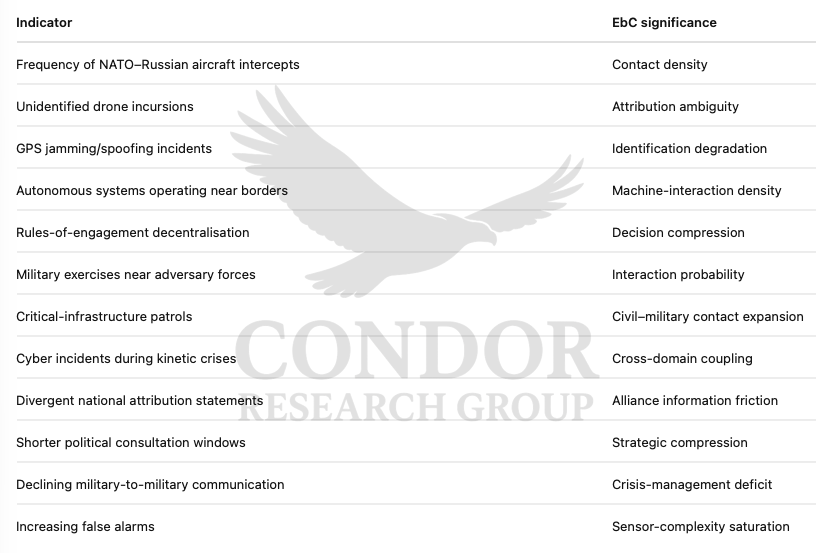
EbC becomes more credible if the following indicators rise simultaneously:
No individual indicator validates the doctrine. The key signal would be covariance.
EbC predicts that escalation danger increases when several indicators rise together.
⸻
XII. Failure Conditions
A useful doctrine must be falsifiable.
EbC would be weakened if:
1. Interaction density rises substantially without producing increasing numbers of ambiguous incidents.
This would suggest integration scales successfully with complexity.
2. Autonomous systems reduce rather than increase attribution uncertainty.
Better sensor fusion may ultimately make incidents easier to classify.
3. NATO command integration consistently prevents national responses from producing contradictory escalation signals.
Institutional complexity would then be primarily stabilising.
4. Russian behaviour demonstrably responds mainly to weakness rather than interaction density.
Under this condition additional NATO capability would remain predominantly stabilising.
5. Improved surveillance consistently expands political decision time.
This would contradict the decision-compression mechanism.
6. Effective NATO–Russia deconfliction mechanisms emerge despite political confrontation.
This could decouple military complexity from escalation risk.
These conditions matter because EbC should not become an all-purpose explanation for deteriorating relations. If everything qualifies as complication, the concept explains nothing.
⸻
XIII. Competing Explanations
Three alternative hypotheses should remain active.
H1 — Deterrence Dominance
NATO reinforcement reduces escalation because Russia increasingly recognises that military coercion cannot succeed.
Prediction: incidents decline as NATO capability becomes visibly credible.
H2 — Adversarial Escalation
Increasing incidents primarily reflect deliberate Russian coercive strategy rather than systemic complexity.
Prediction: incidents correlate with Russian strategic objectives rather than overall interaction density.
H3 — Escalation by Complication
Both sides may remain strategically risk-aware while increasing system density unintentionally generates more escalation opportunities.
Prediction: ambiguous incidents increase disproportionately with interaction density even without identifiable changes in strategic intent.
These hypotheses are not mutually exclusive. The European security system could contain all three mechanisms simultaneously.
⸻
XIV. Preliminary 2026 Assessment
CRG assesses:
Existence of the EbC mechanism: HIGH confidence
The underlying systems mechanism—greater interaction density creating more potential failure and misunderstanding pathways—is well established conceptually and is consistent with contemporary European military developments.
EbC currently operating in European security: MODERATE–HIGH confidence
Drone incursions, airspace violations, electronic warfare, maritime encounters and infrastructure-protection missions provide observable contact surfaces consistent with the model. SIPRI’s contemporary work on Northern European strategic stability independently identifies similar risks.
EbC outweighing NATO deterrence benefits: LOW confidence
Current evidence does not establish this.
NATO’s strengthened posture may be preventing substantially more dangerous Russian behaviour than the observable incidents generated by increased interaction density. That counterfactual cannot presently be measured reliably.
Probability that complexity becomes a more important escalation variable through 2030: MODERATE–HIGH confidence
The combination of autonomous systems, counter-drone networks, distributed sensors, integrated air defence, military mobility, cyber capabilities, space assets and multinational command structures makes increasing interaction density structurally likely.
⸻
XV. Doctrine Implication
Escalation by Complication does not imply that states should reduce deterrence.
It implies that deterrence architecture requires complexity management.
The relevant strategic metric therefore cannot simply be:
How many capabilities have been deployed?
It must also include:
How many interactions do those capabilities create?
and:
How reliably can the resulting interactions be interpreted under crisis conditions?
This produces a different model of strategic stability:
Deterrence Capability
must grow alongside
Interpretation Capability
and
Crisis-Management Capacity.
If the first grows substantially faster than the other two, a security system can become simultaneously:
more powerful,
more defended,
more aware,
and
more escalation-sensitive.
⸻
XVI. CRG Doctrine Statement
Escalation by Complication (EbC) proposes that escalation risk in highly integrated security environments cannot be understood solely through hostile intent or conventional action–reaction models. As military systems become more distributed, autonomous, interconnected and politically coupled, escalation may emerge from the architecture of interaction itself.
The critical unit of analysis therefore shifts.
From:
weapon
to:
interaction.
From:
force posture
to:
contact topology.
From:
intent
to:
intent + system behaviour.
From:
escalation ladder
to:
escalation network.
The resulting proposition is deliberately narrower than the claim that NATO reinforcement is destabilising:
A security architecture can strengthen deterrence while simultaneously increasing the number of pathways through which deterrence can fail.
Europe in 2026 increasingly exhibits the structural prerequisites for this condition.
Whether those pathways remain controlled will depend less on the absolute quantity of military capability than on whether command integration, attribution mechanisms, human-machine control, adversarial communication and political decision architecture scale with the complexity being created.
That is the proposition against which Escalation by Complication should be tested.
CRG Assessment: The hypothesis is plausible and increasingly observable, but the evidence does not presently support the stronger proposition that complexity-generated escalation risk exceeds the deterrent value of NATO’s strengthened posture.
Confidence: MODERATE–HIGH.
⸻
Analytical Note: The strongest feature of EbC as a CRG doctrine is that it does not require NATO, Russia, or any individual government to behave irrationally. Quite the opposite. The dangerous outcome can emerge from a sequence of locally rational decisions. That makes the concept analytically distinct from simple “escalation spiral” arguments and gives us something measurable: interaction density, attribution latency, decision time, authority fragmentation and incident frequency. Those variables could eventually be turned into an EbC Complexity Index for comparing the Baltic, Black Sea, High North and potentially Indo-Pacific theatres.
DOCUMENT INFORMATION
Document: CRG-NATO-DOC-0926/5: Escalation by Complication — How Defensive Complexity Can Generate Escalatory Risk in the European Security System
Classification: Strategic Doctrine Development (Deterrence Complexity & Escalation Dynamics)
Distribution: Public Release
Revision Status: Final — Approved for internal CRG circulation, external academic reference, and web publication
Authorized By: Condor Research Group (CRG)
Division: Geopolitical & Strategic Intelligence Division
Original Draft Date: September 2026
Research Cut-off Date: 18 September 2026
Release Date: 23 September 2026
Version: CRG-DOC-VER-A1-FINAL
Keywords: Escalation by Complication, EbC, Strategic Doctrine, NATO, Russia, European Security, Deterrence, Deterrence Architecture, Strategic Stability, Escalation Dynamics, Escalation Management, Escalation Networks, System Complexity, Interaction Density, Contact Surfaces, Contact-Surface Density, Attribution, Attribution Pressure, Attribution Ambiguity, Decision Compression, Political Commitment Pressure, Crisis Management, Crisis Stability, Force Posture, Forward Defence, Integrated Air and Missile Defence, Airspace Incursion, Drone Operations, Autonomous Systems, Counter-Drone Systems, Electronic Warfare, GPS Jamming, GPS Spoofing, Sensor Fusion, Human-Machine Interaction, Rules of Engagement, Command and Control, Authority Complexity, NATO-EU Defence Cooperation, Baltic Sea, Baltic States, Eastern Flank, High North, Black Sea, Critical Infrastructure, Subsea Infrastructure, Military Mobility, Hybrid Operations, Strategic Signalling, Miscalculation, Misinterpretation, Inadvertent Escalation, Accidental Escalation, Deterrence Failure, Interaction Topology, Complexity Risk, Strategic Indicators, Failure Conditions, Competing Hypotheses, Deterrence Dominance, Adversarial Escalation
Source Report: Escalation by Complication — How Defensive Complexity Can Generate Escalatory Risk in the European Security System
Publication Note: Published on the Condor Research Group website as part of the CRG Strategic Doctrine Development series. This paper introduces Escalation by Complication (EbC) as an analytical framework for examining how individually rational measures intended to strengthen deterrence, defence, resilience and situational awareness can cumulatively increase the structural complexity of a security environment. The framework evaluates the relationship between system complexity, interaction density, contact surfaces, attribution pressure, decision compression, authority fragmentation and political commitment pressure, and examines the conditions under which these variables may generate additional pathways for accidental, inadvertent, misattributed or politically compelled escalation. The doctrine is applied to NATO and the European security environment in 2026, with particular attention to the eastern flank, Baltic region, autonomous and counter-drone systems, integrated air and missile defence, electronic warfare, critical-infrastructure protection and the increasing institutional layering of national, NATO and European Union defence structures. The assessment explicitly tests the EbC hypothesis against competing explanations, including deterrence dominance and deliberate adversarial escalation, and does not assume that increasing military complexity is inherently destabilising. Indicators and failure conditions are provided to permit subsequent empirical testing and reassessment. Confidence classifications represent analytical judgments under uncertainty and do not constitute predictions of future Russian, NATO, European Union or individual state behaviour or military action.