CRG-MENA-INT-0926-4-R3: The Mecca Architecture Under Fire
19/10/26 07:04
Document: CRG-MENA-INT-0926-4-R3
Title: The Mecca Architecture Under Fire
Subtitle: From Commitment to Implementation: Saudi Arabia, Türkiye and Pakistan
Classification: UNCLASSIFIED — Strategic Intelligence Assessment
Date: 11 October 2026 - Delayed publication
Publisher: Condor Research Group (CRG)
Assessment Horizon: 12 October 2026–9 January 2027
Analytical Confidence: Moderate
The Mecca Architecture Under Fire
From Commitment to Implementation: Saudi Arabia, Türkiye and Pakistan
The Mecca Architecture has changed materially. What was still a prospective security arrangement in September 2026 has crossed into declared implementation. The central strategic question is no longer whether Saudi Arabia, Türkiye and Pakistan intend to operationalise their collective-defence commitments, but whether those commitments can be converted into sustained protection of Saudi territory and critical infrastructure. That distinction is decisive. Political commitment is not operational integration. Operational integration is not defensive effectiveness. And defensive effectiveness cannot be inferred from communiqués, announced deployments or institutional machinery alone.
The 5 October decision by the Strategic Political and Defence Committee of the Makkah Alliance for Defense therefore represents an important threshold, but not the completion of the architecture.
CRG assesses that Türkiye and Pakistan are stepping in on a bounded, defensive basis. Saudi Arabia remains under severe pressure, but available evidence does not support an assessment of imminent strategic collapse. Energy infrastructure has demonstrated significant recovery capacity even as the latest attack on Riyadh’s international airport demonstrates continuing vulnerability elsewhere in the Saudi system. Restoration and exposure now coexist.
CRG assesses selective defensive implementation as the leading pathway over the next 90 days, with moderate confidence.
The principal adverse alternative is increasingly clear: escalation may move faster than defensive integration.
⸻
What Changed Since September
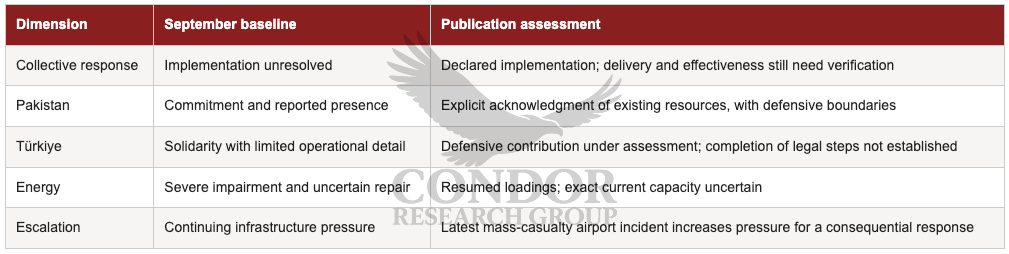
The September analytical baseline treated selective operationalisation as a prospective development and Saudi infrastructure impairment as a potentially persistent strategic constraint. Neither assumption can simply be carried forward into October.
The architecture has subsequently moved through an identifiable political implementation threshold, while Saudi energy infrastructure has demonstrated greater recovery capacity than the September picture suggested. At the same time, the security environment has deteriorated in another dimension. The latest mass-casualty attack against Riyadh’s international airport demonstrates that recovery in one sector does not constitute national strategic recovery.
Saudi resilience is uneven. The current architecture should therefore be understood through three separate layers.
Political commitment: Saudi Arabia, Türkiye and Pakistan have publicly accepted a collective security relationship.
Implementation machinery: the 5 October decision provides institutional direction for converting those commitments into assistance.
Operational performance: the ability to deliver functioning capabilities, coordinate them, sustain them and demonstrably reduce damage remains unproven.
CRG therefore uses the term declared implementation precisely. It describes a documented political and institutional transition. It does not mean that the architecture has become a fully integrated or combat-effective defensive system.
WHAT CHANGED SINCE SEPTEMBER
⸻
The Implementation Threshold
The decisive institutional development occurred on 5 October. At the Riyadh meeting of the Strategic Political and Defence Committee, retired Pakistani Lieutenant General Nauman Mahmood was appointed the alliance’s first secretary-general for a three-year term.
More importantly, the committee directed the immediate practical implementation of collective-defence commitments and the rapid deployment of agreed forces and capabilities to Saudi Arabia, subject to approved arrangements and national legislation. This changes the analytical baseline.
The Mecca Architecture can no longer accurately be characterised as wholly dormant or merely aspirational. But the available public record does not establish force quantities, deployment schedules, operational command structures, rules of engagement, defensive sectors or the degree of integration between Saudi, Pakistani and Turkish capabilities. The distinction between political implementation and military performance therefore remains essential.
Existing bilateral capabilities must also not automatically be counted as new trilateral deployments. Reclassification or coordination of forces already present in Saudi Arabia may strengthen the architecture institutionally without increasing the absolute quantity of military capability available.
⸻
Current Evidence and Chronology
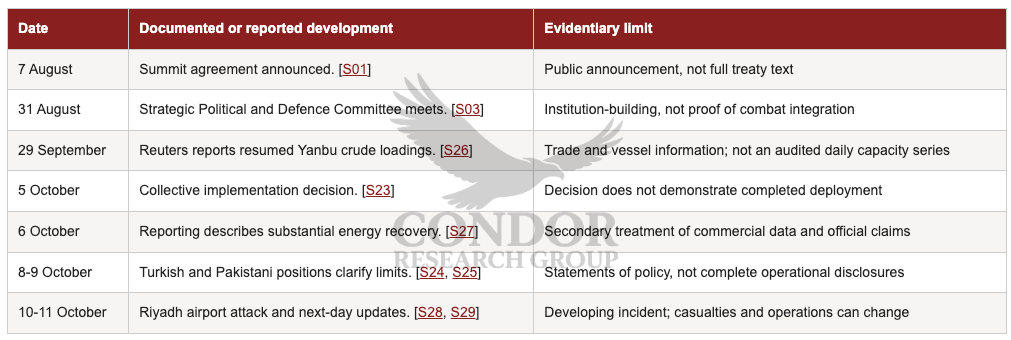
The sequence of developments is analytically important because it prevents separate events from being collapsed into a single causal narrative. Saudi energy recovery, for example, was already visible before the 5 October implementation decision. It therefore cannot simply be attributed to the new trilateral measures. Likewise, the Riyadh airport attack occurred after the political implementation threshold but does not by itself demonstrate the failure of Turkish or Pakistani defensive capabilities. There is insufficient evidence to establish that newly promised allied systems were deployed, operational, assigned to the airport or involved in the engagement.
The chronology instead demonstrates the central problem facing the architecture:
political implementation has begun while operational effectiveness remains unresolved.
CURRENT EVIDENCE AND CHRONOLOGY
⸻
The Riyadh Attack and the Credibility Problem
The 10 October attack on Riyadh’s international airport substantially increases the political pressure surrounding the emerging architecture.
Reporting available at the research cut-off indicated at least 12 fatalities and more than 300 injuries, while airport operations were suspended and flights diverted.
The incident demonstrates that major Saudi civilian infrastructure remains vulnerable after the public move toward collective implementation. But it does not prove that allied systems failed. That distinction matters.
Without evidence showing that Turkish or Pakistani capabilities were operational, assigned to the relevant defensive sector and engaged during the attack, the event cannot defensibly be described as a failure of the trilateral military architecture.
What it does create is a credibility problem. The stronger the public commitment to collective defence becomes, the greater the political cost when attacks continue to penetrate Saudi defensive systems. The architecture has therefore acquired something it possessed only weakly before:
reputational exposure.
⸻
Saudi Arabia: Damaged, Recovering and Still Exposed
Saudi Arabia’s strategic position is increasingly defined by the coexistence of damage and regeneration. The September assessment identified severe impairment of Saudi energy infrastructure. By late September, however, crude loadings had resumed at Yanbu. Subsequent reporting indicated substantial activity through the principal Saudi Red Sea terminals and significant recovery of pipeline flows. These developments weaken any linear exhaustion thesis.
Saudi Arabia has demonstrated that damaged infrastructure can be repaired, rerouted and returned to operation. But recovery does not eliminate exposure. The relevant strategic contest is therefore not simply whether an attack succeeds. It is whether repeated attacks can impose disruption faster than Saudi Arabia can regenerate the affected system. This produces a different resilience equation. Repair capacity, alternative routing, inventories, defensive adaptation and operational redundancy become as important as the immediate effectiveness of interception.
The Riyadh airport attack simultaneously demonstrates why energy recovery cannot be used as a proxy for national resilience. Saudi Arabia faces a portfolio of vulnerabilities. Energy facilities, airports, ports, logistics infrastructure and other critical nodes present different defensive problems. Protecting one category does not protect the others.
CRG therefore assesses Saudi Arabia as damaged, recovering and still exposed.
Available evidence does not support imminent national collapse, loss of territorial control or exhaustion of all defensive options. But neither does infrastructure recovery demonstrate successful deterrence.
⸻
Pakistan: A Present Partner With Stated Boundaries
Pakistan’s position is now considerably clearer. Islamabad has publicly acknowledged substantial Pakistani forces and resources already present in Saudi Arabia while rejecting reporting that Pakistani fighter aircraft are conducting cross-border operations against Houthi targets.
Pakistan has also stated that the defensive arrangement does not entail crossing into Yemen to attack the Houthis. That creates an important operational boundary. Pakistan is not simply a prospective alliance member waiting to deploy. A military presence and established bilateral relationship already exist.
This potentially reduces the organisational cost of additional support and provides an existing platform from which the trilateral architecture can develop. But the distinction between existing presence and additional capability must be maintained. Personnel or systems already in Saudi Arabia should not automatically be presented as new deployments generated by the Mecca Architecture.
CRG assesses territorial protection and reinforcement as the leading Pakistani pathway. Plausible functions include protection of critical facilities, training, coordination and defensive aviation or air-defence functions where assets, permissions and sustainment permit. These remain assessed possibilities rather than a verified force package. Pakistan’s stated territorial boundary is particularly significant.
An offensive campaign inside Yemen would represent a separate escalation decision involving additional political consent, intelligence requirements, logistics and force protection. The existence of a collective-defence agreement does not automatically resolve those choices.
⸻
Türkiye: Capability Contributions Before a Wider Mission
Türkiye appears to be approaching the architecture through selected defensive capabilities rather than an immediate large-scale expeditionary commitment. On 8 October, Foreign Minister Hakan Fidan described the pact as defensive and indicated that Turkish officials were assessing potential contributions, particularly in air defence. This is consistent with a differentiated alliance structure.
Türkiye does not need to replicate Pakistan’s contribution in order to participate meaningfully. Air defence, technical support, coordination, training, maintenance and other enabling capabilities could provide strategically relevant contributions if they address actual Saudi defensive gaps. But capability delivery must not be confused with capability effectiveness. Equipment alone does not create an operational defensive system.
Training, maintenance, communications, ammunition, integration, command arrangements and employment procedures determine whether a delivered capability can provide sustained protection. The relevant implementation horizon is therefore capability-specific. Liaison personnel or advisers can potentially be incorporated comparatively quickly. A new fully supported defensive formation may require substantially more time. The public evidence reviewed by CRG does not permit a reliable estimate of when particular Turkish capabilities would become operational.
This creates a potentially dangerous interval between political commitment and defensive effect. If attacks continue during that interval, pressure will increase on the alliance either to accelerate implementation or expand its mission.
⸻
An Architecture of Unequal Contributions
The Mecca Architecture should not be expected to produce symmetrical national participation.
Saudi Arabia, Türkiye and Pakistan possess different capabilities, political constraints, military relationships and strategic interests.
CRG therefore expects a division of labour rather than identical participation.
Unequal contributions do not inherently constitute alliance failure. The meaningful question is whether those differentiated contributions collectively perform the mission the architecture has accepted. The test is therefore not symmetry. It is functional sufficiency.
⸻
Saudi Defence and the Yemen War Are Different Problems
A further distinction is essential. Defending Saudi Arabia and resolving the Yemen conflict are not the same strategic objective. Reinforcement inside Saudi territory can reduce damage without determining territorial outcomes inside Yemen. Conversely, territorial gains against the Houthis do not necessarily eliminate their capacity to conduct long-range attacks. The Mecca Architecture should therefore be judged against its actual defensive mission. This distinction also allows different coalitions to overlap without becoming identical.
Türkiye, Pakistan, Saudi Arabia and potentially external actors may cooperate in intelligence, air defence, infrastructure protection, logistics or diplomacy while retaining different mandates concerning offensive operations. The possibility of wider participation exists. It is not yet established.
Similarly, descriptions of Houthi attacks should not be converted automatically into assumptions about a unified regional command structure.
The available public record does not establish Iranian operational direction of every incident, and CRG does not infer inevitable interstate escalation from sponsorship, alignment or political association alone.
⸻
The Defensive Paradox
The architecture nevertheless contains an escalation mechanism.
Its declared purpose is defensive. But successful attacks create pressure for offensive responses. As political commitments become stronger, visible failures of protection acquire greater reputational significance. A damaging attack therefore produces demands for stronger defence. If stronger defence cannot be delivered quickly enough, political pressure may shift toward retaliation. Retaliation may widen the conflict. A wider conflict may generate additional attacks. Those attacks may then produce pressure for deeper allied participation.
The Mecca Architecture could consequently move from bounded defensive integration toward mission expansion without its members initially intending to create an offensive alliance. This is the central escalation risk within the present architecture.
⸻
Forward Assessment: The Next 90 Days
Assessment Horizon: 12 October 2026–9 January 2027
CRG identifies three conditional pathways.
They are not event forecasts and they are not mutually exclusive. One may evolve into another as political and military conditions change.
Scenario A: Selective Defensive Implementation
Leading Pathway — Moderate Confidence
Türkiye and Pakistan provide bounded assistance inside Saudi Arabia while Riyadh maintains its own military campaign and diplomatic options.
Contributions differ in scale and function. The architecture becomes progressively more operational without developing a single unrestricted war mandate. Evidence supporting this pathway would include attributable capability arrivals, specific defensive missions, maintained national restrictions and assistance sustained beyond an initial deployment. Continued attacks would not alone falsify the scenario. A defensive architecture can be partially effective without becoming impermeable.
Scenario B: Escalation Outruns Integration
Principal Adverse Alternative
Additional damaging attacks generate demands for retaliation before promised capabilities can deliver reliable protection.
Explicit changes to mission boundaries, acknowledged offensive participation, attacks on allied personnel or widening targeting would indicate movement toward this pathway.
Scenario C: Defensive Reinforcement Supports a Negotiated Reduction
Plausible Alternative — Low-to-Moderate Confidence
Improved protection, reciprocal restraint and mediation reduce the intensity of attacks. The architecture then provides part of the security environment necessary for an acceptable political off-ramp. Evidence would require a sustained reduction in verified incidents and practical arrangements affecting attacks or access. Declarations of goodwill or a temporary quiet period would not be sufficient.
⸻
Indicators and Decision Points
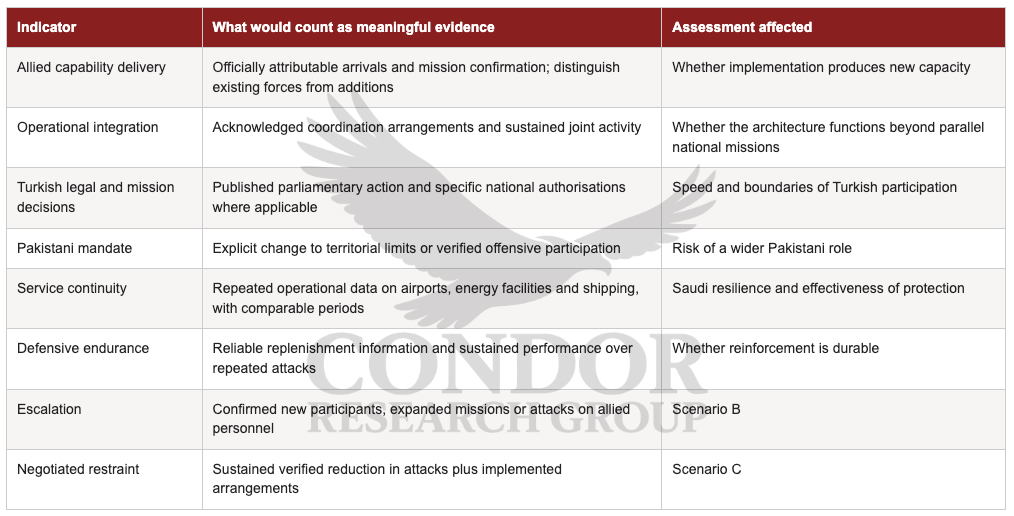
The next phase of the Mecca Architecture should be assessed through observable implementation rather than the number or strength of political declarations.
The critical questions are straightforward.
These questions provide the basis for distinguishing an alliance that is becoming operational from one that is merely becoming institutionally more elaborate.
INDICATORS AND DECISION POINTS
The immediate analytical priority is therefore to establish what has actually arrived under the 5 October decision and distinguish those capabilities from forces already present under bilateral arrangements.
The second priority is operational continuity. Airports, energy infrastructure and shipping should be evaluated across repeated periods rather than through isolated recovery or disruption events.
The third is defensive endurance. Interceptor availability, replenishment, maintenance and sustained performance across repeated attack cycles will ultimately reveal considerably more about the architecture than its founding language.
⸻
What Would Falsify the Assessment
CRG’s central judgment is falsifiable.
The selective-defensive-implementation assessment would require substantial revision if Türkiye or Pakistan demonstrably abandoned agreed assistance.
It would also require revision if both states entered a sustained offensive campaign outside Saudi territory.
At the opposite extreme, reliable evidence that a fully integrated and combat-effective collective defence system was already operating at significant scale would also invalidate the current assessment.
Each development would represent a change in the character of the architecture, rather than merely its public presentation.
⸻
The Architecture’s Real Test
The answer to the original strategic question is now more definite.
The Mecca Architecture has changed.
Its members have moved beyond a wholly prospective response.
Türkiye and Pakistan are stepping in. But they are doing so selectively, defensively and within national political and operational boundaries.
Saudi Arabia therefore cannot accurately be described either as strategically abandoned or as protected by a mature trilateral military shield. It occupies the space between those conditions. Saudi Arabia has demonstrated infrastructure recovery capacity.
Pakistan provides an existing military relationship and physical presence. Türkiye possesses capabilities potentially relevant to important Saudi defensive gaps.
The 5 October decision provides institutional machinery for turning those resources into collective action.
But the architecture has not yet demonstrated repeatable defensive performance at the level required to establish an integrated regional shield.
That creates the defining strategic competition of the next phase: the architecture must integrate faster than the conflict escalates.
CRG Central Judgment
CRG assesses selective defensive implementation as the leading near-term trajectory, with moderate confidence.
The principal adverse risk is not demonstrated imminent Saudi strategic collapse. It is escalation faster than the delivery and integration of effective protection. The Mecca Architecture has therefore entered its decisive phase.
The question is no longer whether the architecture exists it is whether it can perform.
⸻
DOCUMENT INFORMATION
Document: CRG-MENA-INT-0926-4-R3: The Mecca Architecture Under Fire — From Commitment to Implementation: Saudi Arabia, Türkiye and Pakistan
Classification: Strategic Intelligence Assessment (Middle East Security Architecture & Alliance Implementation)
Distribution: Public Release
Revision Status: Revision 3 — Approved for internal CRG circulation, external academic reference, and web publication
Authorized By: Condor Research Group (CRG)
Division: Geopolitical & Strategic Intelligence Division
Original Draft Date: September 2026
Research Cut-off Date: 11 October 2026
Release Date: 11 October 2026 - Delayed publication
Version: CRG-INT-VER-R3-FINAL
Keywords: Mecca Architecture, Makkah Alliance for Defense, Saudi Arabia, Türkiye, Turkey, Pakistan, Yemen, Houthis, Middle East Security, Regional Security Architecture, Collective Defence, Alliance Implementation, Strategic Political and Defence Committee, Saudi Defence, Turkish Defence Policy, Pakistani Defence Policy, Air Defence, Integrated Air Defence, Critical Infrastructure, Critical Infrastructure Protection, Riyadh, Riyadh Airport, Yanbu, Red Sea, Energy Security, Oil Infrastructure, Infrastructure Resilience, Defensive Integration, Alliance Credibility, Operational Integration, Force Deployment, Territorial Defence, Mission Boundaries, Escalation Dynamics, Escalation Management, Mission Expansion, Strategic Resilience, Infrastructure Recovery, Defensive Endurance, Coalition Warfare, Regional Deterrence, Strategic Stability, Saudi-Yemen Conflict, Bab el-Mandeb, US Regional Policy, Military Assistance, Strategic Indicators, Failure Conditions, Selective Defensive Implementation, Escalation Outruns Integration, Negotiated Restraint
Source Report: The Mecca Architecture Under Fire — From Commitment to Implementation: Saudi Arabia, Türkiye and Pakistan
Publication Note: Published on the Condor Research Group website as an updated public-release assessment of the evolving Saudi–Turkish–Pakistani security architecture. CRG-MENA-INT-0926-4-R3 incorporates developments through the 11 October 2026 research cut-off, including the 5 October collective-defence implementation decision, clarified Pakistani and Turkish positions, reported recovery of Saudi Red Sea energy infrastructure, and the latest attack on Riyadh’s international airport. The assessment distinguishes political commitment, declared implementation and demonstrated operational effectiveness and evaluates whether allied support can be converted into sustained protection of Saudi territory and critical infrastructure. It identifies selective defensive implementation as the leading near-term pathway while treating escalation faster than defensive integration as the principal adverse alternative. The assessment does not assume that collective-defence commitments constitute an unrestricted offensive mandate, that existing bilateral forces represent new trilateral deployments, or that public announcements establish combat-effective integration. Confidence classifications represent analytical judgments under uncertainty and do not constitute predictions of future Saudi, Turkish, Pakistani, Houthi, United States or other state or non-state behaviour or military action.
Title: The Mecca Architecture Under Fire
Subtitle: From Commitment to Implementation: Saudi Arabia, Türkiye and Pakistan
Classification: UNCLASSIFIED — Strategic Intelligence Assessment
Date: 11 October 2026 - Delayed publication
Publisher: Condor Research Group (CRG)
Assessment Horizon: 12 October 2026–9 January 2027
Analytical Confidence: Moderate
The Mecca Architecture Under Fire
From Commitment to Implementation: Saudi Arabia, Türkiye and Pakistan
The Mecca Architecture has changed materially. What was still a prospective security arrangement in September 2026 has crossed into declared implementation. The central strategic question is no longer whether Saudi Arabia, Türkiye and Pakistan intend to operationalise their collective-defence commitments, but whether those commitments can be converted into sustained protection of Saudi territory and critical infrastructure. That distinction is decisive. Political commitment is not operational integration. Operational integration is not defensive effectiveness. And defensive effectiveness cannot be inferred from communiqués, announced deployments or institutional machinery alone.
The 5 October decision by the Strategic Political and Defence Committee of the Makkah Alliance for Defense therefore represents an important threshold, but not the completion of the architecture.
CRG assesses that Türkiye and Pakistan are stepping in on a bounded, defensive basis. Saudi Arabia remains under severe pressure, but available evidence does not support an assessment of imminent strategic collapse. Energy infrastructure has demonstrated significant recovery capacity even as the latest attack on Riyadh’s international airport demonstrates continuing vulnerability elsewhere in the Saudi system. Restoration and exposure now coexist.
CRG assesses selective defensive implementation as the leading pathway over the next 90 days, with moderate confidence.
The principal adverse alternative is increasingly clear: escalation may move faster than defensive integration.
⸻
What Changed Since September
The September analytical baseline treated selective operationalisation as a prospective development and Saudi infrastructure impairment as a potentially persistent strategic constraint. Neither assumption can simply be carried forward into October.
The architecture has subsequently moved through an identifiable political implementation threshold, while Saudi energy infrastructure has demonstrated greater recovery capacity than the September picture suggested. At the same time, the security environment has deteriorated in another dimension. The latest mass-casualty attack against Riyadh’s international airport demonstrates that recovery in one sector does not constitute national strategic recovery.
Saudi resilience is uneven. The current architecture should therefore be understood through three separate layers.
Political commitment: Saudi Arabia, Türkiye and Pakistan have publicly accepted a collective security relationship.
Implementation machinery: the 5 October decision provides institutional direction for converting those commitments into assistance.
Operational performance: the ability to deliver functioning capabilities, coordinate them, sustain them and demonstrably reduce damage remains unproven.
CRG therefore uses the term declared implementation precisely. It describes a documented political and institutional transition. It does not mean that the architecture has become a fully integrated or combat-effective defensive system.
WHAT CHANGED SINCE SEPTEMBER
⸻
The Implementation Threshold
The decisive institutional development occurred on 5 October. At the Riyadh meeting of the Strategic Political and Defence Committee, retired Pakistani Lieutenant General Nauman Mahmood was appointed the alliance’s first secretary-general for a three-year term.
More importantly, the committee directed the immediate practical implementation of collective-defence commitments and the rapid deployment of agreed forces and capabilities to Saudi Arabia, subject to approved arrangements and national legislation. This changes the analytical baseline.
The Mecca Architecture can no longer accurately be characterised as wholly dormant or merely aspirational. But the available public record does not establish force quantities, deployment schedules, operational command structures, rules of engagement, defensive sectors or the degree of integration between Saudi, Pakistani and Turkish capabilities. The distinction between political implementation and military performance therefore remains essential.
Existing bilateral capabilities must also not automatically be counted as new trilateral deployments. Reclassification or coordination of forces already present in Saudi Arabia may strengthen the architecture institutionally without increasing the absolute quantity of military capability available.
⸻
Current Evidence and Chronology
The sequence of developments is analytically important because it prevents separate events from being collapsed into a single causal narrative. Saudi energy recovery, for example, was already visible before the 5 October implementation decision. It therefore cannot simply be attributed to the new trilateral measures. Likewise, the Riyadh airport attack occurred after the political implementation threshold but does not by itself demonstrate the failure of Turkish or Pakistani defensive capabilities. There is insufficient evidence to establish that newly promised allied systems were deployed, operational, assigned to the airport or involved in the engagement.
The chronology instead demonstrates the central problem facing the architecture:
political implementation has begun while operational effectiveness remains unresolved.
CURRENT EVIDENCE AND CHRONOLOGY
⸻
The Riyadh Attack and the Credibility Problem
The 10 October attack on Riyadh’s international airport substantially increases the political pressure surrounding the emerging architecture.
Reporting available at the research cut-off indicated at least 12 fatalities and more than 300 injuries, while airport operations were suspended and flights diverted.
The incident demonstrates that major Saudi civilian infrastructure remains vulnerable after the public move toward collective implementation. But it does not prove that allied systems failed. That distinction matters.
Without evidence showing that Turkish or Pakistani capabilities were operational, assigned to the relevant defensive sector and engaged during the attack, the event cannot defensibly be described as a failure of the trilateral military architecture.
What it does create is a credibility problem. The stronger the public commitment to collective defence becomes, the greater the political cost when attacks continue to penetrate Saudi defensive systems. The architecture has therefore acquired something it possessed only weakly before:
reputational exposure.
⸻
Saudi Arabia: Damaged, Recovering and Still Exposed
Saudi Arabia’s strategic position is increasingly defined by the coexistence of damage and regeneration. The September assessment identified severe impairment of Saudi energy infrastructure. By late September, however, crude loadings had resumed at Yanbu. Subsequent reporting indicated substantial activity through the principal Saudi Red Sea terminals and significant recovery of pipeline flows. These developments weaken any linear exhaustion thesis.
Saudi Arabia has demonstrated that damaged infrastructure can be repaired, rerouted and returned to operation. But recovery does not eliminate exposure. The relevant strategic contest is therefore not simply whether an attack succeeds. It is whether repeated attacks can impose disruption faster than Saudi Arabia can regenerate the affected system. This produces a different resilience equation. Repair capacity, alternative routing, inventories, defensive adaptation and operational redundancy become as important as the immediate effectiveness of interception.
The Riyadh airport attack simultaneously demonstrates why energy recovery cannot be used as a proxy for national resilience. Saudi Arabia faces a portfolio of vulnerabilities. Energy facilities, airports, ports, logistics infrastructure and other critical nodes present different defensive problems. Protecting one category does not protect the others.
CRG therefore assesses Saudi Arabia as damaged, recovering and still exposed.
Available evidence does not support imminent national collapse, loss of territorial control or exhaustion of all defensive options. But neither does infrastructure recovery demonstrate successful deterrence.
⸻
Pakistan: A Present Partner With Stated Boundaries
Pakistan’s position is now considerably clearer. Islamabad has publicly acknowledged substantial Pakistani forces and resources already present in Saudi Arabia while rejecting reporting that Pakistani fighter aircraft are conducting cross-border operations against Houthi targets.
Pakistan has also stated that the defensive arrangement does not entail crossing into Yemen to attack the Houthis. That creates an important operational boundary. Pakistan is not simply a prospective alliance member waiting to deploy. A military presence and established bilateral relationship already exist.
This potentially reduces the organisational cost of additional support and provides an existing platform from which the trilateral architecture can develop. But the distinction between existing presence and additional capability must be maintained. Personnel or systems already in Saudi Arabia should not automatically be presented as new deployments generated by the Mecca Architecture.
CRG assesses territorial protection and reinforcement as the leading Pakistani pathway. Plausible functions include protection of critical facilities, training, coordination and defensive aviation or air-defence functions where assets, permissions and sustainment permit. These remain assessed possibilities rather than a verified force package. Pakistan’s stated territorial boundary is particularly significant.
An offensive campaign inside Yemen would represent a separate escalation decision involving additional political consent, intelligence requirements, logistics and force protection. The existence of a collective-defence agreement does not automatically resolve those choices.
⸻
Türkiye: Capability Contributions Before a Wider Mission
Türkiye appears to be approaching the architecture through selected defensive capabilities rather than an immediate large-scale expeditionary commitment. On 8 October, Foreign Minister Hakan Fidan described the pact as defensive and indicated that Turkish officials were assessing potential contributions, particularly in air defence. This is consistent with a differentiated alliance structure.
Türkiye does not need to replicate Pakistan’s contribution in order to participate meaningfully. Air defence, technical support, coordination, training, maintenance and other enabling capabilities could provide strategically relevant contributions if they address actual Saudi defensive gaps. But capability delivery must not be confused with capability effectiveness. Equipment alone does not create an operational defensive system.
Training, maintenance, communications, ammunition, integration, command arrangements and employment procedures determine whether a delivered capability can provide sustained protection. The relevant implementation horizon is therefore capability-specific. Liaison personnel or advisers can potentially be incorporated comparatively quickly. A new fully supported defensive formation may require substantially more time. The public evidence reviewed by CRG does not permit a reliable estimate of when particular Turkish capabilities would become operational.
This creates a potentially dangerous interval between political commitment and defensive effect. If attacks continue during that interval, pressure will increase on the alliance either to accelerate implementation or expand its mission.
⸻
An Architecture of Unequal Contributions
The Mecca Architecture should not be expected to produce symmetrical national participation.
Saudi Arabia, Türkiye and Pakistan possess different capabilities, political constraints, military relationships and strategic interests.
CRG therefore expects a division of labour rather than identical participation.
- Pakistan may derive comparative advantage from its existing personnel and longstanding Saudi relationship.
- Türkiye may contribute selected defensive systems, technical expertise and specialised capabilities.
- Saudi Arabia remains the territorial anchor of the architecture and retains responsibility for its national defence and its own military campaign.
Unequal contributions do not inherently constitute alliance failure. The meaningful question is whether those differentiated contributions collectively perform the mission the architecture has accepted. The test is therefore not symmetry. It is functional sufficiency.
⸻
Saudi Defence and the Yemen War Are Different Problems
A further distinction is essential. Defending Saudi Arabia and resolving the Yemen conflict are not the same strategic objective. Reinforcement inside Saudi territory can reduce damage without determining territorial outcomes inside Yemen. Conversely, territorial gains against the Houthis do not necessarily eliminate their capacity to conduct long-range attacks. The Mecca Architecture should therefore be judged against its actual defensive mission. This distinction also allows different coalitions to overlap without becoming identical.
Türkiye, Pakistan, Saudi Arabia and potentially external actors may cooperate in intelligence, air defence, infrastructure protection, logistics or diplomacy while retaining different mandates concerning offensive operations. The possibility of wider participation exists. It is not yet established.
Similarly, descriptions of Houthi attacks should not be converted automatically into assumptions about a unified regional command structure.
The available public record does not establish Iranian operational direction of every incident, and CRG does not infer inevitable interstate escalation from sponsorship, alignment or political association alone.
⸻
The Defensive Paradox
The architecture nevertheless contains an escalation mechanism.
Its declared purpose is defensive. But successful attacks create pressure for offensive responses. As political commitments become stronger, visible failures of protection acquire greater reputational significance. A damaging attack therefore produces demands for stronger defence. If stronger defence cannot be delivered quickly enough, political pressure may shift toward retaliation. Retaliation may widen the conflict. A wider conflict may generate additional attacks. Those attacks may then produce pressure for deeper allied participation.
The Mecca Architecture could consequently move from bounded defensive integration toward mission expansion without its members initially intending to create an offensive alliance. This is the central escalation risk within the present architecture.
⸻
Forward Assessment: The Next 90 Days
Assessment Horizon: 12 October 2026–9 January 2027
CRG identifies three conditional pathways.
They are not event forecasts and they are not mutually exclusive. One may evolve into another as political and military conditions change.
Scenario A: Selective Defensive Implementation
Leading Pathway — Moderate Confidence
Türkiye and Pakistan provide bounded assistance inside Saudi Arabia while Riyadh maintains its own military campaign and diplomatic options.
Contributions differ in scale and function. The architecture becomes progressively more operational without developing a single unrestricted war mandate. Evidence supporting this pathway would include attributable capability arrivals, specific defensive missions, maintained national restrictions and assistance sustained beyond an initial deployment. Continued attacks would not alone falsify the scenario. A defensive architecture can be partially effective without becoming impermeable.
Scenario B: Escalation Outruns Integration
Principal Adverse Alternative
Additional damaging attacks generate demands for retaliation before promised capabilities can deliver reliable protection.
- Saudi operations expand.
- Partners face requests for wider participation.
- External actors consider or undertake additional roles.
- The mechanism is political as well as military.
Explicit changes to mission boundaries, acknowledged offensive participation, attacks on allied personnel or widening targeting would indicate movement toward this pathway.
Scenario C: Defensive Reinforcement Supports a Negotiated Reduction
Plausible Alternative — Low-to-Moderate Confidence
Improved protection, reciprocal restraint and mediation reduce the intensity of attacks. The architecture then provides part of the security environment necessary for an acceptable political off-ramp. Evidence would require a sustained reduction in verified incidents and practical arrangements affecting attacks or access. Declarations of goodwill or a temporary quiet period would not be sufficient.
⸻
Indicators and Decision Points
The next phase of the Mecca Architecture should be assessed through observable implementation rather than the number or strength of political declarations.
The critical questions are straightforward.
- What has actually arrived?
- What capability is genuinely new?
- What was already present?
- What missions have been authorised?
- What can the combined architecture protect?
- How long can it sustain that protection?
- And where do national political boundaries begin to constrain collective military action?
These questions provide the basis for distinguishing an alliance that is becoming operational from one that is merely becoming institutionally more elaborate.
INDICATORS AND DECISION POINTS
The immediate analytical priority is therefore to establish what has actually arrived under the 5 October decision and distinguish those capabilities from forces already present under bilateral arrangements.
The second priority is operational continuity. Airports, energy infrastructure and shipping should be evaluated across repeated periods rather than through isolated recovery or disruption events.
The third is defensive endurance. Interceptor availability, replenishment, maintenance and sustained performance across repeated attack cycles will ultimately reveal considerably more about the architecture than its founding language.
⸻
What Would Falsify the Assessment
CRG’s central judgment is falsifiable.
The selective-defensive-implementation assessment would require substantial revision if Türkiye or Pakistan demonstrably abandoned agreed assistance.
It would also require revision if both states entered a sustained offensive campaign outside Saudi territory.
At the opposite extreme, reliable evidence that a fully integrated and combat-effective collective defence system was already operating at significant scale would also invalidate the current assessment.
Each development would represent a change in the character of the architecture, rather than merely its public presentation.
⸻
The Architecture’s Real Test
The answer to the original strategic question is now more definite.
The Mecca Architecture has changed.
Its members have moved beyond a wholly prospective response.
Türkiye and Pakistan are stepping in. But they are doing so selectively, defensively and within national political and operational boundaries.
Saudi Arabia therefore cannot accurately be described either as strategically abandoned or as protected by a mature trilateral military shield. It occupies the space between those conditions. Saudi Arabia has demonstrated infrastructure recovery capacity.
Pakistan provides an existing military relationship and physical presence. Türkiye possesses capabilities potentially relevant to important Saudi defensive gaps.
The 5 October decision provides institutional machinery for turning those resources into collective action.
But the architecture has not yet demonstrated repeatable defensive performance at the level required to establish an integrated regional shield.
That creates the defining strategic competition of the next phase: the architecture must integrate faster than the conflict escalates.
- If it succeeds, the Mecca Architecture could acquire credibility as a regional security institution built around differentiated but mutually reinforcing national capabilities.
- If implementation remains primarily declaratory while damaging attacks continue, the gap between promise and performance may become the architecture’s defining weakness.
- And if repeated attacks generate political demands for action faster than defensive integration can satisfy them, the alliance may progressively be pulled beyond the bounded defensive mission its members currently describe.
CRG Central Judgment
CRG assesses selective defensive implementation as the leading near-term trajectory, with moderate confidence.
The principal adverse risk is not demonstrated imminent Saudi strategic collapse. It is escalation faster than the delivery and integration of effective protection. The Mecca Architecture has therefore entered its decisive phase.
The question is no longer whether the architecture exists it is whether it can perform.
⸻
DOCUMENT INFORMATION
Document: CRG-MENA-INT-0926-4-R3: The Mecca Architecture Under Fire — From Commitment to Implementation: Saudi Arabia, Türkiye and Pakistan
Classification: Strategic Intelligence Assessment (Middle East Security Architecture & Alliance Implementation)
Distribution: Public Release
Revision Status: Revision 3 — Approved for internal CRG circulation, external academic reference, and web publication
Authorized By: Condor Research Group (CRG)
Division: Geopolitical & Strategic Intelligence Division
Original Draft Date: September 2026
Research Cut-off Date: 11 October 2026
Release Date: 11 October 2026 - Delayed publication
Version: CRG-INT-VER-R3-FINAL
Keywords: Mecca Architecture, Makkah Alliance for Defense, Saudi Arabia, Türkiye, Turkey, Pakistan, Yemen, Houthis, Middle East Security, Regional Security Architecture, Collective Defence, Alliance Implementation, Strategic Political and Defence Committee, Saudi Defence, Turkish Defence Policy, Pakistani Defence Policy, Air Defence, Integrated Air Defence, Critical Infrastructure, Critical Infrastructure Protection, Riyadh, Riyadh Airport, Yanbu, Red Sea, Energy Security, Oil Infrastructure, Infrastructure Resilience, Defensive Integration, Alliance Credibility, Operational Integration, Force Deployment, Territorial Defence, Mission Boundaries, Escalation Dynamics, Escalation Management, Mission Expansion, Strategic Resilience, Infrastructure Recovery, Defensive Endurance, Coalition Warfare, Regional Deterrence, Strategic Stability, Saudi-Yemen Conflict, Bab el-Mandeb, US Regional Policy, Military Assistance, Strategic Indicators, Failure Conditions, Selective Defensive Implementation, Escalation Outruns Integration, Negotiated Restraint
Source Report: The Mecca Architecture Under Fire — From Commitment to Implementation: Saudi Arabia, Türkiye and Pakistan
Publication Note: Published on the Condor Research Group website as an updated public-release assessment of the evolving Saudi–Turkish–Pakistani security architecture. CRG-MENA-INT-0926-4-R3 incorporates developments through the 11 October 2026 research cut-off, including the 5 October collective-defence implementation decision, clarified Pakistani and Turkish positions, reported recovery of Saudi Red Sea energy infrastructure, and the latest attack on Riyadh’s international airport. The assessment distinguishes political commitment, declared implementation and demonstrated operational effectiveness and evaluates whether allied support can be converted into sustained protection of Saudi territory and critical infrastructure. It identifies selective defensive implementation as the leading near-term pathway while treating escalation faster than defensive integration as the principal adverse alternative. The assessment does not assume that collective-defence commitments constitute an unrestricted offensive mandate, that existing bilateral forces represent new trilateral deployments, or that public announcements establish combat-effective integration. Confidence classifications represent analytical judgments under uncertainty and do not constitute predictions of future Saudi, Turkish, Pakistani, Houthi, United States or other state or non-state behaviour or military action.