CRG-MENA-INT-0926-3-R3: The Two Gates - Restored Flows, Persistent Exposure
09/10/26 08:24
Document: CRG-MENA-INT-0926-3-R3
Title: The Two Gates
Subtitle: Restored Flows, Persistent Exposure
Classification: UNCLASSIFIED — Strategic Intelligence Assessment
Date: 9 October 2026 - Delayed publication from late September 2026
Publisher: Condor Research Group (CRG)
Assessment Horizon: 9 October–6 November 2026
Analytical Confidence: Moderate–High
THE TWO GATES
Restored Flows, Persistent Exposure
Condor Research Group | Strategic Intelligence Assessment | 9 October 2026
Gulf oil exports have demonstrated a capacity to recover under sustained pressure. Saudi pipeline repairs, renewed activity at Yanbu and changes in tanker routing have restored useful export options. The evidence therefore supports a more qualified assessment of Gulf vulnerability than the September baseline: alternative routes remain commercially significant, but their ability to sustain deliveries through repeated disruption is not assured.
CRG assesses with MODERATE–HIGH confidence that crude-export recovery is real. Confidence is lower in the volume that can be sustained without further interruption or exceptional inventory support. CRG-MENA-INT-0926-3-R3
From Route Failure to Route Resilience
The central analytical change is significant. The evidence no longer supports treating the Saudi western bypass as persistently disabled, nor does it support treating adaptation as merely prospective.
Saudi Arabia’s East-West pipeline returned to operation after the September disruption. Subsequent maritime observations at Yanbu provide evidence that recovery progressed beyond repair intentions into renewed physical export activity. That does not establish uninterrupted operation. Reporting surrounding a further alleged attack on 4 October remains contradictory. AFP cited a Saudi energy-sector source who said pumping had stopped. Bloomberg reporting cited sources saying that the pipeline continued to operate normally. The available evidence does not resolve whether another interruption occurred or, if it did, how long it lasted. The appropriate analytical question has therefore changed. It is no longer simply whether the western bypass can recover.
It is whether recovered infrastructure can sustain useful deliveries through repeated disruption.
The Two Gates Remain Two Different Problems
The September assessment examined the interaction between two principal exposure systems: Hormuz and the Red Sea/Suez architecture. The updated evidence reinforces the need to keep those routes analytically separate. Saudi crude moving north from Yanbu toward Suez or SUMED does not require passage through Bab el-Mandeb.
ADCOP provides another geographically distinct mechanism, moving Abu Dhabi crude toward Fujairah outside the Strait of Hormuz. Neither route should be reduced to nominal pipeline capacity. Pipeline throughput, terminal activity, tanker availability, inventories and completed destination deliveries measure different stages of the system.
Resilience exists only when the chain produces usable delivery.
Adaptation at Hormuz
The maritime system is also adapting. Lloyd’s List Intelligence identified former Hormuz shuttle VLCCs delivering Saudi-origin crude directly to India or conducting transfers off India’s west coast during September.
This matters because it demonstrates operational adaptation rather than hypothetical rerouting. Direct delivery can remove a congested transfer stage from an individual cargo movement. It does not eliminate exposure to Hormuz, and it may increase the voyage cycle of vessels previously employed as shuttle tankers. The net effect therefore depends on vessel availability, waiting times, voyage duration and the ability of other ships to substitute into the system. The relevant conclusion is not that Hormuz exposure has disappeared.
It is that the shipping system is changing its behaviour in response to that exposure.
The Constraint Can Move
Recovery at one point in a supply chain does not mean that the entire chain has recovered. This is increasingly important to the Two Gates assessment. When pipeline feed is unavailable, infrastructure can become the dominant constraint. When pipeline feed returns, the constraint can migrate. Terminal readiness, tanker availability, insurance, voyage-cycle duration, refining capacity, clean-product shipping and customer allocation can subsequently become limiting factors.
CRG therefore does not currently identify Petroline, Yanbu or the previously examined N19 replacement-tanker mechanism as a universally dominant bottleneck. A bottleneck should be identified only when impairment at that stage explains the observed delivery shortfall while adjacent stages remain available.
The constraint is an empirical finding, not a permanent feature of the model.
Crude Recovery Is Not Product Recovery
The most consequential change in the current assessment is the growing distinction between crude supply and refined-product availability.
On 2 October, the International Energy Agency reported substantial recovery in Middle Eastern crude exports while refined-product flows remained severely constrained. That distinction changes the analytical centre of gravity. Additional crude cannot immediately substitute for diesel of the required specification at the required destination. Crude must reach suitable refining capacity. Refineries must be available. The required products must be produced. Clean-product tankers must then be available to transport them. The system can therefore display improving crude availability while consumers continue to experience product shortages and elevated transport costs.
CRG assesses this crude/product divergence at MODERATE–HIGH confidence, while confidence in its persistence remains MODERATE.
Reserves Can Bridge — But Not Erase — the Gap
Strategic reserves now form a more important component of the assessment. The G7 commitment announced on 2 October provides for a coordinated 100-million-barrel release over four months, including frontloaded diesel volumes. This creates a potentially significant bridge between recovering crude supply and constrained refined-product availability. It should not, however, be treated as 100 million additional barrels already delivered to market. Implementation matters. Product matters. Location matters. Timing matters.
A strategic reserve is operationally relevant only when the required material reaches the market in which the shortage exists.
Reserve releases can therefore reduce the consequences of disruption without demonstrating that the underlying supply chain has recovered.
Shipping Is Adaptable — and Unevenly Accessible
High freight rates demonstrate pressure but do not by themselves identify the location of the constraint. Changes in tanker employment, direct delivery and ship-to-ship transfer patterns show that the fleet can adapt. That adaptation has costs. Longer voyages consume vessel-days. Risk changes insurance conditions. Clean-to-dirty tanker switching can increase crude-carrying capacity while simultaneously reducing the vessels available for refined products. The same adaptation that assists crude recovery can therefore contribute to continued product tightness.
This is one mechanism through which the crude/product divergence can persist even while headline export volumes improve.
The Forward Assessment
Through 6 November, CRG’s central case is RECOVERY UNDER CONTINUED EXPOSURE.
Confidence: MODERATE.
Both Saudi export channels remain commercially useful when functioning, while shippers continue adapting between direct voyages and transfer arrangements. Crude availability is expected to improve unevenly. Refined products remain more vulnerable to shortages, transport constraints and implementation delays.
The improvement case would require repaired infrastructure to operate steadily, broader owner participation, reduced transfer waiting times, successful reserve-diesel delivery, improved refinery availability and greater clean-tanker capacity. Under those conditions, product tightness could ease substantially even while the wider security environment remains dangerous.
The deterioration case requires more than another attack headline. The relevant threshold is sustained delivery loss.
Repeated infrastructure damage combined with a sustained reduction in Hormuz sailings could overwhelm the inventory and routing mechanisms presently supporting recovery. A wider interruption of refined-product exports would amplify the effect even if some crude continued moving. CRG-MENA-INT-0926-3-R3
Forward Indicators and Falsification Rules
The revised assessment establishes explicit forward indicators for each of its seven key judgments. These indicators are intended to distinguish temporary disruption from structural deterioration and to prevent the assessment from becoming resistant to contrary evidence.
The tests focus on matched origin, loading and destination data; pipeline and terminal readiness; comparable crude-export periods; route-specific Saudi voyages; actual reserve implementation; tanker employment and voyage-cycle evidence; and the relationship between crude arrivals and refined-product availability.
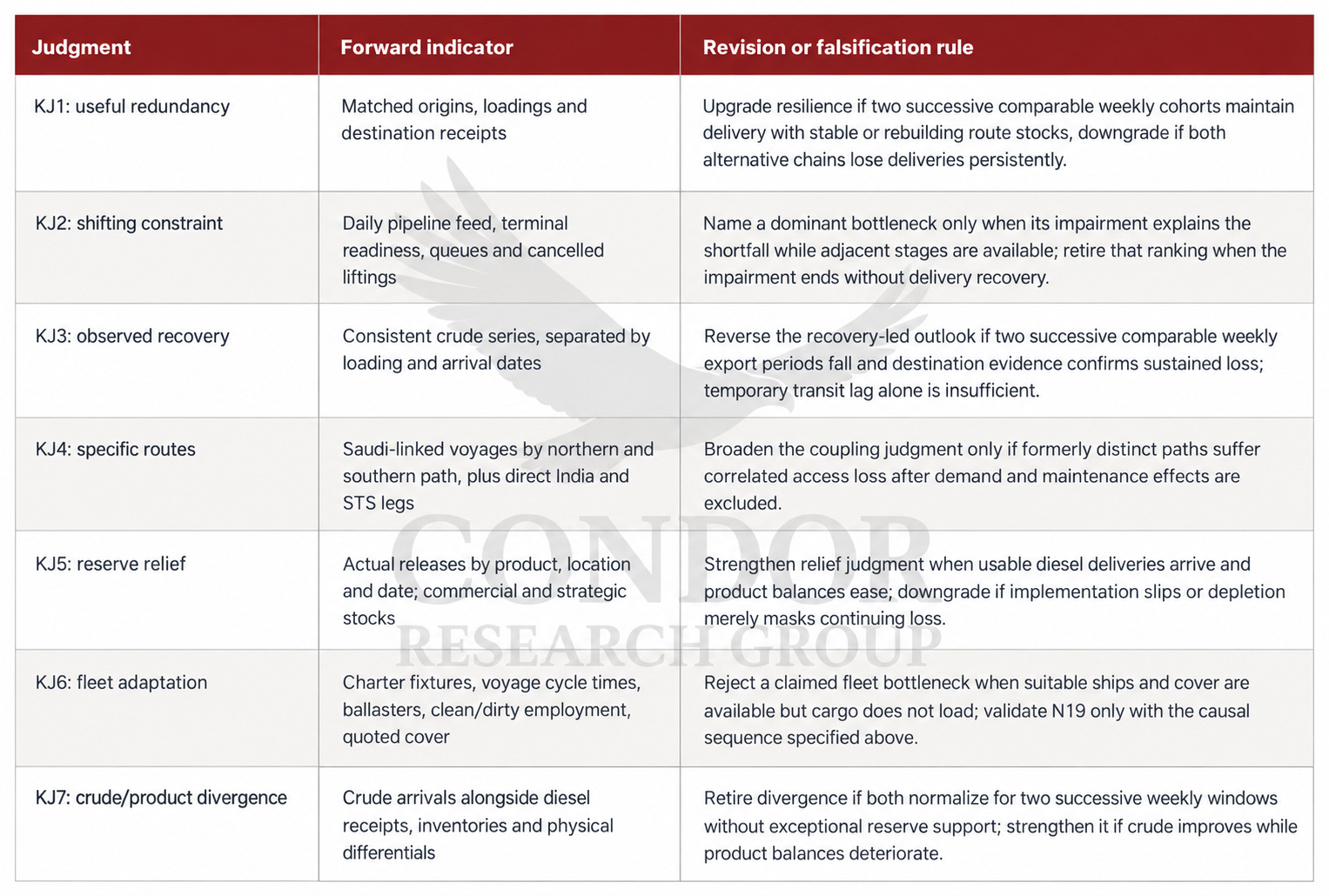
These are CRG prospective decision rules.
They are not statistical significance thresholds and should not be interpreted as measurements supplied by external sources. The use of successive comparable weekly periods is intended to impose analytical discipline on reassessment. Destination evidence must account for voyage duration and compare equivalent cargo cohorts.
A confirmed major outage or other event capable of materially changing the supply architecture would warrant immediate reassessment rather than waiting for those observation windows to complete. CRG-MENA-INT-0926-3-R3
What Would Change the Assessment?
The recovery-led outlook should strengthen if matched loadings and destination receipts remain stable across successive comparable periods without exceptional inventory depletion.
It should weaken if renewed disruption produces sustained delivery losses across alternative chains.
The crude/product divergence should weaken if both crude and refined-product balances normalise without exceptional reserve support.
It should strengthen if crude availability continues improving while diesel receipts, inventories or physical product balances deteriorate.
Similarly, a claimed tanker bottleneck should be rejected where suitable ships and insurance cover are demonstrably available but cargo nevertheless fails to load.
The analytical objective is not to preserve the original Two Gates thesis. It is to determine which constraint actually governs the system as conditions change.
CRG Assessment
The September shock demonstrated that Gulf export infrastructure can be disrupted.
The subsequent recovery demonstrates something equally important:
Disruption is not the same as exhaustion.
The Gulf export system has shown a greater capacity for repair, rerouting and fleet adaptation than the earlier assessment could establish.
That does not make the system secure. The strategic exposure has changed form. The central question is now whether repaired infrastructure, alternative routes, inventories, reserve releases and maritime adaptation can absorb repeated disruption faster than renewed attacks and transport constraints can degrade them.
CRG’s current assessment is therefore:
Continued crude adaptation with intermittent disruption, while refined products remain more vulnerable to shortages and transport friction.
Confidence: MODERATE.
The Two Gates remain strategically relevant. But the problem is no longer simply whether they are open or closed.
The problem is how much disruption the system between them can absorb before recovery ceases to outrun attrition.
⸻
DOCUMENT INFORMATION
Document: CRG-MENA-INT-0926-3-R3: The Two Gates — Restored Flows, Persistent Exposure
Classification: Strategic Intelligence Assessment (Gulf Energy Security & Maritime Chokepoint Analysis)
Distribution: Public Release
Revision Status: R3 — Updated Assessment — Approved for internal CRG circulation, external academic reference, and web publication
Authorized By: Condor Research Group (CRG)
Division: Geopolitical & Strategic Intelligence Division
Original Draft Date: September 2026
Research Cut-off Date: 9 October 2026, 13:28 UTC
Release Date: 9 October 2026
Version: CRG-INT-VER-R3-FINAL
Keywords: The Two Gates, Gulf Energy Security, Persian Gulf, Strait of Hormuz, Red Sea, Bab el-Mandeb, Suez Canal, SUMED, Saudi Arabia, East-West Pipeline, Petroline, Yanbu, ADCOP, Fujairah, Crude Oil, Refined Products, Diesel, Oil Exports, Energy Security, Maritime Security, Maritime Chokepoints, Strategic Chokepoints, Supply-Chain Resilience, Export Redundancy, Route Resilience, Route Adaptation, Tanker Shipping, VLCC, Tanker Availability, Ship-to-Ship Transfer, STS, Freight Rates, War-Risk Insurance, Voyage Cycles, N19, Pipeline Infrastructure, Terminal Operations, Strategic Petroleum Reserves, Strategic Reserves, G7, IEA, Inventory Support, Refinery Capacity, Product Supply, Crude/Product Divergence, Supply Disruption, Infrastructure Attack, Houthi Operations, Hormuz Transit, Gulf Shipping, Red Sea Shipping, Energy Markets, Strategic Indicators, Failure Conditions, Falsification Rules, Forward Assessment, Recovery Under Continued Exposure
Source Report: CRG-MENA-INT-0926-3-R3 — The Two Gates: Restored Flows, Persistent Exposure
Publication Note: Published on the Condor Research Group website as an updated assessment of CRG-MENA-INT-0926-3. R3 reassesses the September Two Gates thesis against evidence available through 9 October 2026. The update finds that Gulf oil-export redundancy has recovered useful capacity and that the evidence no longer supports treating the Saudi western bypass as persistently disabled or maritime adaptation as merely prospective. Renewed pipeline activity, Yanbu loadings and changes in tanker employment demonstrate material crude-export recovery, while conflicting reporting concerning subsequent disruption prevents the system from being characterised as secure or fully normalised. The assessment therefore shifts from route exhaustion toward recovery under continued exposure. Particular attention is given to the distinction between crude recovery and refined-product vulnerability, the migration of constraints between infrastructure, terminals, shipping, refining and product transport, and the potential role of strategic reserve releases in bridging temporary shortages. Seven key judgments are paired with forward indicators and explicit revision or falsification rules to permit subsequent empirical testing. Confidence classifications represent analytical judgments under uncertainty and do not constitute predictions of future Saudi, Iranian, Houthi, G7, shipping-industry or other state and non-state behaviour.
Title: The Two Gates
Subtitle: Restored Flows, Persistent Exposure
Classification: UNCLASSIFIED — Strategic Intelligence Assessment
Date: 9 October 2026 - Delayed publication from late September 2026
Publisher: Condor Research Group (CRG)
Assessment Horizon: 9 October–6 November 2026
Analytical Confidence: Moderate–High
THE TWO GATES
Restored Flows, Persistent Exposure
Condor Research Group | Strategic Intelligence Assessment | 9 October 2026
Gulf oil exports have demonstrated a capacity to recover under sustained pressure. Saudi pipeline repairs, renewed activity at Yanbu and changes in tanker routing have restored useful export options. The evidence therefore supports a more qualified assessment of Gulf vulnerability than the September baseline: alternative routes remain commercially significant, but their ability to sustain deliveries through repeated disruption is not assured.
CRG assesses with MODERATE–HIGH confidence that crude-export recovery is real. Confidence is lower in the volume that can be sustained without further interruption or exceptional inventory support. CRG-MENA-INT-0926-3-R3
From Route Failure to Route Resilience
The central analytical change is significant. The evidence no longer supports treating the Saudi western bypass as persistently disabled, nor does it support treating adaptation as merely prospective.
Saudi Arabia’s East-West pipeline returned to operation after the September disruption. Subsequent maritime observations at Yanbu provide evidence that recovery progressed beyond repair intentions into renewed physical export activity. That does not establish uninterrupted operation. Reporting surrounding a further alleged attack on 4 October remains contradictory. AFP cited a Saudi energy-sector source who said pumping had stopped. Bloomberg reporting cited sources saying that the pipeline continued to operate normally. The available evidence does not resolve whether another interruption occurred or, if it did, how long it lasted. The appropriate analytical question has therefore changed. It is no longer simply whether the western bypass can recover.
It is whether recovered infrastructure can sustain useful deliveries through repeated disruption.
The Two Gates Remain Two Different Problems
The September assessment examined the interaction between two principal exposure systems: Hormuz and the Red Sea/Suez architecture. The updated evidence reinforces the need to keep those routes analytically separate. Saudi crude moving north from Yanbu toward Suez or SUMED does not require passage through Bab el-Mandeb.
ADCOP provides another geographically distinct mechanism, moving Abu Dhabi crude toward Fujairah outside the Strait of Hormuz. Neither route should be reduced to nominal pipeline capacity. Pipeline throughput, terminal activity, tanker availability, inventories and completed destination deliveries measure different stages of the system.
Resilience exists only when the chain produces usable delivery.
Adaptation at Hormuz
The maritime system is also adapting. Lloyd’s List Intelligence identified former Hormuz shuttle VLCCs delivering Saudi-origin crude directly to India or conducting transfers off India’s west coast during September.
This matters because it demonstrates operational adaptation rather than hypothetical rerouting. Direct delivery can remove a congested transfer stage from an individual cargo movement. It does not eliminate exposure to Hormuz, and it may increase the voyage cycle of vessels previously employed as shuttle tankers. The net effect therefore depends on vessel availability, waiting times, voyage duration and the ability of other ships to substitute into the system. The relevant conclusion is not that Hormuz exposure has disappeared.
It is that the shipping system is changing its behaviour in response to that exposure.
The Constraint Can Move
Recovery at one point in a supply chain does not mean that the entire chain has recovered. This is increasingly important to the Two Gates assessment. When pipeline feed is unavailable, infrastructure can become the dominant constraint. When pipeline feed returns, the constraint can migrate. Terminal readiness, tanker availability, insurance, voyage-cycle duration, refining capacity, clean-product shipping and customer allocation can subsequently become limiting factors.
CRG therefore does not currently identify Petroline, Yanbu or the previously examined N19 replacement-tanker mechanism as a universally dominant bottleneck. A bottleneck should be identified only when impairment at that stage explains the observed delivery shortfall while adjacent stages remain available.
The constraint is an empirical finding, not a permanent feature of the model.
Crude Recovery Is Not Product Recovery
The most consequential change in the current assessment is the growing distinction between crude supply and refined-product availability.
On 2 October, the International Energy Agency reported substantial recovery in Middle Eastern crude exports while refined-product flows remained severely constrained. That distinction changes the analytical centre of gravity. Additional crude cannot immediately substitute for diesel of the required specification at the required destination. Crude must reach suitable refining capacity. Refineries must be available. The required products must be produced. Clean-product tankers must then be available to transport them. The system can therefore display improving crude availability while consumers continue to experience product shortages and elevated transport costs.
CRG assesses this crude/product divergence at MODERATE–HIGH confidence, while confidence in its persistence remains MODERATE.
Reserves Can Bridge — But Not Erase — the Gap
Strategic reserves now form a more important component of the assessment. The G7 commitment announced on 2 October provides for a coordinated 100-million-barrel release over four months, including frontloaded diesel volumes. This creates a potentially significant bridge between recovering crude supply and constrained refined-product availability. It should not, however, be treated as 100 million additional barrels already delivered to market. Implementation matters. Product matters. Location matters. Timing matters.
A strategic reserve is operationally relevant only when the required material reaches the market in which the shortage exists.
Reserve releases can therefore reduce the consequences of disruption without demonstrating that the underlying supply chain has recovered.
Shipping Is Adaptable — and Unevenly Accessible
High freight rates demonstrate pressure but do not by themselves identify the location of the constraint. Changes in tanker employment, direct delivery and ship-to-ship transfer patterns show that the fleet can adapt. That adaptation has costs. Longer voyages consume vessel-days. Risk changes insurance conditions. Clean-to-dirty tanker switching can increase crude-carrying capacity while simultaneously reducing the vessels available for refined products. The same adaptation that assists crude recovery can therefore contribute to continued product tightness.
This is one mechanism through which the crude/product divergence can persist even while headline export volumes improve.
The Forward Assessment
Through 6 November, CRG’s central case is RECOVERY UNDER CONTINUED EXPOSURE.
Confidence: MODERATE.
Both Saudi export channels remain commercially useful when functioning, while shippers continue adapting between direct voyages and transfer arrangements. Crude availability is expected to improve unevenly. Refined products remain more vulnerable to shortages, transport constraints and implementation delays.
The improvement case would require repaired infrastructure to operate steadily, broader owner participation, reduced transfer waiting times, successful reserve-diesel delivery, improved refinery availability and greater clean-tanker capacity. Under those conditions, product tightness could ease substantially even while the wider security environment remains dangerous.
The deterioration case requires more than another attack headline. The relevant threshold is sustained delivery loss.
Repeated infrastructure damage combined with a sustained reduction in Hormuz sailings could overwhelm the inventory and routing mechanisms presently supporting recovery. A wider interruption of refined-product exports would amplify the effect even if some crude continued moving. CRG-MENA-INT-0926-3-R3
Forward Indicators and Falsification Rules
The revised assessment establishes explicit forward indicators for each of its seven key judgments. These indicators are intended to distinguish temporary disruption from structural deterioration and to prevent the assessment from becoming resistant to contrary evidence.
The tests focus on matched origin, loading and destination data; pipeline and terminal readiness; comparable crude-export periods; route-specific Saudi voyages; actual reserve implementation; tanker employment and voyage-cycle evidence; and the relationship between crude arrivals and refined-product availability.
These are CRG prospective decision rules.
They are not statistical significance thresholds and should not be interpreted as measurements supplied by external sources. The use of successive comparable weekly periods is intended to impose analytical discipline on reassessment. Destination evidence must account for voyage duration and compare equivalent cargo cohorts.
A confirmed major outage or other event capable of materially changing the supply architecture would warrant immediate reassessment rather than waiting for those observation windows to complete. CRG-MENA-INT-0926-3-R3
What Would Change the Assessment?
The recovery-led outlook should strengthen if matched loadings and destination receipts remain stable across successive comparable periods without exceptional inventory depletion.
It should weaken if renewed disruption produces sustained delivery losses across alternative chains.
The crude/product divergence should weaken if both crude and refined-product balances normalise without exceptional reserve support.
It should strengthen if crude availability continues improving while diesel receipts, inventories or physical product balances deteriorate.
Similarly, a claimed tanker bottleneck should be rejected where suitable ships and insurance cover are demonstrably available but cargo nevertheless fails to load.
The analytical objective is not to preserve the original Two Gates thesis. It is to determine which constraint actually governs the system as conditions change.
CRG Assessment
The September shock demonstrated that Gulf export infrastructure can be disrupted.
The subsequent recovery demonstrates something equally important:
Disruption is not the same as exhaustion.
The Gulf export system has shown a greater capacity for repair, rerouting and fleet adaptation than the earlier assessment could establish.
That does not make the system secure. The strategic exposure has changed form. The central question is now whether repaired infrastructure, alternative routes, inventories, reserve releases and maritime adaptation can absorb repeated disruption faster than renewed attacks and transport constraints can degrade them.
CRG’s current assessment is therefore:
Continued crude adaptation with intermittent disruption, while refined products remain more vulnerable to shortages and transport friction.
Confidence: MODERATE.
The Two Gates remain strategically relevant. But the problem is no longer simply whether they are open or closed.
The problem is how much disruption the system between them can absorb before recovery ceases to outrun attrition.
⸻
DOCUMENT INFORMATION
Document: CRG-MENA-INT-0926-3-R3: The Two Gates — Restored Flows, Persistent Exposure
Classification: Strategic Intelligence Assessment (Gulf Energy Security & Maritime Chokepoint Analysis)
Distribution: Public Release
Revision Status: R3 — Updated Assessment — Approved for internal CRG circulation, external academic reference, and web publication
Authorized By: Condor Research Group (CRG)
Division: Geopolitical & Strategic Intelligence Division
Original Draft Date: September 2026
Research Cut-off Date: 9 October 2026, 13:28 UTC
Release Date: 9 October 2026
Version: CRG-INT-VER-R3-FINAL
Keywords: The Two Gates, Gulf Energy Security, Persian Gulf, Strait of Hormuz, Red Sea, Bab el-Mandeb, Suez Canal, SUMED, Saudi Arabia, East-West Pipeline, Petroline, Yanbu, ADCOP, Fujairah, Crude Oil, Refined Products, Diesel, Oil Exports, Energy Security, Maritime Security, Maritime Chokepoints, Strategic Chokepoints, Supply-Chain Resilience, Export Redundancy, Route Resilience, Route Adaptation, Tanker Shipping, VLCC, Tanker Availability, Ship-to-Ship Transfer, STS, Freight Rates, War-Risk Insurance, Voyage Cycles, N19, Pipeline Infrastructure, Terminal Operations, Strategic Petroleum Reserves, Strategic Reserves, G7, IEA, Inventory Support, Refinery Capacity, Product Supply, Crude/Product Divergence, Supply Disruption, Infrastructure Attack, Houthi Operations, Hormuz Transit, Gulf Shipping, Red Sea Shipping, Energy Markets, Strategic Indicators, Failure Conditions, Falsification Rules, Forward Assessment, Recovery Under Continued Exposure
Source Report: CRG-MENA-INT-0926-3-R3 — The Two Gates: Restored Flows, Persistent Exposure
Publication Note: Published on the Condor Research Group website as an updated assessment of CRG-MENA-INT-0926-3. R3 reassesses the September Two Gates thesis against evidence available through 9 October 2026. The update finds that Gulf oil-export redundancy has recovered useful capacity and that the evidence no longer supports treating the Saudi western bypass as persistently disabled or maritime adaptation as merely prospective. Renewed pipeline activity, Yanbu loadings and changes in tanker employment demonstrate material crude-export recovery, while conflicting reporting concerning subsequent disruption prevents the system from being characterised as secure or fully normalised. The assessment therefore shifts from route exhaustion toward recovery under continued exposure. Particular attention is given to the distinction between crude recovery and refined-product vulnerability, the migration of constraints between infrastructure, terminals, shipping, refining and product transport, and the potential role of strategic reserve releases in bridging temporary shortages. Seven key judgments are paired with forward indicators and explicit revision or falsification rules to permit subsequent empirical testing. Confidence classifications represent analytical judgments under uncertainty and do not constitute predictions of future Saudi, Iranian, Houthi, G7, shipping-industry or other state and non-state behaviour.