CRG-EUR-INT-0926/2: THE ARTICLE FIVE TEST
13/09/26 08:55
THE ARTICLE FIVE TEST
Pathways to a Russia–Europe War
Document: CRG-EUR-INT-0926/2
Title: The Article Five Test — Pathways to a Russia-Europe War
Subtitle: Russian Probe Scenarios and NATO Cohesion
Classification: UNCLASSIFIED
Date: 13 September 2026
Publisher: Condor Research Group (CRG)
Europe’s most dangerous pathway to a direct war with Russia may not begin with an invasion.
It may begin with an event deliberately designed to make NATO governments argue over whether an attack has occurred at all.
The Article Five Test examines a specific hypothesis: that under certain political and military conditions, Moscow could find it strategically rational to conduct a limited, ambiguous and potentially deniable action against NATO interests—not primarily to seize territory, but to test the cohesion, speed and credibility of the Alliance’s collective response.
The assessment does not predict that such an action will occur.
Nor does it conclude that a general Russia–Europe war is imminent or probable.
Instead, it asks a narrower question:
What sequence of events could transform the persistent European gray zone into a direct NATO–Russia confrontation, and what observable indicators would tell us that the threshold was being approached?
The analysis produces five competing hypotheses: a deliberate Article 5 test; continuation of persistent gray-zone activity; accidental escalation; opportunistic escalation; and continued deterrence.
The balance of evidence presently favours continued deterrence and persistent gray-zone competition over a deliberate near-term test. But the pathway to a test is sufficiently plausible—and its consequences sufficiently serious—to warrant structured monitoring.
Key Judgments
The assessment separates probability from confidence. A low-probability event can be assessed with high confidence; conversely, a plausible event may remain supported only with moderate or low confidence.
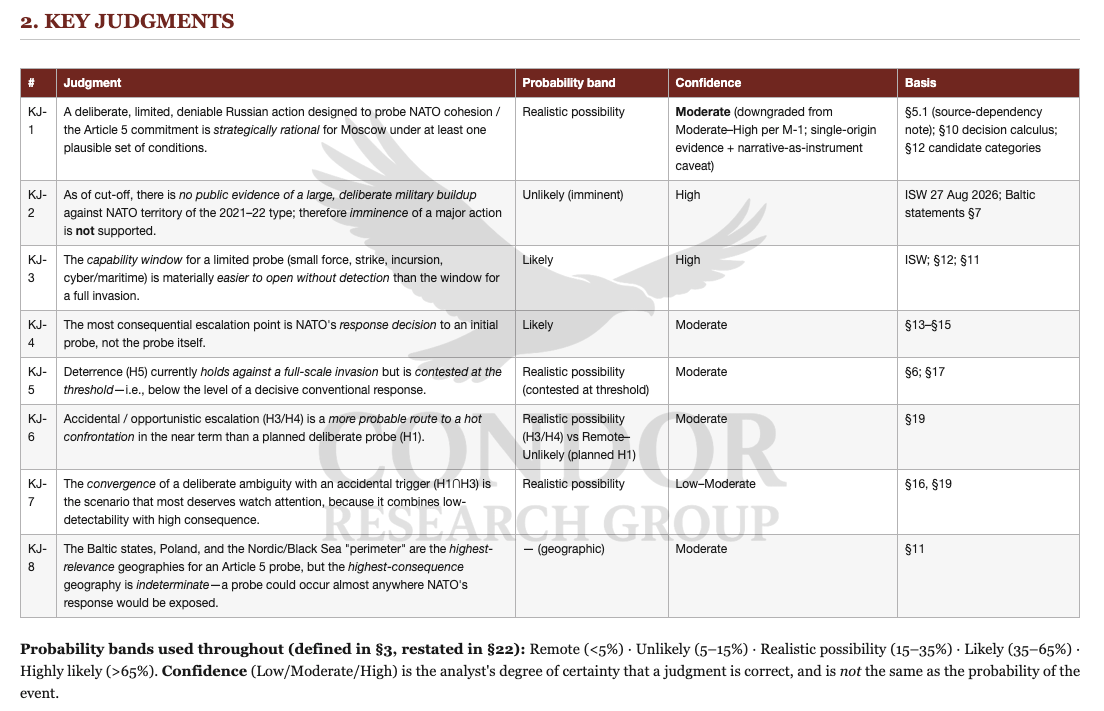
Figure 1. CRG Key Judgments — probability, confidence and analytical basis.
Several findings are particularly important.
There is currently no public evidence of a large, deliberate Russian military buildup against NATO territory comparable to the preparations preceding Russia’s 2022 invasion of Ukraine. Imminence of a major conventional attack is therefore not supported. A limited probe presents a fundamentally different warning problem.
The forces and preparation required for a drone incident, maritime confrontation, cyber operation, subsea infrastructure event, limited stand-off strike or deliberately ambiguous attribution event are considerably smaller than those required for a territorial invasion. The absence of a conventional buildup therefore provides much less warning value against this class of action.
This produces one of the assessment’s central distinctions:
The capability window for a limited probe can open without the warning signatures associated with preparations for general war.
The Objective May Not Be Territory
A conventional invasion has an obvious military objective: territory, destruction of forces, or political control. An Article 5 probe could have a different object entirely.
Its value would lie in the information generated by NATO’s response.
A geographically small event could therefore produce strategically valuable information about the Alliance.
There is an important evidentiary limitation. The public case that Russia may specifically seek to test NATO cohesion rests substantially on a single-origin intelligence-reporting cluster that was subsequently repeated across several secondary sources. Multiple publications do not constitute multiple independent confirmations of the underlying intelligence.
CRG therefore treats a deliberate Article 5 test as a credible hypothesis rather than an established Russian strategy.
What Might a Probe Look Like?
The assessment compares eight broad categories of candidate action according to warning time, deniability, threshold ambiguity, exposure of NATO’s response mechanism, terminability and overall suitability as a probe.
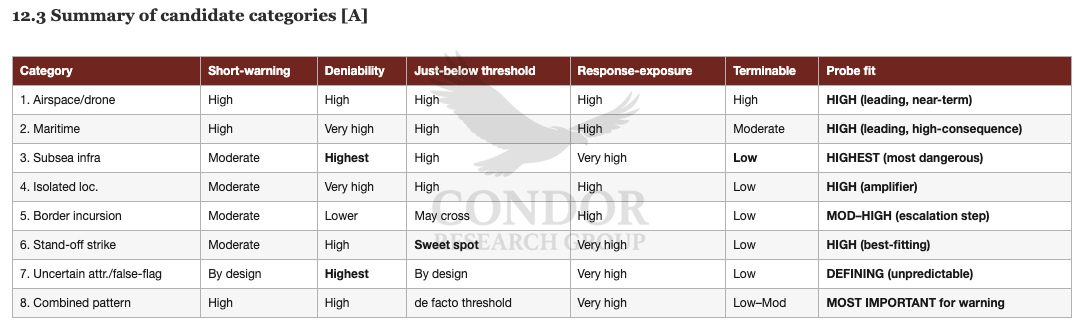
Figure 2. Candidate actions assessed by warning, deniability, threshold characteristics and probe suitability.
The analysis points away from the popular image of Russian armour suddenly crossing a NATO frontier as the most useful model for an initial test.
A stand-off strike could create a much clearer military threshold while retaining some ability to constrain the geographic scope of the confrontation. And combinations of several activities may matter more than any isolated event.
The analytical problem is therefore not simply:
“Has Russia attacked NATO?”
It is also:
“Is a pattern of activity emerging whose cumulative purpose or effect is to expose NATO’s decision process?”
The Response Is the Pivot
The most consequential escalation point may not be the initial Russian action. It may be NATO’s response to it.
An ambiguous event begins a sequence of political and military gates: detection, attribution, legal characterization, consultation, collective political agreement, selection of a response, Russian interpretation of that response, and the decision by both sides either to terminate or continue the interaction.
A decisive and coherent response could reinforce deterrence. A fragmented or delayed response could produce the opposite effect, even if the original incident itself caused little physical damage.
This is why a limited probe presents an unusual escalation problem. The aggressor may be attempting to learn something while simultaneously creating the conditions under which miscalculation becomes possible.
From Gray Zone to General War
CRG models escalation as a ladder rather than a binary transition between peace and war.
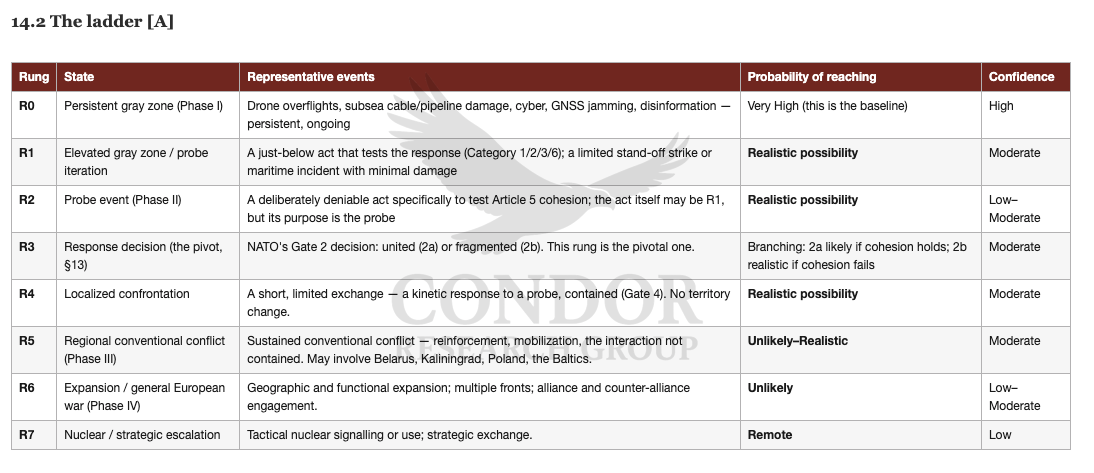
Figure 3. CRG escalation ladder from persistent gray-zone activity to strategic escalation.
The baseline is persistent gray-zone competition. From there, activity can move through elevated probing behaviour and a deliberate probe event before reaching the pivotal response decision.
A confrontation does not automatically climb further. A localized exchange may remain contained. Regional conventional conflict requires another failure of termination or deterrence.
General European war requires still further geographic and functional expansion.
Nuclear or strategic escalation sits at the extreme end of the ladder.
This distinction matters because possibility at one rung is not probability at the next.
The existence of a credible pathway to general war does not mean that general war is itself probable.
The assessment consequently judges a deliberate limited probe as a realistic possibility while treating progression toward general European war as increasingly unlikely and nuclear escalation as remote. The danger lies in the conditional chain.
What We Do Not Know
A useful intelligence assessment should expose its uncertainties rather than bury them. For that reason, The Article Five Test maintains an explicit intelligence-gap register.
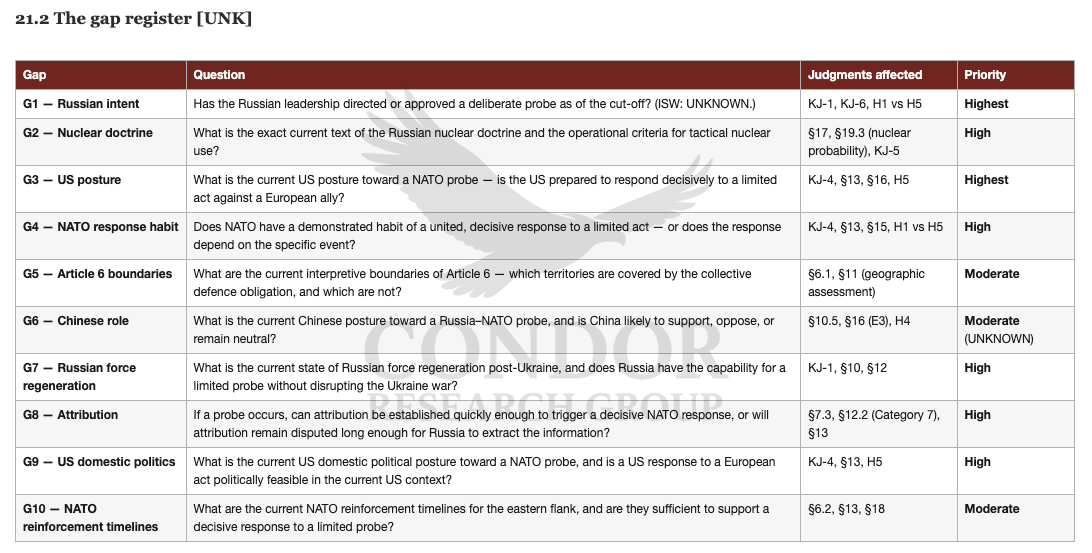
Figure 4. Principal intelligence gaps capable of materially changing the assessment.
The most important unknown is also the most obvious:
Russian intent.
Public information cannot establish whether the Russian leadership has directed or approved a deliberate Article 5 probe.
Other major uncertainties concern US posture, NATO’s demonstrated response behaviour, Russian force regeneration, attribution capability, reinforcement timelines, domestic US political constraints and the precise operational implications of Russian nuclear doctrine.
These gaps matter because they are not peripheral details. Resolving several of them could materially change the assessment.
The distinction between capability and intent is particularly important. Russia possessing the means to undertake a limited action does not demonstrate an intention to do so. Likewise, hostile rhetoric does not establish an operational decision.
The Warning Problem
Traditional warning analysis looks for preparation. For a major conventional attack, that remains useful: concentration of forces, logistics, mobilization, command activity and other observable preparations create signatures. A deliberately limited probe may be designed specifically to avoid them. The warning problem therefore shifts.
Instead of asking only:
“Are Russian forces preparing to attack NATO?”
analysts must also ask:
“Are the political, military and informational conditions making a limited test increasingly attractive, and are observable events moving the system toward that threshold?”
That requires signposts.
What Would Make CRG Change Its Assessment?
The assessment defines eight developments that would trigger reassessment rather than simply collecting indicators indefinitely.
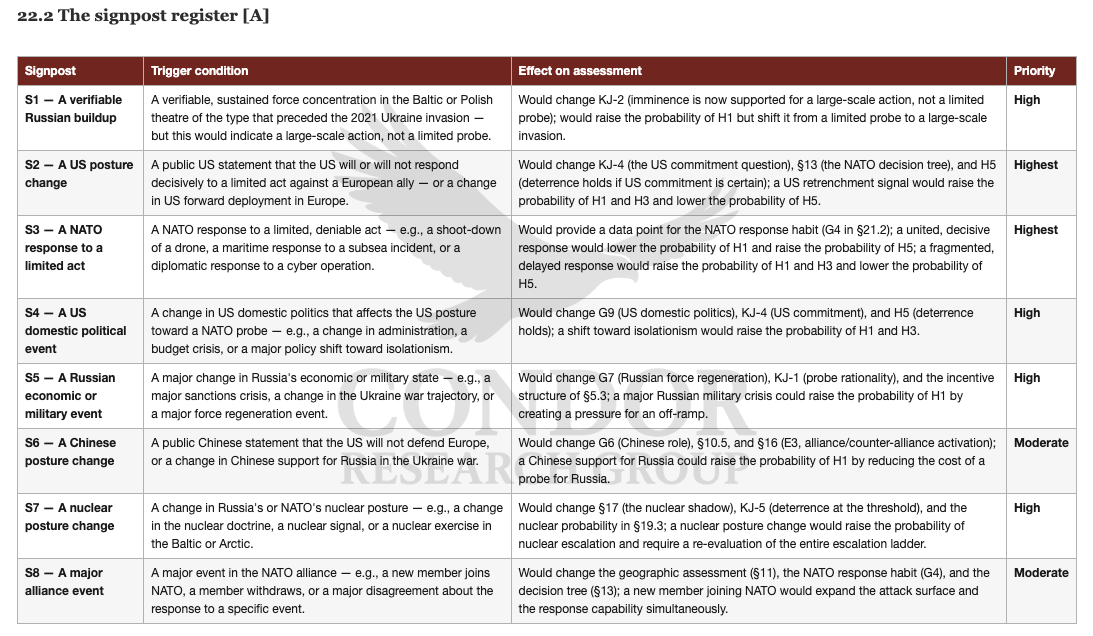
Figure 5. Observable developments requiring reassessment of the Article Five Test.
Three deserve particular attention.
A significant change in US posture toward the defence of a European ally could alter both Russian incentives and NATO deterrence. An actual NATO response to a limited, ambiguous act would provide valuable empirical evidence about Alliance cohesion and response behaviour. And major changes in US domestic politics affecting willingness or ability to respond could alter Moscow’s perception of the risks associated with a probe. Other signposts include a verifiable Russian military buildup, substantial Russian economic or military changes, a change in Chinese posture, nuclear signalling and major changes within the Alliance itself.
These are not predictions. They are conditions under which the existing assessment should no longer be trusted without being re-run.
The Central Judgment
The Article Five Test does not conclude that Russia is preparing to invade Europe. It does not conclude that Moscow has decided to test Article 5. And it does not predict an inevitable progression from gray-zone confrontation to general war.
The central judgment is narrower:
A pathway from persistent gray-zone activity to a deliberate, limited and deniable test of NATO cohesion is identifiable. The pathway is observable in part, strategically plausible under certain conditions, and potentially dangerous because the decisive escalation mechanism may be the political and military response to the initial event rather than the event itself.
The most probable near-term outcome remains that deterrence holds while gray-zone competition continues. That should not be confused with the absence of risk. The relevant warning question is therefore not simply whether Russia intends to start a European war. It is whether the conditions are developing in which a limited test appears sufficiently cheap, sufficiently deniable and sufficiently informative to be worth attempting, and whether NATO’s response would close the experiment or encourage another iteration.
That is the Article Five test.
⸻
DOCUMENT INFORMATION
Document: CRG-EUR-INT-0926/2: The Article Five Test — Pathways to a Russia-Europe War
Classification: Strategic Intelligence Assessment (NATO Deterrence & Escalation Analysis)
Distribution: Public Release
Revision Status: Final — Approved for internal CRG circulation, external academic reference, and web publication
Authorized By: Condor Research Group (CRG)
Division: Geopolitical & Strategic Intelligence Division
Original Draft Date: September 2026
Research Cut-off Date: 4 September 2026
Release Date: 13 September 2026
Version: CRG-INT-VER-A1-FINAL
Keywords: NATO, Article 5, Article 6, Russia, European Security, Collective Defence, Alliance Cohesion, Deterrence, Extended Deterrence, Strategic Ambiguity, Grey-Zone Operations, Hybrid Warfare, Russian Probe, Limited Military Action, Denial and Deception, Attribution, Airspace Incursion, Drone Operations, Maritime Incidents, Subsea Infrastructure, Critical Infrastructure, Border Incursion, Stand-Off Strike, False Flag, Escalation Management, Escalation Ladder, Nuclear Doctrine, Nuclear Signalling, US Security Commitment, US Posture, NATO Response, NATO Reinforcement, Baltic States, Poland, Nordic Region, Baltic Sea, Black Sea, Kaliningrad, Belarus, China, Strategic Warning, Intelligence Gaps, Reassessment Signposts, Scenario Analysis, Strategic Indicators, Decision Thresholds
Source Report: The Article Five Test — Pathways to a Russia-Europe War
Publication Note: Published on the Condor Research Group website as part of the CRG Strategic Intelligence Assessment series. This assessment examines the conditions under which Russia could conduct a limited, deniable or deliberately ambiguous action intended to test NATO cohesion and the credibility of the Article 5 commitment without initiating a planned general war. It evaluates candidate action categories, geographic exposure, alliance response dynamics, US posture, attribution constraints, Russian force requirements and the escalation pathways through which a contained probe could develop into localized confrontation or wider European conflict. Particular attention is given to the distinction between capability and intent, the strategic significance of NATO’s response decision rather than the initiating event alone, and the convergence of deliberate ambiguity with accidental or opportunistic escalation. Intelligence gaps and reassessment signposts identify the evidence most capable of materially changing the assessment. Probability bands and confidence classifications represent comparative analytical judgments under uncertainty and do not constitute predictions of future Russian, NATO or individual state behaviour or military action.
Pathways to a Russia–Europe War
Document: CRG-EUR-INT-0926/2
Title: The Article Five Test — Pathways to a Russia-Europe War
Subtitle: Russian Probe Scenarios and NATO Cohesion
Classification: UNCLASSIFIED
Date: 13 September 2026
Publisher: Condor Research Group (CRG)
Europe’s most dangerous pathway to a direct war with Russia may not begin with an invasion.
It may begin with an event deliberately designed to make NATO governments argue over whether an attack has occurred at all.
The Article Five Test examines a specific hypothesis: that under certain political and military conditions, Moscow could find it strategically rational to conduct a limited, ambiguous and potentially deniable action against NATO interests—not primarily to seize territory, but to test the cohesion, speed and credibility of the Alliance’s collective response.
The assessment does not predict that such an action will occur.
Nor does it conclude that a general Russia–Europe war is imminent or probable.
Instead, it asks a narrower question:
What sequence of events could transform the persistent European gray zone into a direct NATO–Russia confrontation, and what observable indicators would tell us that the threshold was being approached?
The analysis produces five competing hypotheses: a deliberate Article 5 test; continuation of persistent gray-zone activity; accidental escalation; opportunistic escalation; and continued deterrence.
The balance of evidence presently favours continued deterrence and persistent gray-zone competition over a deliberate near-term test. But the pathway to a test is sufficiently plausible—and its consequences sufficiently serious—to warrant structured monitoring.
Key Judgments
The assessment separates probability from confidence. A low-probability event can be assessed with high confidence; conversely, a plausible event may remain supported only with moderate or low confidence.
Figure 1. CRG Key Judgments — probability, confidence and analytical basis.
Several findings are particularly important.
There is currently no public evidence of a large, deliberate Russian military buildup against NATO territory comparable to the preparations preceding Russia’s 2022 invasion of Ukraine. Imminence of a major conventional attack is therefore not supported. A limited probe presents a fundamentally different warning problem.
The forces and preparation required for a drone incident, maritime confrontation, cyber operation, subsea infrastructure event, limited stand-off strike or deliberately ambiguous attribution event are considerably smaller than those required for a territorial invasion. The absence of a conventional buildup therefore provides much less warning value against this class of action.
This produces one of the assessment’s central distinctions:
The capability window for a limited probe can open without the warning signatures associated with preparations for general war.
The Objective May Not Be Territory
A conventional invasion has an obvious military objective: territory, destruction of forces, or political control. An Article 5 probe could have a different object entirely.
Its value would lie in the information generated by NATO’s response.
- How quickly is the event attributed?
- Do allies agree on what happened?
- Is the action considered an “armed attack”?
- Does NATO respond collectively?
- What type of response follows?
- Does the United States immediately commit itself?
- Can political disagreement delay military action?
A geographically small event could therefore produce strategically valuable information about the Alliance.
There is an important evidentiary limitation. The public case that Russia may specifically seek to test NATO cohesion rests substantially on a single-origin intelligence-reporting cluster that was subsequently repeated across several secondary sources. Multiple publications do not constitute multiple independent confirmations of the underlying intelligence.
CRG therefore treats a deliberate Article 5 test as a credible hypothesis rather than an established Russian strategy.
What Might a Probe Look Like?
The assessment compares eight broad categories of candidate action according to warning time, deniability, threshold ambiguity, exposure of NATO’s response mechanism, terminability and overall suitability as a probe.
Figure 2. Candidate actions assessed by warning, deniability, threshold characteristics and probe suitability.
The analysis points away from the popular image of Russian armour suddenly crossing a NATO frontier as the most useful model for an initial test.
- Airspace and drone incidents offer short warning and considerable ambiguity.
- Maritime incidents combine high deniability with potentially serious consequences.
- Subsea infrastructure presents particularly difficult attribution and response problems.
- Cyber operations can create substantial effects while leaving both attribution and threshold classification contested.
A stand-off strike could create a much clearer military threshold while retaining some ability to constrain the geographic scope of the confrontation. And combinations of several activities may matter more than any isolated event.
The analytical problem is therefore not simply:
“Has Russia attacked NATO?”
It is also:
“Is a pattern of activity emerging whose cumulative purpose or effect is to expose NATO’s decision process?”
The Response Is the Pivot
The most consequential escalation point may not be the initial Russian action. It may be NATO’s response to it.
An ambiguous event begins a sequence of political and military gates: detection, attribution, legal characterization, consultation, collective political agreement, selection of a response, Russian interpretation of that response, and the decision by both sides either to terminate or continue the interaction.
A decisive and coherent response could reinforce deterrence. A fragmented or delayed response could produce the opposite effect, even if the original incident itself caused little physical damage.
This is why a limited probe presents an unusual escalation problem. The aggressor may be attempting to learn something while simultaneously creating the conditions under which miscalculation becomes possible.
From Gray Zone to General War
CRG models escalation as a ladder rather than a binary transition between peace and war.
Figure 3. CRG escalation ladder from persistent gray-zone activity to strategic escalation.
The baseline is persistent gray-zone competition. From there, activity can move through elevated probing behaviour and a deliberate probe event before reaching the pivotal response decision.
A confrontation does not automatically climb further. A localized exchange may remain contained. Regional conventional conflict requires another failure of termination or deterrence.
General European war requires still further geographic and functional expansion.
Nuclear or strategic escalation sits at the extreme end of the ladder.
This distinction matters because possibility at one rung is not probability at the next.
The existence of a credible pathway to general war does not mean that general war is itself probable.
The assessment consequently judges a deliberate limited probe as a realistic possibility while treating progression toward general European war as increasingly unlikely and nuclear escalation as remote. The danger lies in the conditional chain.
What We Do Not Know
A useful intelligence assessment should expose its uncertainties rather than bury them. For that reason, The Article Five Test maintains an explicit intelligence-gap register.
Figure 4. Principal intelligence gaps capable of materially changing the assessment.
The most important unknown is also the most obvious:
Russian intent.
Public information cannot establish whether the Russian leadership has directed or approved a deliberate Article 5 probe.
Other major uncertainties concern US posture, NATO’s demonstrated response behaviour, Russian force regeneration, attribution capability, reinforcement timelines, domestic US political constraints and the precise operational implications of Russian nuclear doctrine.
These gaps matter because they are not peripheral details. Resolving several of them could materially change the assessment.
The distinction between capability and intent is particularly important. Russia possessing the means to undertake a limited action does not demonstrate an intention to do so. Likewise, hostile rhetoric does not establish an operational decision.
The Warning Problem
Traditional warning analysis looks for preparation. For a major conventional attack, that remains useful: concentration of forces, logistics, mobilization, command activity and other observable preparations create signatures. A deliberately limited probe may be designed specifically to avoid them. The warning problem therefore shifts.
Instead of asking only:
“Are Russian forces preparing to attack NATO?”
analysts must also ask:
“Are the political, military and informational conditions making a limited test increasingly attractive, and are observable events moving the system toward that threshold?”
That requires signposts.
What Would Make CRG Change Its Assessment?
The assessment defines eight developments that would trigger reassessment rather than simply collecting indicators indefinitely.
Figure 5. Observable developments requiring reassessment of the Article Five Test.
Three deserve particular attention.
A significant change in US posture toward the defence of a European ally could alter both Russian incentives and NATO deterrence. An actual NATO response to a limited, ambiguous act would provide valuable empirical evidence about Alliance cohesion and response behaviour. And major changes in US domestic politics affecting willingness or ability to respond could alter Moscow’s perception of the risks associated with a probe. Other signposts include a verifiable Russian military buildup, substantial Russian economic or military changes, a change in Chinese posture, nuclear signalling and major changes within the Alliance itself.
These are not predictions. They are conditions under which the existing assessment should no longer be trusted without being re-run.
The Central Judgment
The Article Five Test does not conclude that Russia is preparing to invade Europe. It does not conclude that Moscow has decided to test Article 5. And it does not predict an inevitable progression from gray-zone confrontation to general war.
The central judgment is narrower:
A pathway from persistent gray-zone activity to a deliberate, limited and deniable test of NATO cohesion is identifiable. The pathway is observable in part, strategically plausible under certain conditions, and potentially dangerous because the decisive escalation mechanism may be the political and military response to the initial event rather than the event itself.
The most probable near-term outcome remains that deterrence holds while gray-zone competition continues. That should not be confused with the absence of risk. The relevant warning question is therefore not simply whether Russia intends to start a European war. It is whether the conditions are developing in which a limited test appears sufficiently cheap, sufficiently deniable and sufficiently informative to be worth attempting, and whether NATO’s response would close the experiment or encourage another iteration.
That is the Article Five test.
⸻
DOCUMENT INFORMATION
Document: CRG-EUR-INT-0926/2: The Article Five Test — Pathways to a Russia-Europe War
Classification: Strategic Intelligence Assessment (NATO Deterrence & Escalation Analysis)
Distribution: Public Release
Revision Status: Final — Approved for internal CRG circulation, external academic reference, and web publication
Authorized By: Condor Research Group (CRG)
Division: Geopolitical & Strategic Intelligence Division
Original Draft Date: September 2026
Research Cut-off Date: 4 September 2026
Release Date: 13 September 2026
Version: CRG-INT-VER-A1-FINAL
Keywords: NATO, Article 5, Article 6, Russia, European Security, Collective Defence, Alliance Cohesion, Deterrence, Extended Deterrence, Strategic Ambiguity, Grey-Zone Operations, Hybrid Warfare, Russian Probe, Limited Military Action, Denial and Deception, Attribution, Airspace Incursion, Drone Operations, Maritime Incidents, Subsea Infrastructure, Critical Infrastructure, Border Incursion, Stand-Off Strike, False Flag, Escalation Management, Escalation Ladder, Nuclear Doctrine, Nuclear Signalling, US Security Commitment, US Posture, NATO Response, NATO Reinforcement, Baltic States, Poland, Nordic Region, Baltic Sea, Black Sea, Kaliningrad, Belarus, China, Strategic Warning, Intelligence Gaps, Reassessment Signposts, Scenario Analysis, Strategic Indicators, Decision Thresholds
Source Report: The Article Five Test — Pathways to a Russia-Europe War
Publication Note: Published on the Condor Research Group website as part of the CRG Strategic Intelligence Assessment series. This assessment examines the conditions under which Russia could conduct a limited, deniable or deliberately ambiguous action intended to test NATO cohesion and the credibility of the Article 5 commitment without initiating a planned general war. It evaluates candidate action categories, geographic exposure, alliance response dynamics, US posture, attribution constraints, Russian force requirements and the escalation pathways through which a contained probe could develop into localized confrontation or wider European conflict. Particular attention is given to the distinction between capability and intent, the strategic significance of NATO’s response decision rather than the initiating event alone, and the convergence of deliberate ambiguity with accidental or opportunistic escalation. Intelligence gaps and reassessment signposts identify the evidence most capable of materially changing the assessment. Probability bands and confidence classifications represent comparative analytical judgments under uncertainty and do not constitute predictions of future Russian, NATO or individual state behaviour or military action.