CRG-ARC-INT-0126/2: Greenland Coercive Transition — Alliance Fracture and Arctic Control Dynamics
Greenland Coercive Transition — Alliance Fracture and Arctic Seizure Dynamics
Prepared by: Condor Research Group (CRG)
Classification: Internal Analytical Memorandum
Date: January 2026
Domain: Arctic / Alliance Systems / Coercive State Behavior
Executive Summary
Background: In early 2026, U.S. President Donald Trump, in his second administration, has openly declared that Greenland will come under U.S. control, asserting it can happen “the easy way or the hard way.” This unprecedented claim on a self-governing Danish territory has escalated into a live crisis. The White House has refused to rule out military options for acquiring Greenland , even confirming that contingency plans are in preparation. Trump justifies his stance by warning that if the U.S. doesn’t act, Russia or China would “take over Greenland” – something he vows to prevent at all costs . The situation is unfolding amid an emboldened U.S. foreign policy: just days earlier, U.S. special forces conducted a lightning raid in Caracas to capture Venezuela’s president, signaling Trump’s willingness to use force for strategic gains .
Short-Term Outlook (2026–2027): The probability of an outright U.S. invasion of Greenland in this period, while not certain, is alarmingly high by historical standards. Trump’s public threats and the preparation of military options indicate a credible risk of armed action unless a face-saving solution is found. U.S. officials maintain that diplomacy and even purchase remain preferred avenues, but they simultaneously emphasize that “the military is always an option” for achieving Trump’s goal . Domestically, only a small minority of Americans (≈7%) support the idea of invading a NATO ally’s territory , but Trump’s track record of acting decisively “on the cheap” when he perceives low risk suggests he may press forward . Expert views diverge: some analysts see a “really good chance” Trump could attempt a “short and sharp” seizure of Greenland given his recent successes (Iran, Nigeria, Venezuela) , while others believe he might instead pursue indirect tactics by stoking Greenland’s independence movement to invite U.S. intervention without a traditional invasion .
Likely U.S. Strategy: If military action proceeds, the U.S. would probably favor a rapid surprise operation to seize key strategic points in Greenland, rather than a protracted campaign. Military experts assess that the U.S. could occupy Greenland quickly and with minimal loss of life, given the vast imbalance in power between U.S. forces and Denmark’s limited defense assets . The Pentagon would aim to “get in first, control the chokepoints” – namely Greenland’s few airfields, ports, and communication hubs – within hours . An initial strike package would likely involve Special Operations units (e.g. Delta Force and Navy SEALs) and the Army’s 75th Ranger Regiment to capture airfields under cover of darkness, quickly followed by an airborne brigade (e.g. the 82nd Airborne Division) to reinforce and secure perimeters . The U.S. already has a foothold at Thule Air Base (Pituffik) in northwest Greenland, which could serve as a critical beachhead for the invasion – though its status as a site for early-warning missile radars injects additional caution to avoid miscalculations involving strategic assets . The logistics challenge is formidable: Greenland’s vast distances and harsh climate mean the U.S. would mobilize substantial airlift (C-17, C-130 transports) and aerial refueling tankers, plus likely deploy a Carrier Strike Group and amphibious Marine force to secure sea lines of communication . The key U.S. objective would be to present a swift fait accompli, capturing infrastructure rather than engaging in widespread combat , and then hold those assets while political pressure forces Denmark to concede.
Hybrid Tactics vs. Occupation: In parallel with or prior to any direct assault, Washington is already employing hybrid tactics. According to reports, the Trump administration has considered “coercion, pressure, blackmail… [and] extortion” as opening moves . One plan under discussion is literally bribing Greenland’s population; offering each Greenlander between $10,000 and $100,000 to accept U.S. sovereignty . U.S. diplomats are also probing Greenlandic political fissures: the leader of Greenland’s opposition Naleraq party (which polled 25% in 2025) has publicly urged the Greenland government to negotiate directly with Washington “without Denmark”, proposing a “free association” where Greenland would be independent but host U.S. forces . Such moves aim to undermine Copenhagen’s control and potentially install a cooperative local authority that could invite U.S. presence, reducing the need for open conflict. However, if these tactics fail and an occupation ensues, the U.S. would be forced to garrison Greenland for the long haul. Analysts estimate at least a brigade-sized force (3,000–5,000 troops) would be needed as an occupation footprint, including Arctic-trained units, engineers, and air defense to hold the island’s key sites . Sustaining an occupation in the High North would be costly and logistically intense; “Greenland is a logistics problem wearing a parka,” as one commentator put it, and U.S. forces would be vulnerable to both the environment and any asymmetric resistance over time. Washington’s hope would be to leverage a rapid victory into a negotiated settlement (e.g. purchase or lease) before a protracted insurgency or international isolation sets in .
Denmark’s Response: Denmark has reacted with shock, defiance, and urgent diplomacy. Politically, Copenhagen has made it unequivocally clear that it will not cede Greenland. Danish Prime Minister Mette Frederiksen, whose government sees this as an existential threat, stated that a U.S. attack on Greenland (and thus on Denmark) would spell the end of NATO and the post-World War II security order . She and Greenland’s Prime Minister issued a joint declaration reaffirming that “Greenland belongs to the Greenlanders” and that borders and sovereignty cannot be changed by force. Diplomatically, Denmark is racing to internationalize the issue. It has invoked NATO’s consultation mechanisms and reached out to allies across Europe and North America to rally support for Greenland’s status. Foreign Minister Lars Løkke Rasmussen and Greenlandic Minister Vivian Motzfeldt have secured an urgent meeting with U.S. Secretary of State Marco Rubio, aiming to de-escalate through dialogue. Their plea is for a “sensible dialogue” to replace the current confrontation. At the same time, Denmark has intensified its messaging at the United Nations and EU, emphasizing the inviolability of sovereign territory.
Militarily, Denmark faces an acute dilemma. Its defense of Greenland is mostly symbolic; a handful of patrol vessels, surveillance aircraft, and specialized Arctic troops, no match for American forces. Recognizing this, Denmark is not expected to offer armed resistance if U.S. troops arrive; experts note Copenhagen would likely avoid a suicidal fight that could even invite U.S. strikes on Denmark itself. Instead, Denmark’s strategy is to prevent conflict by raising the political costs for Washington. Copenhagen has leveraged what some call the “Greenland card”, Denmark’s strategic importance to U.S. Arctic defense, for decades, and is now underscoring how betrayal of an ally will damage U.S. interests globally. In recent years (even before this crisis), Denmark began boosting its Arctic defense investments, pledging 42 billion DKK (~$6.5 billion) in new capabilities after U.S. complaints that it wasn’t doing enough to secure Greenland. These moves were meant to assuage U.S. concerns and signal Denmark’s commitment to Greenland’s security. Now, facing U.S. aggression, Denmark will likely station any available forces in Greenland as tripwires; for example, rotating a few F-16 fighters or special forces to Greenland’s airbases if possible, and encourage allied troops to do likewise, as a deterrent measure . Indeed, European partners have already been training in Greenland: in September 2025, Danish, German, French, and Nordic troops held joint military drills in Kangerlussuaq, Greenland (near a key airbase) to send a subtle signal of readiness . While Denmark’s direct military options are limited, its ultimate response will be to invoke every treaty and institution – from NATO’s Article 5 to UN resolutions – to isolate the U.S. and portray it as a violator of international law, hoping to shame Washington into backing down.
Greenland’s Internal Dynamics and Resistance: Greenland’s 57,000 residents have been thrust to the front line of this crisis. Public sentiment in Greenland is overwhelmingly against becoming part of the United States by force or purchase. A recent poll found 85% of Greenlanders reject joining the U.S. , and civil society voices have been outspoken: for instance, the head of Greenland’s largest trade union pointedly told Trump, “we are not for sale”, in response to the renewed annexation talk . All major Greenlandic political parties desire eventual independence from Denmark, but crucially, none favors a coerced handover to the U.S.; even the most pro-sovereignty factions insist on the principle of self-determination. Greenland’s government (Naalakkersuisut), currently led by a coalition including the Inuit Ataqatigiit party, stands firmly with Denmark in opposing Trump’s moves. Foreign Minister Vivian Motzfeldt has rebuffed suggestions that Greenland negotiate behind Denmark’s back, noting that under the 2009 Self-Rule Act, Greenland cannot conduct its own foreign/defense policy or alter its status without Danish consent. She emphasized adherence to the Kingdom’s legal process and expressed hope that diplomatic meetings (like the one with Rubio) will normalize relations.
However, internal political rifts are starting to show. The populist Naleraq party, now the largest opposition party, is openly mulling a future aligned with the U.S. rather than Denmark. Naleraq’s leader, Pele Broberg, has proposed exploring a “free association” model akin to Pacific states’ compacts with Washington; where Greenland would become independent but trade U.S. basing rights for financial support and protection. Broberg argues that Denmark’s hardline stance is “antagonising” both Greenland and the U.S., and he calls for direct Greenland–U.S. talks to at least hear what Washington is offering. This stance has proven controversial domestically, but it resonates with some Greenlanders frustrated by Copenhagen’s control. Indeed, Naleraq doubled its seats in the last election on a promise of faster independence.
In the short term, however, national unity against foreign invasion is likely to override partisan differences. The specter of American troops landing in Greenland has triggered feelings of Greenlandic nationhood perhaps stronger than ever, reinforcing that whatever their views on Denmark, most Greenlanders do not want to become Americans overnight. If U.S. forces attempt to occupy the island, we can expect civil resistance ranging from non-compliance and protests to potential sabotage of infrastructure. While Greenland’s population is small and not heavily armed, locals are intimately familiar with the harsh terrain. A grassroots insurgency cannot be ruled out: hunting rifles and fishing boats could be turned against occupying forces in sporadic acts of defiance, especially if aided clandestinely by Danish intelligence or special forces. The longer an occupation lasts, the higher the risk that Greenlanders organize clandestine opposition; for example, hiding vital equipment, guiding U.S. supply convoys into ambush by the elements, or cyber-disrupting communications. Greenland’s vast geography would make it nearly impossible for U.S. troops to fully control; they might hold the towns and bases, but losing legitimacy among the locals would make governance and logistics extraordinarily difficult. The U.S. would also face a “hearts and minds” battle: in a country where virtually every family has ties to Denmark or other NATO nations, U.S. actions could be met with passive resistance (strikes, refusals to work in critical facilities) and international moral outrage amplified by Greenlanders acting as witnesses. Notably, Greenland’s law guarantees the right to decide independence via referendum, underscoring that any change in sovereignty imposed externally will lack legal and moral validity in the eyes of Greenland’s people. In sum, while an overt guerrilla war might not erupt immediately, the risk of prolonged unrest is high. U.S. planners privately acknowledge that “legitimacy is the part that breaks occupations (eventually)”; and an American takeover of Greenland would start with virtually zero legitimacy at home or abroad.
European Union Reaction: The European Union has swiftly and unanimously backed Denmark and Greenland, treating the U.S. threat as a fundamental challenge to Europe’s norms and security. EU leaders have condemned Washington’s stance in the strongest terms. European Council President António Costa declared, “Greenland belongs to its people. Nothing can be decided about Denmark or Greenland without Denmark or Greenland”, equating the situation to other international law violations in places like Ukraine or Cyprus. He vowed that the EU “will not accept violations of international law – no matter where they occur”, implicitly comparing an American annexation of Greenland to the very aggressions Europe opposes elsewhere. In practical terms, Brussels has offered full diplomatic support to Copenhagen: the EU is coordinating unified statements, summoning U.S. ambassadors in European capitals for formal protests, and preparing a package of political and economic countermeasures should the U.S. move beyond rhetoric. High Representative for Foreign Affairs (and EU foreign ministers collectively) are reportedly weighing actions ranging from suspension of EU-U.S. dialogues to targeted trade measures if the crisis escalates. The overarching goal is to deter Washington through isolation: by making it clear the U.S. would become a pariah in Europe, the EU hopes cooler heads in Washington will recalculate the costs.
In the immediate term, European governments are engaging in intense behind-the-scenes diplomacy with U.S. officials. France and Germany, Europe’s heavyweights, have taken the lead in crafting a contingency plan “in the event the United States follows through” on its Greenland threats. French Foreign Minister Jean-Noël Barrot indicated that allied nations are prepared to act if the U.S. attempts to seize Greenland, but stressed the need to respond jointly as Europeans. This likely refers to coordinating everything from unified condemnations to potentially collective sanctions. Indeed, European officials have quietly begun discussing an escalatory ladder of pressure short of military confrontation. This ladder starts with NATO Article 4 consultations (framing the U.S. as the alliance’s problem) and UN General Assembly resolutions condemning U.S. threats . It then scales up through economic levers: EU regulatory scrutiny on U.S. companies, delays in U.S.-EU trade cooperation, and perhaps even preparatory work on sanctions, to signal that transatlantic business cannot proceed normally under aggression. European powers understand these steps “need not be dramatic to be effective” – persistent diplomatic and economic friction can hurt the U.S. while avoiding a direct military showdown.
Significantly, some European states have already taken discrete military precautions as a form of deterrence. When Trump’s Greenland ambitions resurfaced last year, France reportedly deployed a nuclear attack submarine to patrol near Greenland – a signal that France’s own nearby territories (such as Saint Pierre and Miquelon near Canada) and the broader Atlantic must be respected. This kind of maneuver, albeit quiet, indicates Europe’s willingness to show a military flag in solidarity with Denmark. Moreover, influential voices like Keir Giles of Chatham House argue Europe’s best hope to deter a U.S. move is to place a multinational “tripwire” force on Greenland now – just as NATO forward-deployed troops to deter Russia in the Baltics. While politically fraught, this idea is being discussed in European defense circles. The presence of, say, a small Norwegian or Canadian contingent in Greenland at Denmark’s invitation could complicate U.S. plans by raising the prospect of shooting not just Danes, but other allies.
The EU’s reaction is also guided by wider principle and precedent. Europeans view capitulating on Greenland as opening Pandora’s box: if a mighty nation can simply take territory from a smaller one, Europe’s entire security architecture – built on rule of law and territorial integrity – would be shattered. This explains why even Europe’s smaller states and non-NATO neutrals are aligning with Denmark. For example, Finland’s parliamentary Foreign Affairs chair called for addressing the crisis within NATO to “bring the United States into line” and make clear an ally cannot “pursue its own power ambitions” at others’ expense. Even countries outside NATO, like Ireland, have issued statements supporting Denmark. The EU is also leveraging global forums: it has worked with Canada, the UK, and others on a UN General Assembly resolution condemning threats of force to change Greenland’s status. Such a resolution, citing the UN Charter’s ban on force, would politically isolate the U.S., as every nation’s vote or abstention becomes a public stance.
In summary, the EU’s immediate response couples unambiguous political backing for Denmark/Greenland with contingency planning for economic and diplomatic retaliation against the U.S. All these actions are aimed at preventing the worst (actual conflict) while upholding the fundamental tenet that “might does not make right” in Europe’s neighborhood. Over the medium term, if the crisis deepens, we can expect the EU to accelerate efforts at European strategic autonomy – essentially preparing for a future where U.S. security guarantees are void. European defense cooperation initiatives (from joint military units to alternative alliance structures) would likely gain momentum as a hedge against an increasingly unpredictable Washington.
NATO’s Response and Alliance Cohesion: The North Atlantic Treaty Organization is confronting an existential crisis from within. NATO’s founding concept; that members defend each other against external aggression, never contemplated a scenario where the primary threat comes from the United States itself. As Danish leaders have starkly noted, if one NATO member attacks another, it would “mean the end of NATO”, or at best leave it a shadow of its former self. This is not mere rhetoric: Article 5 of the NATO Treaty calls for collective defense against an armed attack, but invoking Article 5 requires unanimous consent; a consensus that obviously cannot include the aggressor nation. There is, quite literally, no mechanism for NATO to fight itself. As one analysis put it, NATO has “no clean, elegant, ready-made mechanism for ‘the biggest kid in the alliance just went feral’”. The likely outcome, should Denmark request Article 5 protection, is an immediate paralysis of NATO decision-making. The U.S. would veto any collective action, and other allies would be trapped in an agonizing dilemma, torn between their legal commitment to defend Denmark and the impossibility of waging war on their ally America.
In the short term, NATO has already moved to Article 4 consultations (urgent meetings when a member feels its security is threatened). Denmark and other allies (notably the Nordic countries and Canada) have likely called multiple emergency Council sessions since Trump’s statements. These meetings are aimed not at planning military action against the U.S., but at crisis management to preserve what remains of alliance unity. The immediate NATO response is expected to be diplomatic: issuing strong statements of solidarity with Denmark, urging the U.S. to refrain from unilateral force, and perhaps forming a special commission to engage U.S. officials. Yet this approach has limits; NATO operates by consensus, so even a statement condemning the U.S. or demanding it stand down might be blocked by Washington’s representatives.
If the U.S. actually moved militarily on Greenland, NATO as we know it would likely fracture. Historical precedents are telling but far less severe: in 1974, when Turkey (a NATO member) invaded Cyprus, Greece withdrew from NATO’s integrated command in protest . NATO avoided taking sides in that intra-alliance conflict, and it took years to repair the rift. The Greenland crisis is potentially much more destructive because it involves NATO’s leading power and the alliance’s collective credibility. Analysts across the spectrum agree that a U.S.–Danish clash would “destroy NATO” in any meaningful sense. John Mearsheimer bluntly predicts NATO “would be a shadow of itself – effectively wrecked” if the Greenland invasion happens during the ongoing war in Ukraine. Michael McFaul similarly warns that even threatening such an action has “already damaged America’s reputation abroad”, and carrying it out would be the worst foreign policy blunder of our lifetime.
That said, the individual responses of NATO member states would not be uniform. We would likely see a split between a cohort of staunch supporters of Denmark and a group more cautious or even quietly sympathetic to the U.S. position (though few if any European allies support violating sovereignty, some may be less confrontational due to security or political ties with Washington). Britain, France, Germany, Canada, Norway, and others have already “jumped to support Denmark and Greenland”, indicating broad backing for the victim of aggression. Behind closed doors, a subset of allies; especially the Nordic countries, might consider forming an independent coalition to assist Denmark militarily if the U.S. attacks. In a “Twilight Zone” scenario envisaged by defense analysts, several likeminded NATO members (e.g. Norway, the UK, Canada, maybe France) could create an ad hoc force outside NATO’s formal command to help Denmark defend Greenland. This would essentially be a “coalition of the willing” operating under the banner of supporting a UN Charter principle (collective self-defense) rather than NATO, since NATO as an institution would be incapacitated. The war aim of any such coalition would not be to fight the United States outright, but to deny the success of the invasion; for example, interdicting U.S. supply lines, disrupting lodgments, and forcing Washington to reconsider. This is a highly risky path that most NATO governments would be extremely reluctant to pursue; even the possibility of shots fired between U.S. and European forces is almost unthinkable in policy circles. Still, the mere discussion of it underscores how grave the situation is for NATO’s unity.
More plausibly, NATO’s European members (plus Canada) will pursue non-kinetic collective responses. We have already seen NATO allies signal partial boycotts of cooperation: e.g., European defense officials floating the idea of pausing joint exercises and exchanges with the U.S. as a form of censure. Some countries may quietly restrict U.S. base access on their soil; not ejecting U.S. forces outright, but slowing approvals and introducing “friction” to show displeasure . Such steps send a message: “you do not get to lead the alliance while threatening the alliance.” If the crisis continues, NATO-Europe would likely accelerate plans for European defense autonomy, explicitly framing it as a hedge against U.S. unpredictability. This kind of strategic reorientation, Europe preparing to defend itself without America, would have been unthinkable a few years ago, but after Greenland it could gain inevitability.
In summary, NATO as a formal entity would enter a state of institutional paralysis if the U.S. pressed forward. The Alliance might technically continue to exist (the buildings in Brussels won’t vanish overnight), but its core mutual-defense function would be fatally undermined. The longer-term outcome might be a de facto dissolution or at least a deep freeze of NATO, with Europe moving toward its own collective defense arrangement. In the worst case (actual conflict), NATO members might splinter into pro-U.S. vs pro-Denmark camps; a geopolitical earthquake that Russia and China would surely exploit. As a European diplomat observed, “the alliance was built to deter the Soviet Union, not to discipline the United States”, and there is no precedent or playbook for what is now unfolding.
Impact on the Ukraine Conflict and NATO–Russia Dynamics: The Greenland crisis comes at a precarious moment for European security, as the war in Ukraine (sparked by Russia’s 2022 invasion) is still raging. A schism in NATO or a diversion of U.S. attention could profoundly affect the trajectory of the Ukraine conflict. European strategists fear a “deadly one-two combination”: Russia’s ongoing military pressure in Eastern Europe, combined with NATO’s rupture over Greenland, could “basically ruin the alliance,” leaving it unable to effectively deter Russia . President Putin and his generals are undoubtedly observing this crisis intently. From Moscow’s perspective, a U.S.–Denmark confrontation is an unexpected strategic gift. It validates the Kremlin’s narrative that the Western alliance is fragile and hypocritical, and it potentially distracts the U.S. from the Eastern Front. If NATO is paralyzed or politically torn, Russia may seize the opportunity to escalate in Ukraine or elsewhere, calculating that a divided West will struggle to respond. For instance, Russia might intensify its offensive in Ukraine in 2026, betting that the U.S. (diplomatically isolated and militarily focused on Greenland) will have less bandwidth or willingness to coordinate massive new aid packages or deployments in Europe. Already, there are concerns that Washington’s commitment to arming Ukraine could wane if Trump’s priorities shift – Trump has in the past expressed ambivalence about funding Ukraine’s defense, and an internal conflict with NATO allies could further erode U.S. support for NATO’s eastern flank.
Even short of deliberate Russian escalation, the cohesion of the pro-Ukraine coalition could falter. The Greenland episode is straining trust between the U.S. and Europe at the highest levels, at a time when unity over Ukraine was essential. European leaders, as reported, convened with U.S. officials in Paris recently to shore up security guarantees for Ukraine, but pointedly “said nothing in public about Venezuela or Greenland” so as not to derail the delicate talks. Europe’s priority has been to keep the Americans engaged in Ukraine (“keeping the Americans in” ), which explains why they treaded lightly initially. However, as the Greenland crisis deepens, European nations may feel compelled to distance themselves from Washington, even if it harms the united front on Ukraine. We could see scenarios where European NATO members double-down on supporting Ukraine on their own, while the U.S. becomes more isolationist or even hostile to European security concerns. This fragmentation could slow the supply of arms and intelligence to Kyiv or complicate strategic decision-making.
Another crucial aspect is the moral-political dimension: America’s stance toward Greenland undermines the West’s argument for supporting Ukraine. The West has rallied against Russia’s annexation of Ukrainian territory (Crimea, Donbas) on principle; if the U.S. attempts a territorial grab of its own, it “offers alibis for other wars of conquest and annexation”, as McFaul warns. Vladimir Putin would highlight U.S. behavior to deflect criticism of Russia’s actions: Washington would lose any remaining moral high ground to condemn Moscow’s aggression when it is echoing that aggression against an ally. Indeed, experts note that invading Greenland would hand Moscow “the greatest gift” yet from Trump’s administration. Putin could claim vindication: his long-standing narrative is that NATO and the U.S. are aggressive and untrustworthy; now the U.S. would be literally proving him right by attacking a NATO friend. This could sap the resolve of some nations to continue sacrificing for Ukraine, especially if domestic audiences (in Europe, Africa, Asia) start seeing the conflict in Ukraine as a great-power struggle no different morally than America’s grab in Greenland . As Germany’s President Steinmeier cautioned amid this crisis, the erosion of shared values in NATO threatens to turn the world into “a den of robbers, where the most unscrupulous take whatever they want”. That worldview would make it far harder to rally global support to resist Russia’s land-grabs, since Western appeals would ring hollow.
In practical terms, NATO-Russia military dynamics in the Arctic and Atlantic would shift. With NATO potentially split, Russia might probe NATO’s perimeter more aggressively; e.g., flying more bombers near Norway or deploying additional submarines in the North Atlantic, to test responses. On the flip side, if U.S. forces divert to Greenland, Russia might find less U.S. naval/air presence in Europe to contend with, enabling it to operate more freely. Additionally, if NATO’s command structure breaks down, the coordination of Arctic surveillance (which currently relies on U.S.-Canadian-Danish cooperation through NORAD and NATO) could suffer, creating gaps that Russia could exploit to push units forward in the High North undetected.
It is also possible that Ukraine itself could become a bargaining chip or casualty of this new rift. Trump might, for instance, attempt to trade concessions in Ukraine for European acquiescence on Greenland; a speculative but not inconceivable maneuver given his transactional approach. European allies would almost certainly reject any such deal, but the mere prospect could introduce division or confusion in the alliance’s Ukraine strategy.
In sum, the Greenland crisis threatens to profoundly weaken NATO’s eastern flank by fracturing the unity that has underpinned support for Ukraine. It diverts attention and resources at a critical time, undercuts the West’s moral stance against territorial aggression, and emboldens Russia’s strategic calculus. Putin stands to benefit significantly: as one expert put it, “we would be acting just like him. If Xi Jinping decides to invade Taiwan, he would do so after we invade Greenland, knowing we have no moral authority to criticize his decision.” The linkage is clear; American action in Greenland would reverberate in the Donbas and beyond, potentially unraveling the coalition resisting Russian expansionism.
Global Power Rebalancing: China, Russia, and the Strategic Arctic: Beyond the transatlantic theater, a U.S. move on Greenland would accelerate shifts in the global power balance, particularly involving China and Russia. China, which has long eyed the Arctic for its strategic and economic value, sees both risks and opportunities in this crisis. Beijing has already condemned the U.S. threats, with Chinese officials refuting Trump’s claims that America “needs” Greenland to deter China. The Chinese Foreign Ministry bristled at being used as a justification, calling U.S. references to a China threat in Greenland a pretext for American expansionism. If Washington establishes control over Greenland, China would regard it as a significant loss: Greenland’s rare earth minerals and emerging Arctic shipping routes have been on China’s radar (Beijing even attempted investments in Greenland’s mining and airport infrastructure in recent years). A U.S.-dominated Greenland could shut China out of critical resources and solidify U.S. presence along Arctic sea lanes that China as a “near-Arctic state” hopes to use. Strategically, the People’s Liberation Army Navy would be deeply concerned by a greatly expanded U.S. Arctic footprint that could monitor or impede Chinese vessels in the North Atlantic.
On the other hand, Washington’s blatant resort to 19th-century style spheres of influence (invoking the Monroe Doctrine for the Western Hemisphere and acting on it) provides China with powerful propaganda ammunition and strategic cover. Chinese analysts interpret Trump’s actions as confirmation that the U.S. is “comfortable with hemispheric spheres of influence” and will openly enforce them. This plays directly into China’s narrative justifying its own sphere in East Asia. Hardliners in Beijing are likely saying: if the U.S. can seize territory in its “back yard,” China is justified in asserting primacy in the South China Sea and, ultimately, in pursuing reunification with Taiwan on its terms. Indeed, commentators on Chinese social media are drawing explicit parallels – one viral Weibo post noted, “Since the US can illegally invade Venezuela and arrest its president, [China] can legitimately… exercise its sovereignty [over Taiwan]”. While Beijing’s official line remains that Taiwan is an internal matter, Trump’s Greenland gambit effectively erodes the stigma of forcible annexation. It will be easier for Chinese diplomats to push back against Western criticism by simply pointing to Greenland as evidence of Western double-standards. In the medium term, Xi Jinping could feel emboldened that any future move on Taiwan (or disputed islands) would meet a muted Western response, given the West’s own leading power set the precedent.
Russia’s position is somewhat analogous. Moscow stands to gain geopolitically from NATO’s turmoil and can opportunistically support international principles this time. We can expect Russia to loudly oppose the U.S. on Greenland in forums like the UN – ironically casting itself as a defender of small nations’ sovereignty (despite its own actions in Ukraine). Foreign Minister Lavrov might join with China to veto any U.S.-favorable statements in the UN Security Council and to support Denmark’s appeals in the General Assembly. This would deepen the emerging Russia-China entente in shaping a post-American global order where might-makes-right is openly accepted. Both countries will highlight Greenland in outreach to the Global South, arguing that Washington is an imperialist power just like the colonial powers of old, thereby seeking to peel other nations away from U.S. influence.
In the Arctic region specifically, Russia is the other major player (with the largest Arctic coastline), and it will recalibrate its strategy in light of a potential U.S.-controlled Greenland. On one hand, a U.S. annexation of Greenland removes Denmark (a comparatively benign actor) and inserts an aggressive U.S. presence much closer to Russian Arctic territory. The GIUK gap (Greenland–Iceland–UK) is a critical naval chokepoint; if Greenland becomes effectively an American fortress, Russia could see its Northern Fleet’s Atlantic access more tightly constrained. This might drive Russia to bolster its own Arctic military posture further – deploying additional icebreaker warships, coastal missile systems, or even considering placing tactical nuclear weapons in extreme north locations to counterbalance U.S. power projection from Greenland. The risk of military incidents in the Arctic would rise, as more Russian and American assets operate in proximity amid high tensions. Notably, Russian and Chinese navies have already been conducting more joint naval exercises in Arctic waters in recent years . Such cooperation might intensify, effectively forming a Eurasian Arctic partnership to contest U.S. claims of dominance.
Conversely, if NATO collapses, Russia may prefer diplomacy in the Arctic Council to maximize its gains. The Arctic Council (comprising the eight Arctic states, including Russia, the U.S., and Denmark/Greenland) has been a venue for managing regional issues by consensus. A Greenland grab by the U.S. could paralyze the Council too (Denmark and others would protest seating a U.S.-appointed Greenland representative, for instance). Russia and China could try to re-frame Arctic governance in a way that sidelines Washington; for example, supporting Canadian and Nordic calls for multilateral stewardship of the Arctic Sea routes, thereby isolating the U.S. as a destabilizing force.
Importantly, the global economic balance might tilt as well. Europe’s possible distancing from the U.S. could push it toward greater economic cooperation with Asia. If transatlantic trade suffers due to sanctions/counter-sanctions over Greenland, China might become an even more vital market and partner for Europe. This could result in China gaining leverage in Europe at America’s expense. Meanwhile, U.S. companies might find themselves facing regulatory pressure in the EU (antitrust cases, data privacy actions) as indirect punishment; a boon to Chinese competitors on the world market.
Finally, the Greenland episode underscores the new era of strategic Arctic importance. Climate change is opening Arctic sea lanes and resource access, and great powers are racing to secure footholds. Trump’s assertion that the U.S. “needs Greenland for defense” and economic security (even mentioning resuming control of Panama in the same breath) reflects a doctrine of American hemispheric dominance not seen since the Cold War. If the U.S. follows through, it signals a definitive end to the post-Cold War spirit of cooperation in the Arctic. We would enter a period of open great-power competition in the High North, with each power viewing territory and resources in zero-sum terms. China has long studied Arctic opportunities and will double down on its presence (through scientific stations in Iceland, investments in Russia’s LNG projects in Siberia, etc.) to ensure it is not locked out. Russia will solidify its bastion in its Arctic far north, continuing militarization from Franz Josef Land to Wrangel Island.
In conclusion, an American military attempt to take Greenland would reverberate across the global system. It would likely cripple NATO, bolster Russia and China’s strategic positions, and mark a historic shift toward open territorial competition among major powers. The short-term (2026–2027) consequences include a high risk of military confrontation, the fragmentation of Western alliances, and destabilization of ongoing conflicts like Ukraine. The medium-term outlook is a world where U.S. credibility is severely undermined, adversaries are emboldened to pursue their own “hard way” conquests, and the norms that restrained great-power behavior since 1945 are profoundly weakened. This crisis, if not defused, could usher in nothing less than a new global paradigm; one fraught with peril for small states and great powers alike, from the North Atlantic to the South China Sea.
Table of Contents
Executive Summary
1. Probability of a U.S. Invasion of Greenland (2026–2027)
2. Likely U.S. Military Strategy: Rapid Seizure, Hybrid Tactics, or Occupation
3. Denmark’s Expected Political, Diplomatic, and Military Response
4. Greenland’s Internal Alignment and Risk of Insurgency or Civil Resistance
5. Immediate and Medium-Term Reactions from the European Union
6. NATO’s Response: Institutional Paralysis, Member State Actions, and Fracture Risk
7. Impact on the Ukraine Conflict and NATO–Russia Dynamics
8. Global Power Rebalancing: Responses of China, Russia, and the Strategic Arctic
1. Probability of a U.S. Invasion of Greenland in the Short Term (2026–2027)
The probability of the United States launching a military invasion of Greenland in the 2026–2027 timeframe; once an almost unthinkable prospect, must now be assessed as a real, if not yet certain, possibility. President Trump’s explicit threats and military posturing have created a live crisis where allies and analysts alike are taking the invasion scenario seriously. Several factors inform the short-term likelihood: the intent and resolve of the Trump administration, domestic and international constraints, and the success or failure of non-military paths (like negotiation or coercive pressure short of war).
Trump’s Intent and Resolve: President Trump has demonstrated an unusual fixation on Greenland as part of his vision of American greatness and security. Since his re-election in 2024, he has escalated rhetoric from the 2019 notion of “buying” Greenland to now threatening annexation by force. In early January 2026, Trump doubled down publicly, declaring the U.S. would do “something [in Greenland] whether they like it or not”. He even phrased it as “the nice way or the more difficult way”, implying a willingness to use force if Denmark and Greenland refuse a deal. This explicit warning was made in front of White House guests, signaling that it is not an offhand remark but part of a deliberate position. Administration officials have echoed this hard line: Deputy Chief of Staff Stephen Miller reiterated that it has been the “formal position” of the U.S. government since Trump took office that “Greenland should be part of the United States.” Rubio (Secretary of State) and Karoline Leavitt (Press Secretary) have both refused to take military options off the table when pressed, insisting simply that all options remain available to the President as commander-in-chief.
Crucially, Trump appears emboldened by recent military successes. As noted, just a week prior, he authorized “Operation Absolute Resolve” in Venezuela; a risky special forces raid that succeeded in capturing President Nicolás Maduro with no U.S. casualties. This victory, on top of reported strikes on Iran (June 2025) and Nigeria (Dec 2025), has given Trump a sense that limited force can achieve quick wins at low cost. Mearsheimer observes that given Trump’s pattern of using force “when you can do it on the cheap and get away with it,” the President likely perceives Greenland as another low-cost, high-impact target; “another pinprick operation” that could succeed swiftly . This perception makes an order to invade more probable, because Trump is not deterred by fear of a quagmire; he believes, perhaps mistakenly, that Greenland would fall as easily as Maduro’s regime did.
However, intentions can be tempered by practical constraints and risk calculations. On the domestic front, there is limited public or political appetite for a war against Denmark. U.S. public opinion is strongly against using force on a NATO ally: only 7% of Americans support the idea of a military invasion of Greenland. Such a low approval rating suggests Trump does not have a popular mandate for this action, and it could become a political liability if things go poorly. In Congress, while Republican leadership so far stands by Trump’s goals (House Speaker Mike Johnson said the U.S. is looking at diplomatic solutions and downplayed military talk ), bipartisan concern is brewing beneath the surface. Opposition Democrats and even some GOP lawmakers have hinted at legislative moves to restrain Trump’s freedom to use force; for instance, citing the need for Congress to authorize war. Michael McFaul bluntly urged that “if Trump cannot move past this fixation, Congress should pass a law preventing the United States from invading a democratic ally”, expressing confidence it would pass overwhelmingly. This suggests a potential domestic check on Trump’s plans: an anti-invasion coalition in Washington that could delay or complicate an overt attack. The administration might try to circumvent such efforts (e.g. by framing an intervention as an emergency or an invitation from Greenland’s “true government”), but it introduces uncertainty.
Internationally, the unanimous opposition of allies and the prospect of shattering NATO’s unity act as deterrents; or at least as heavy baggage, on the decision to invade. Trump has often criticized NATO and European allies, so he may not be as constrained by their disapproval as previous presidents. Yet the Pentagon and career national security officials will be acutely aware that attacking Greenland means effectively breaking NATO (as Section 6 details, NATO would likely dissolve or be paralyzed). This is a radical step: the end of the NATO alliance is an outcome that even Trump’s hawkish advisers must weigh carefully, given that it could severely disadvantage the U.S. globally (removing allies at a time of “great power competition”). There might be internal resistance within the U.S. military to undertaking an action that pits them against an ally and potentially against other NATO members coming to Denmark’s aid. While civilian control means the military must follow lawful orders, generals may voice strong caution in internal councils about the strategic risks; including the scenario of facing a multi-front backlash (for example, what if Norway or Canada actively resists the U.S. landing in Greenland?). Such resistance could delay or diminish the probability of Trump actually pulling the trigger.
Given these cross-pressures, a useful approach is to break down the short-term outcomes into scenarios with estimated probabilities, acknowledging the fluidity of the situation:
Table 1: Short-Term Scenarios for U.S.–Greenland Crisis (2026–27)
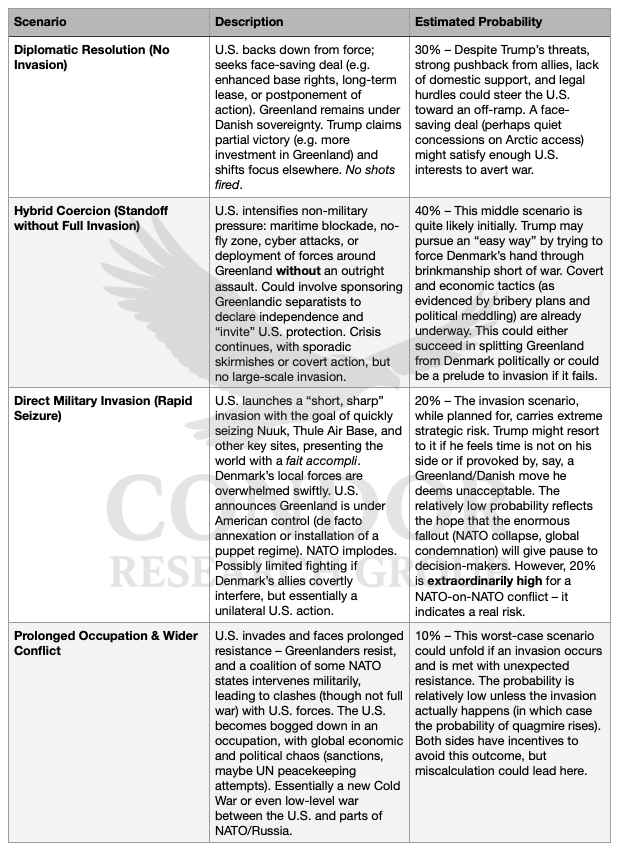
(Percentages are rough estimates based on current information. They sum to 100% across scenarios. Actual outcomes may shift as the crisis evolves. The values could serve as initial values for tracking with Bayesian analysis.)
Current indicators slightly favor the Hybrid Coercion path in the immediate future. The Trump administration is likely to try coercive and political tactics first, as suggested by experts and some officials. For example, Secretary Rubio has emphasized the intent to purchase Greenland if possible; “That’s always been the president’s intent from the very beginning”, and Leavitt noted Trump’s “first option, always, has been diplomacy”. This suggests that if a deal or non-violent solution can be found (even one coercive toward Denmark), Trump would prefer it to ordering an invasion that could spiral out of control. Indeed, Anna Wieslander of the Atlantic Council assesses that the Venezuela operation followed immediately by Greenland threats “in the short run, made [an invasion] more likely” (signaling momentum), but she and other European experts still treat the actual use of force as something to be deterred with serious pushback .
On the other hand, time is a factor. Trump likely feels he must secure Greenland before the end of his term (2028) lest the opportunity slip away. His impatience was evident when he revived the issue, saying the U.S. needs Greenland “very badly, as a national security imperative”. If months of standoff pass without Denmark yielding, Trump could decide to act militarily by late 2026 or 2027, calculating that election dynamics or other events might constrain him later. Mearsheimer’s view is that given Trump’s bold track record and the ability to “portray [an invasion] as a pinprick,” there’s “a really good chance that he could take Greenland” unless effectively deterred. That “really good chance” might be on the order of 50-50 in his mind, but our table above averages it out with other inputs to around 20–30% chance of actual invasion at this juncture.
In conclusion, the probability of a U.S. invasion of Greenland in 2026–2027 is uncomfortably high for a scenario that would shatter seven decades of alliance norms. Diplomatic and hybrid approaches are slightly more likely in the immediate term, as Washington tests whether Greenland can be coerced “the easy way.” But make no mistake: the risk of Trump choosing the “hard way”; sending in troops, is real. All actors are treating it as a credible threat, which is itself a destabilizing reality. As Danish PM Frederiksen said, “unimaginable” has quickly become “possible”, and now Europe and the world must plan accordingly.
2. Likely U.S. Military Strategy: Rapid Seizure, Hybrid Tactics, or Long-Term Occupation
Should President Trump decide to proceed with taking Greenland, the United States faces a strategic choice in how to execute the operation. Broadly, three approaches are on the table (potentially sequentially): (a) a rapid “shock-and-awe” seizure of key objectives to force a quick capitulation; (b) hybrid or gray-zone tactics to achieve control through subversion, political manipulation, and minimal overt force; and (c) preparations for a long-term occupation, implying willingness to garrison and govern Greenland against resistance. These are not mutually exclusive; indeed, a likely U.S. plan might integrate hybrid tactics as a prelude or accompaniment to a lightning military strike, with an occupation force ready to deploy if needed.
2.1 Rapid Seizure (“Short and Sharp” Operation)
A fast, decisive strike is tactically attractive to U.S. planners because it leverages overwhelming American military superiority to minimize actual fighting. In this concept, the U.S. would aim to neutralize any Danish/Greenlandic resistance within days (or even hours), thereby presenting the world with a fait accompli before opponents can coordinate a response. One defense expert quoted by ABC News opined that if the U.S. did go ahead with invasion, it would be “very short and sharp”; reflecting the expectation that Denmark “would be no match” and likely unable (or unwilling) to put up prolonged resistance. The U.S. enjoys massive advantages: local U.S. presence, vast airlift and power projection capabilities, and the element of surprise.
A rapid seizure strategy would center on a simultaneous multi-axis strike at Greenland’s critical nodes:
- Airfields: Control of airfields is paramount, given Greenland’s size and the need to fly in troops. The U.S. already controls Pituffik (Thule) Air Base in the far north. The other key airfields (civilian/military dual-use) include Nuuk (the capital), Kangerlussuaq (the largest runway in SW Greenland), Narsarsuaq in the south, and Illulissat and Qaanaaq (smaller strips). Expect U.S. special forces to target these. For example, the 75th Ranger Regiment, which specializes in airfield seizures, would likely drop onto Kangerlussuaq or Nuuk in the opening hours. Their job: overwhelm any local garrison or airport security and hold the runways for incoming transports.
- Ports and coastal approaches: Greenland has a few deepwater ports (Nuuk, Sisimiut, etc.). The U.S. might insert Marine Corps units via amphibious ships or helicopters to secure port facilities, ensuring sea lines for heavy equipment delivery. A Marine Expeditionary Unit aboard an Amphibious Ready Group could rapidly occupy Nuuk’s harbor, for instance, with tanks and armored vehicles coming ashore to provide on-ground firepower.
- Communication & Government Centers: A Delta Force or SEAL Team could be tasked with raiding government buildings in Nuuk – essentially a decapitation strike to detain Greenland’s political leadership (the Prime Minister, ministers) and any Danish officials. Unlike Venezuela, where capturing Maduro was central, in Greenland the emphasis is on “capturing infrastructure, not a leader,” since the ultimate goal is control of territory. Still, neutralizing local leadership would help prevent organized resistance. U.S. cyber units would also likely target Greenland’s communications, cutting internet and radio to isolate the populace and prevent coordination with Denmark.
- Pituffik/Thule Base: Interestingly, Thule (now officially Pituffik Space Base) might not be assaulted since it’s already a U.S.-operated installation (with Danish liaison presence). However, its assets are crucial. Thule houses a powerful early-warning radar and space tracking station. Because of its strategic importance (tied into nuclear missile warning systems), the U.S. would reinforce Pituffik but also exercise extreme caution; they must prevent any accidents or mis-signals that Russia could misinterpret as a strategic missile launch. So U.S. forces at Pituffik would likely hunker down defensively to ensure no party (Danish loyalists or others) tampers with the radar. The importance of Thule is such that “hands off the nukes and adjacent warning systems” would be a mantra; meaning U.S. would avoid any action that could trigger a misunderstanding with Russia’s nuclear forces . This could effectively constrain fighting around Thule.
The force composition for a rapid seizure draws from elite, readily deployable units:
- Joint Special Operations Command (JSOC) units – Delta Force, SEAL Team Six; for surgical assaults on high-value targets (government HQ, perhaps taking control of Greenland’s small military/police barracks).
- 82nd Airborne Division (Global Response Force) – one brigade can be wheels up within 18 hours. Paratroopers could drop in to secure secondary sites or reinforce Special Forces at captured airfields.
- Air Mobility Command – dozens of C-17 and C-130 transport aircraft would airlift troops and supplies once airstrips are held . Given distances (U.S. East Coast to Greenland is ~4,000 km), aerial refueling (KC-135, KC-46 tankers) would be on standby to support both transports and fighter coverage .
- Air supremacy fighters – F-22s and F-35s to ensure any Danish or allied aircraft cannot interfere. Denmark’s Air Force has modern F-35s, but likely few would be in Greenland at the moment of attack; if Norway or Canada tried to fly in jets to assist Denmark, the U.S. would use stealth fighters to control the skies. U.S. electronic warfare (EA-18G Growlers) would jam communications and any Danish radar.
- Naval Task Force – A Carrier Strike Group (with, say, F/A-18E/F fighters and cruise missiles) would probably patrol the North Atlantic to deter any other naval forces from intervening. The U.S. might also station attack submarines near Greenland’s coast to act as unseen sentinels, raising the stakes for any third-party ships entering a quarantine zone. Additionally, a fleet of logistical support ships would trail; because even a short operation needs a lot of fuel and supplies in the Arctic environment.
The mantra for the rapid strike is speed and surprise. One can analogize it to the 2003 U.S. invasion of Iraq’s opening phase (the “shock and awe”), but on a much smaller scale and without expecting combat with a standing army. A better analogy might be the 1983 U.S. invasion of Grenada or the 1989 invasion of Panama; both were swift operations to topple a government or seize territory with minimal casualties, relying on overwhelming force at key points. The difference is Greenland’s geography (huge but sparsely populated) and weather (Arctic conditions complicate timing; winter operations would be extremely harsh with limited daylight). The U.S. might prefer a summer window for any large deployment, meaning if an invasion hasn’t occurred by autumn 2026, the next viable period might be spring/summer 2027. However, Trump’s recent actions (attacking Venezuela in January) show willingness to act even in less-than-ideal seasons, perhaps counting on the element of surprise when adversaries least expect it.
A scenario for a rapid seizure could unfold like this (hypothetical timeline):
- H-Hour (Surprise Airborne Landing): In the pre-dawn darkness, stealthy special ops helicopters (MH-47G, MH-60) from the 160th Special Operations Aviation Regiment; likely having staged from a U.S. base in Canada or from an aircraft carrier, insert Delta Force teams into Nuuk and other strategic sites . Simultaneously, Air Force transport planes drop Ranger companies onto Kangerlussuaq and maybe Nuuk’s airport. Within the first 2–3 hours, these forces aim to secure runways and key installations with minimal shooting (ideally overawing any local guards).
- Day 1 (Secure the Air Bridge): Once airfields are in U.S. hands, waves of C-17 aircraft fly in additional troops (e.g. the rest of the Ranger battalion, an airborne infantry battalion) along with light armored vehicles. The priority is to establish a secure “air bridge” so U.S. reinforcements and supplies can flow unimpeded. F-35 fighters out of U.S. bases in the northeast or from the carrier ensure no Danish or allied aircraft approach. Notably, the mission is not to attack Denmark proper, U.S. forces would scrupulously avoid any strike on Danish soil, focusing purely on Greenland, to limit the legal and moral transgression .
- Day 2 (Consolidation): U.S. Marines arrive by sea or air to take control of coastal towns and secondary settlements. Given Greenland’s small population, a psychological operation might commence – broadcasting messages that the U.S. is “liberating” Greenland from Danish neglect or preventing Chinese intrusion, etc. By this time, the U.S. flag might be raised over the Nuuk government complex, and a pro-U.S. figure (perhaps from Naleraq party) could be presented as part of an interim authority cooperating with U.S. commanders.
- Minimal Casualties Aim: In all of this, U.S. strategy banks on Danish forces standing down. Denmark’s troops in Greenland consist of a few hundred personnel of the Sirius Dog Sled Patrol (who monitor remote areas) and the Danish Arctic Command (with small naval vessels and a company of troops). Confronted by overwhelming U.S. force, it’s likely most would refrain from fighting; some may retreat or be detained peacefully. Professor Donald Rothwell notes he “can’t see Denmark wanting to militarily resist in any significant way”, even suggesting Copenhagen would fear worse attacks if they did (e.g. on mainland Denmark) . Thus, the U.S. could conceivably pull off an occupation of Greenland without large-scale violence, fulfilling Trump’s desire for a seeming “clean win.”
2.2 Hybrid Tactics and “Hard Power” Posturing
Even as the Pentagon prepares for the above, the U.S. is already employing a suite of hybrid tactics; a blend of political, economic, and informational warfare, to soften the target and possibly achieve strategic aims without full invasion. National Security experts describe Trump’s opening moves as coercion and subversion: “coercion, pressure, blackmail, direct or indirect subversive activities or extortion” are expected to be in the playbook. The goal of hybrid tactics would be to force a change in Greenland’s status with minimal overt combat, by eroding the will of Greenlanders and Danes to resist U.S. designs.
Key elements of the hybrid approach include:
- Economic Incentives (“Carrot”): As reported, the Trump administration is considering literally paying Greenlanders to acquiesce. A floated proposal would give every Greenlandic resident between $10,000 and $100,000 in cash as a signing bonus if Greenland “joins” the U.S. . Such a massive direct payout (totaling $0.5–5 billion) is unprecedented but is aimed at turning public opinion or at least creating a constituency in Greenland that sees personal benefit in U.S. annexation. Additionally, Trump could promise major infrastructure projects; ports, hospitals, housing, essentially a Marshall Plan for Greenland to outshine what Copenhagen provides. This might sway some minds in a population that, while proud, also faces economic challenges and might welcome development.
- Political Manipulation: The U.S. is likely covertly cultivating local allies in Greenland’s political landscape. We see overt evidence: opposition leader Pele Broberg of Naleraq openly calls for dialogue with the U.S. without Denmark. It is plausible that U.S. diplomats or intelligence have assured Broberg and similar figures that if they facilitate a transfer of allegiance, they could lead an “independent” Greenland under U.S. auspices. Naleraq’s idea of a “free association” (like Palau or Marshall Islands have with the U.S.) might be encouraged as a stepping stone . In a hybrid scenario, Washington could seek a “Greenlandic Declaration of Independence” engineered through the local parliament (Inatsisartut), perhaps during a moment of high tension with Denmark. If a faction of Greenlandic politicians declared independence and requested U.S. protection, Trump could claim legitimacy for intervention (invited by “the new sovereign Greenland”). This is the “easy way” Trump alludes to: effectively splitting Greenland from Denmark politically so the U.S. can enter by invitation.
- Information Warfare: U.S.-based media and social media campaigns may target Greenlanders and Danes with narratives supporting U.S. action. For example, messaging that “Russia and China covet Greenland and only U.S. protection can save it” is already being pushed by Trump (“we’re not going to have Russia or China as a neighbor” ). There may also be attempts to sow distrust between Greenland and Denmark; highlighting any historical grievances Greenlanders have (e.g. past colonial policies, Danish funding shortfalls) to suggest Greenland would be better off cutting ties. Conversely, propaganda to the American public downplays the conflict: official statements frame it as protecting freedom or countering adversaries. By controlling narratives, the U.S. aims to reduce domestic opposition and fragment Greenlandic unity.
- Cyber and Electronic Operations: Expect the U.S. Cyber Command to engage in cyberattacks to disable Danish governmental communications with Greenland and to protect U.S. operations. There might be efforts to hack Greenland’s voter rolls or government databases, perhaps to manipulate or gather compromising information on officials. Electronic warfare units could jam Greenland’s communications selectively at critical moments (for instance, preventing Danish commanders in Greenland from receiving orders when an operation commences).
- Legal and Diplomatic Pressure (“Stick”): The U.S. can also use lawfare or sanctions. It might, for example, threaten Danish commercial interests: Trump could impose tariffs on Danish products or restrict U.S.-Denmark trade if Denmark “does not cooperate” on Greenland (leveraging America’s market power as extortion). Already, some hints of this emerged: Europe fears Trump could divide Europe through tariffs or other punitive measures in context of Greenland. Another angle: the U.S. might challenge the 1951 Denmark-U.S. base treaty’s interpretation, claiming Denmark violated some term, to justify unilateral actions. Or, recognizing Denmark’s dependence on Greenland for strategic weight, the U.S. might quietly offer, then withdraw, security cooperation in other areas as a pressure tactic (e.g. “if you don’t sell us Greenland, we won’t defend you against Russia”). While extreme, these tactics underscore that the U.S. has numerous levers short of shooting to coerce Denmark.
The hybrid campaign is already underway, as evidenced by multiple 2025–26 developments. For instance, Reuters reported that Trump’s team demanded the newly installed Venezuela (post-Maduro) regime cut ties with China and others; this kind of maximalist demand signals the U.S. pushing a broader hemispheric agenda (Monroe Doctrine revival) that includes Greenland. Also, the mere appointment of a special U.S. “Envoy to Greenland” last year (which Denmark protested ) was part of soft-power encroachment, attempting to deal with Greenland over Copenhagen’s head.
We should note a hybrid approach dovetails with a gradual military presence increase short of invasion. The U.S. might try to deploy additional “defensive” assets to Thule/Pituffik under the guise of countering Russia, essentially slipping more troops onto Greenland soil pre-crisis. Also, the U.S. Coast Guard could make “freedom of navigation” patrols around Greenland to assert a presence, or even stage “exercises” near Greenland with the implicit threat that exercise forces could quickly become an occupying force.
From a strategic standpoint, hybrid tactics serve two purposes: they might succeed alone (forcing Greenland’s alignment shift without war), or they set conditions that make any eventual invasion easier. Keir Giles pointed out that Trump’s likely opening moves are indeed these coercive, possibly clandestine measures . If Greenlanders were bribed or politically split, an invading U.S. force might land to find a portion of the population welcoming them or at least a demoralized opposition. Conversely, if hybrid efforts fail and solidify Greenlandic/Danish resistance, Trump might conclude only a brute force solution remains, accepting more risks.
2.3 Long-Term Occupation Strategy
If the U.S. succeeds in seizing Greenland, it must then confront the challenge of holding and governing it. A long-term occupation (beyond a quick regime-change operation) brings immense demands: troop rotation, local administration, dealing with potential insurgency (as covered in Section 4), and international management of what will be seen as an illegitimate conquest. Nonetheless, the U.S. military appears to be preparing for the necessity of “staying power” in Greenland if ordered.
A U.S. occupation force would likely be structured as follows:
- Initial Stabilization Force: After the “first wave” of Rangers, Marines, etc., the Pentagon would rotate in a more sustainable force. Analysts suggest at minimum a brigade-sized footprint (approximately 4,000 troops) to secure key zones like Nuuk, Thule, and Kangerlussuaq. This could be drawn from Arctic-experienced units. Notably, the U.S. Army’s 11th Airborne Division (based in Alaska) and the 10th Mountain Division have been intensively training for Arctic warfare, participating in exercises in Finland and Norway. Elements of those units could be tasked to Greenland occupation, given their cold-weather gear and survival skills.
- Support and Infrastructure: Army Corps of Engineers units would be critical to maintain airfields, repair any damage, and perhaps expand facilities for long-term use. Greenland’s limited infrastructure means the occupiers must ensure runways, ports, and power sources stay operational year-round. Construction of new bases or expansion of Thule might be on the agenda to house troops and assets (e.g. building more heated hangars and housing).
- Force Protection: An occupation force would deploy air defense systems (such as Patriot missile batteries) to guard against any hypothetical air threat; perhaps not from Denmark, but conceivably if things spiraled, from European coalition strikes or even Russian probing. Counter-drone and counter-sabotage units would also be on high alert, given the risk of small-scale attacks.
- Logistics and Sustainment: The environment is punishing; a large rotation of search-and-rescue teams, medevac units, and winter warfare specialists (possibly drawn from National Guard units in Alaska, Vermont, etc.) would be needed . The U.S. Navy’s Military Sealift Command would have to run a near-constant supply shuttle of fuel and provisions from North America, since local supplies are scant. This is why controlling sea lanes is critical; without secure lines of supply, an occupation falters quickly in the Arctic.
- Administration and Governance: The U.S. might set up a military governorship or use a proxy local government. Possibly a U.S. senior official (maybe styled an “Administrator of Greenland”) would be installed. The challenge is enormous: how to run civil services for 57,000 people who resent your presence? The U.S. might try to recruit Greenlandic police or officials with promises of high pay, while replacing Danish laws gradually with U.S. military law. It could declare martial law initially to suppress protests. In the longer run, if annexation is intended, steps would be taken to incorporate Greenland legally as a U.S. territory (though that would face challenges both in Greenland and in U.S. Congress).
Strategists like McFaul warn that any annexation attempt would lead to permanent estrangement from a key ally (Denmark) and likely unmanageable burdens. The U.S. would lose more in global standing and alliances than it gains in territory or resources. But if Trump proceeds regardless, the Pentagon’s posture and training indicate they want troops who “can live and operate in misery without collapsing,” an almost darkly humorous but apt description of Arctic duty . In recent years, the U.S. Army and Marines have refocused on cold-weather operations, precisely to ensure units are capable in places like Greenland. The motto might be “prepared for the worst”: if an occupation becomes a drawn-out, painful mission due to local resistance or international harassment (e.g. Europe imposes embargoes making resupply costly), the U.S. wants forces that can tough it out.
One likely U.S. military strategy in an occupation is to concentrate control on critical areas and ignore the rest. Given Greenland’s vast empty expanses, the U.S. could adopt a “hub and spokes” model: fortify hubs (Nuuk, Thule, perhaps one southern port and one eastern airstrip like Constable Point near Ittoqqortoormiit) and maintain air/sea patrols between them, while not attempting to physically occupy every settlement. Outlying towns might be left under nominal local administration as long as they don’t challenge U.S. authority. This reduces the footprint needed and avoids spreading forces too thin. However, it also gives space for any insurgents to operate in the gaps (though Greenland’s geography; mostly uninhabitable ice cap, limits guerrilla hideouts to the coasts and mountains). The U.S. might leverage technology (drones, satellites) to monitor unoccupied zones rather than patrolling them with soldiers.
We should also consider how long the U.S. is prepared to hold Greenland. Trump’s rhetoric suggests he views it as permanently American once taken (“make it part of the United States” ). That implies an indefinite occupation or integration. U.S. military plans likely have milestones: secure in days, pacify in weeks, consolidate in months. But what about years? If by 2027 an occupation faces continual unrest or crippling sanctions, the U.S. could be pressured to withdraw. So part of the strategy might be to quickly seek legitimacy moves: e.g. organize a “referendum” under U.S. supervision where, perhaps through intimidation or propaganda, a vote is managed to show Greenlanders “choosing” to join the U.S. (even if the world calls it sham). This could be used to bolster a claim that the occupation is turning into a legitimate transfer of sovereignty, thus justifying a longer stay.
Finally, U.S. planners must anticipate potential military opposition even after initial success. While Denmark might not fight initially, what if a coalition of Nordic states later tries to land forces on Greenland to contest U.S. control? As discussed, a few nations might covertly aid a Greenland resistance. The U.S. military strategy would thus involve turning Greenland into a hard target: establishing robust anti-access/area denial (A2/AD) capabilities around it. This means having fighter jets on station, SAM batteries, and naval patrols such that any foreign attempt to intervene is deterred or can be intercepted. Essentially, after taking Greenland, the U.S. would fortify it almost like a Cold War outpost.
In conclusion, the likely U.S. approach blends these strategies:
- Start with hybrid measures (political pressure, bribery, information war) to destabilize Danish control and preferably arrange a handover without full conflict.
- If that fails or stalls, execute a rapid, overwhelming strike to seize control before the world can react. Use speed and force concentration to minimize fighting.
- Follow through with an occupation posture geared towards holding key infrastructure, leveraging specialized Arctic-trained troops, and deterring any counter-intervention.
- Throughout, manage the narrative to frame actions as defensive or necessary (e.g. invoking the threat of China/Russia in Greenland), in hopes of muting backlash.
This three-pronged strategy reflects both confidence and concern: confidence that militarily Greenland can be taken (“with little or no loss of life” as McFaul said ), but concern that politically it could become a fiasco unless either very quick or somehow justified by Greenlandic consent. The Trump administration appears willing to run this risk, preparing for scenarios ranging from a near-bloodless coup (Greenland flips allegiance internally) to a full military campaign in Arctic conditions; a testament to how strategically valuable Greenland is seen in Washington’s eyes. The next sections, however, show that Denmark, Greenlanders, and the international community are equally determined to make any U.S. military adventure as costly and difficult as possible.
3. Denmark’s Expected Political, Diplomatic, and Military Response
Denmark faces what is arguably the greatest threat to its sovereignty in modern history. Its response is multifaceted; combining political resolve, diplomatic mobilization, and limited military precautions, all aimed at protecting Greenland and deterring the United States from using force. However, Denmark must also reckon with its own constraints: militarily, it cannot win a fight against the U.S., and politically, it is defending control over a territory that openly seeks eventual independence. Copenhagen’s approach, therefore, is to invoke international law and alliances, hoping that the weight of global condemnation and alliance principles will restrain Washington.
Political Stance – “Firm but Measured”: From the outset, Danish leaders have adopted an unyielding public stance against Trump’s demands. Prime Minister Mette Frederiksen has emerged as a symbol of resistance. She famously stated that “Greenland is not for sale” back in 2019, and now in 2026 she has escalated the rhetoric: any U.S. attack on Greenland = attack on Denmark = end of NATO and post-WWII security order. This statement serves a dual purpose: it signals Denmark’s seriousness (willing to invoke the NATO charter consequences) and simultaneously warns the U.S. that it would be isolating itself by such an act. Frederiksen’s government, which includes Greenlandic representatives in its deliberations, has emphasized Greenlanders’ right to self-determination. They cite the legal fact that Greenland’s status can only change with Greenlanders’ consent and Danish approval. By foregrounding this, Denmark positions itself as upholding democratic principles; painting the U.S. as the aggressor against the will of the people of Greenland.
At the same time, Denmark’s tone remains one of regretful astonishment rather than antagonism toward the U.S. There’s a conscious effort not to provoke Trump further. For instance, after Trump’s latest remarks, the Danish Foreign Minister Lars Løkke Rasmussen called for replacing the “shouting match” with “sensible dialogue, now”. This suggests Denmark is leaving space for the U.S. to step back without humiliation. Politically, Denmark is trying to rally domestic unity. All major Danish parties, including the opposition, have expressed support for the government’s handling of the Greenland crisis; a bipartisan consensus that Danish sovereignty and alliance norms must be defended.
Notably, Denmark has also been transparent with its public about the stakes. By invoking the potential end of NATO, Danish leaders are preparing their citizens (and Greenland’s) for the gravity of what might come, while sending a message to Washington about how far-reaching the consequences would be. It’s a delicate balance: show resolve without closing off dialogue. So far, Frederiksen and Greenland’s Prime Minister (currently Jens-Frederik Nielsen in scenario ) presented a unified front; even issuing joint statements as mentioned. This unity between Copenhagen and Nuuk is crucial; it undercuts any U.S. narrative that it’s “liberating” Greenland from Denmark.
Diplomatic Response – Rallying Allies and International Law: Denmark’s primary recourse is diplomacy. Recognizing it cannot defend Greenland alone by force, Copenhagen is maximizing international diplomatic pressure on the U.S. to either deter action or build a coalition to oppose it. This effort has several layers:
- NATO and Bilateral Allies: Denmark immediately sought support from NATO allies. Even if NATO as an institution is stymied by U.S. veto (as discussed), Denmark has received strong public assurances of support from key members. Germany and France have been particularly vocal. A German government source told Reuters that Berlin is “closely working together” with other allies on a plan to support Greenland . France’s foreign minister Barrot confirmed that European nations “want to act… if the US moves to seize Greenland” and will do so jointly . These statements likely stem from behind-the-scenes Danish diplomacy. Denmark’s appeal is simple: today it’s my territory under threat, tomorrow it could be any smaller nation facing a powerful aggressor, so stand with us now. The result has been a wave of European solidarity; from EU institutions to national governments; rallying behind Denmark. Even the UK (historically very close to Washington) reportedly signaled firm support for Danish sovereignty in private, though perhaps more quietly in public.
Within NATO, Denmark invoked Article 4 (consultations) as soon as Trump’s intentions became clear. Finland’s NATO parliament delegate called for addressing the issue inside NATO to bring the U.S. “into line”, indicating regional push for NATO to deal with it. Denmark would use NATO fora to confront U.S. officials with unified opposition at every turn; forcing, for instance, the U.S. Ambassador to NATO to hear 29 allies condemn the notion of attacking Denmark. While this may not stop Washington, it contributes to a narrative of isolation.
- European Union: As covered in Section 5, the EU as a bloc has taken a strong stance: Council President Costa explicitly said the EU will not accept such violations. Denmark has leveraged its EU membership to ensure Greenland’s cause is Europe’s cause. Copenhagen likely initiated emergency discussions in the European Council and with the European Commission about responses if the U.S. escalates. The EU has offered political statements and is preparing practical support; e.g. legal action through international courts, or economic measures (the EU can coordinate sanctions among member states against the U.S. if needed, albeit that is a nuclear option diplomatically).
Additionally, Denmark has likely asked NATO European allies to consider a peacekeeping presence or monitoring mission in Greenland; something to increase the political cost for the U.S. to intervene (as Keir Giles suggested). There’s no public confirmation, but given that a European plan is being worked on if the U.S. follows through, it might include stationing European personnel in Greenland on Danish invitation, even symbolically.
- United Nations: Denmark has turned to the UN to frame the issue as one of international law. Though the U.S. can veto any Security Council resolution, Denmark has the option of using the UN General Assembly. Indeed, European diplomats have contemplated bringing the matter to the General Assembly to condemn the threat of force. Denmark would spearhead a resolution affirming the principle that no state may acquire another’s territory by threat or use of force (echoing language from the UN Charter and GA Resolution 2625). This could garner widespread global support and produce a moral victory for Denmark; a likely overwhelming majority of nations would side with Denmark, further isolating the U.S. While such a resolution is not enforceable, it heightens reputational costs for Washington.
Meanwhile, Denmark could also seek to involve the International Court of Justice (ICJ) pre-emptively, perhaps asking for an advisory opinion on the legality of any U.S. claim over Greenland. The ICJ route is slow, but Denmark may think in terms of building a long-term legal bulwark.
- Nordic and Arctic Partnerships: Denmark is a member of the Nordic Council and has close ties with Norway, Sweden, Finland, and Iceland. These countries have been staunch supporters; not only out of friendship, but because the idea of the U.S. throwing its weight around in the Arctic alarms them. Norway especially, as a neighbor to Greenland in the Arctic, has reportedly been part of joint military exercises there. The Nordic foreign ministers likely coordinated statements. Notably, Iceland (which has a defense agreement with the U.S. but is a small state) is likely sympathetic to Denmark due to its own history with big allies. We have seen historical precedence: in the Cod Wars between the UK and Iceland (two NATO allies), NATO pressure and U.S. mediation eventually forced the UK to back down to preserve alliance unity. Denmark might hope for a similar dynamic; that allies like the UK, who have Trump’s ear, will counsel restraint to avoid blowing up NATO.
As an Arctic state, Denmark via Greenland is on the Arctic Council. Diplomatically, Denmark can convene or use the Arctic Council (minus the U.S., if need be) to decry the militarization of an Arctic dispute by the U.S. and possibly suspend U.S. participation in Arctic forums if it acts aggressively.
- Global South Outreach: It’s likely Denmark has quietly reached out to influential countries beyond the West; e.g. India, Japan, Australia, African and Latin American nations, to garner statements of support. For example, if emerging powers say “we stand for Denmark’s sovereignty over Greenland,” it underlines the broad principle at stake. This is not heavily reported, but Denmark’s diplomats would be making the case that allowing a powerful country to snatch territory sets a dangerous precedent for everyone (resonating particularly for countries that fear neighbors). Some might recall that after WWII, the U.S. itself insisted on non-annexation principles, a point Denmark can use.
In essence, Denmark’s diplomatic response is to internationalize the crisis as much as possible, converting a lopsided U.S.-Denmark dispute into a U.S.-vs.-World issue. The Reuters piece captured a bit of Denmark’s uncomfortable position: “Denmark is rallying support to protect a territory whose population wants independence”, highlighting the irony that Denmark is fighting hard to keep Greenland only to possibly let it go in the future. Denmark’s foreign ministry and PM are aware of this irony; however, they frame it not as colonial hang-on, but as upholding a legal process and protecting Greenland’s people from unwanted rule. They stress they are defending principle, not just territory: “You cannot annex another country… Greenland belongs to the Greenlanders.” This principle-based framing has been effective in galvanizing allies.
Military Response – Cautious and Symbolic Defense:
While Denmark cannot wage war on the U.S., it is not entirely without military responses. Copenhagen’s challenge is to show determination to defend itself without triggering a premature confrontation that it would lose.
Key military actions/considerations for Denmark:
- Invocation of Article 5: Legally, if U.S. forces attack Greenland, Denmark can claim Article 5 (collective defense) of NATO. Frederiksen explicitly warned it: “If the U.S. chooses to attack… everything stops, including NATO security since WWII” , indicating Denmark views it as an Article 5 situation. In practice, as discussed, NATO might not function, but Denmark likely will still formally invoke Article 5. This compels each NATO member to at least “assist” Denmark as it deems necessary. The significance is political: it forces every ally to publicly choose whether to consider the U.S. an aggressor. This would be unprecedented and probably collapse NATO, but Denmark might do it to maximize pressure. It is basically the last-resort call for help.
- Defense of Greenland on-site: Denmark has a modest military presence in Greenland under the Joint Arctic Command. This includes the Sirius Patrol (small units patrolling by dogsled in the far north), some Danish Navy inspectors with patrol ships (Knud Rasmussen-class vessels), and a company-sized unit of Danish Special Forces or Arctic Response Force that occasionally rotates through for training. In late 2025, Denmark conducted a joint drill in Greenland with other allies (photo evidence by Reuters of Danish, German, French troops training in Kangerlussuaq ). This exercise was likely a direct response to rising tensions, meant to improve readiness. Should an invasion threaten, Denmark might deploy whatever troops it can to Greenland preemptively. For instance, it could send a detachment of the Jaeger Corps (Danish Special Forces) or Frogman Corps (naval special ops) to liaise with Greenlandic authorities and prepare for possible sabotage or intelligence roles during any U.S. operation. Realistically, these few troops cannot stop a U.S. invasion, but they could carry out early warning or limited sabotage (blowing up an airfield if about to be captured, etc.).
Denmark could also discreetly fly in a handful of fighter aircraft. However, sustaining them in Greenland is difficult (no support infrastructure outside Thule, which the U.S. controls). More likely, Denmark (and perhaps Norway/Canada) have quietly moved some maritime and air assets near Greenland’s periphery – for example, a Danish frigate could patrol near Greenland’s Atlantic approaches, and Danish surveillance aircraft (or allied P-8 Poseidon patrol planes) might monitor U.S. ship movements. The aim would be to track any impending assault.
- Rules of Engagement: If U.S. forces arrived, it is expected that Denmark would avoid open combat to prevent bloodshed, unless perhaps fired upon. This is a painful stance: essentially yielding militarily to avoid massacre. A Danish defense official might conclude, as quoted, “I just can’t see a Danish PM wanting to even allow the possibility” of direct clashes, given the U.S. could devastate Denmark proper if provoked . That said, small-scale Danish resistance in Greenland cannot be ruled out. Perhaps a Danish patrol boat might refuse orders to leave and has a standoff with U.S. ships, or Danish troops at a radar station barricade themselves initially. But orders from Copenhagen would likely instruct Danish forces not to fire on Americans, to prevent giving the U.S. a pretext to escalate.
- Covert Operations and Intelligence: Denmark’s intelligence service (DDIS) and special forces might pivot to a covert campaign if invasion occurs. They could assist Greenlandic volunteers in forming an underground resistance (training them in sabotage, providing encrypted comms). Denmark has highly capable special forces that operated alongside Americans in Afghanistan; these could ironically now be repurposed to covertly frustrate U.S. occupiers. It’s risky, as capture of Danish operatives by U.S. forces could cause an incident, but Denmark might consider it a legitimate defense measure under occupation.
Intelligence-wise, Denmark will share all relevant intel with allies and likely receive intelligence from allies about U.S. deployments (e.g. European states might leak info on U.S. forces moving, to help Denmark prepare). This info can be used diplomatically too (“we know you’re assembling forces, we will expose this at UN”).
- Homeland Defense Considerations: Although an American attack on continental Denmark is extremely unlikely (and not at all signaled by the U.S.), Danish defense planners must consider worst-case. The mention by Prof. Rothwell that Denmark would fear U.S. strikes on Copenhagen is theoretical, but Denmark has likely alerted its national defense forces to a higher readiness just in case. Danish air defense around Copenhagen and key infrastructure might quietly go on alert in case of any unpredictable event. Article 5 would traditionally guarantee U.S. defense of Denmark; now Denmark might ironically ask European neighbors like Germany or Poland to increase readiness to help defend Denmark itself if things truly spiraled. This scenario is remote but shows how upside-down this crisis is.
Summary of Denmark’s Approach: Denmark is effectively playing for time and global support. Militarily, it cannot stop a determined U.S.; so its aims are to delay and deter. Delay, in hope that diplomatic pressure builds or that Trump reconsiders. Deter, by signaling that even if Denmark cannot win, the costs (political, moral, long-term) to the U.S. will be massive. There’s also an implicit trust that American institutions or people might restrain Trump if confronted with the abyss of fighting an ally. By rallying NATO and the EU, Denmark likely hopes influential Americans (Congress members, generals) will counsel Trump that this path is too ruinous.
Denmark’s expected behavior in a crunch moment (say U.S. forces en route) would be to maintain a non-provocative defense: not attack first, but possibly invoke legal measures (like Article 5) and demand emergency UN Security Council meetings to buy every minute. Danish officials would also keep communication lines with Washington open – perhaps offering last-minute compromises (“more American investment? Extended base rights?”) to stave off conflict.
In sum, Denmark will stand diplomatically firm; it cannot and will not agree to any transfer of Greenland under duress, but militarily it will act with caution, aware of its limitations. As a Danish commentator put it, Denmark is in “patriotic overdrive” to hold onto Greenland now, even if Greenland might leave peacefully later. It’s a matter of principle and survival of international norms. Denmark’s fight, therefore, is being waged in meeting rooms, on the airwaves, and through treaties, doing everything possible short of direct military conflict to prevent the unthinkable rupture that a U.S. invasion would bring.
4. Greenland’s Internal Political Alignment, Risk of Insurgency, or Civil Resistance
Greenland, though small in population, is not a passive prize in this crisis, it is an active political actor with its own interests and divisions. As the U.S. presses its claim, Greenlanders have overwhelmingly indicated they do not consent to becoming part of the United States. However, there are nuanced internal dynamics: a shared national desire for independence from Denmark (in the long run), differing opinions on the timeline and means of achieving that independence, and a nascent debate on whether aligning with the U.S. might serve Greenlandic interests or endanger them. We also must assess how Greenlanders might resist an imposed change; whether through political mobilization, civil disobedience, or even armed insurgency, if American forces attempt to assert control.
Greenlandic National Sentiment – “Not for Sale, Not for Taking”: Public opinion in Greenland is staunchly against Trump’s approach. Greenland’s people have been vocal since 2019 that they are not commodities to be traded. The chair of SIK (Greenland’s largest workers’ union) famously rebuked Trump’s suggestion to purchase the island, saying “We are not for sale.” This sentiment has only hardened with the threat of force. A late-2025 poll indicated a whopping 85% of Greenlanders reject the idea of joining the U.S. . That figure shows near-consensus – critical in a population of ~57,000, where social cohesion is strong. Culturally, Greenlanders (who are mostly Inuit or mixed Danish-Inuit) have been gradually asserting their national identity and rights, culminating in the 2009 Self-Rule Act which explicitly gives them the right to independence if they choose . They cherish this right to chart their own destiny. An American diktat essentially steals that choice, replacing one foreign administrator (Denmark) with another (the U.S.) without their consent.
The Greenlandic government; the Naalakkersuisut, reflects this popular will. The former Prime Minister Múte Egede has stood alongside Denmark’s PM stating that Greenland’s fate cannot be decided over its head. Greenland’s Foreign Minister Vivian Motzfeldt reinforced that Greenland cannot legally negotiate foreign affairs alone and thus will not entertain separate U.S. talks, effectively backing Denmark’s process. This is important: the official Greenlandic stance is aligned with Denmark’s in opposing the U.S. threats. Greenland’s parliament (Inatsisartut) has likely passed a resolution condemning Trump’s statements and affirming that Greenland is not for sale or annexation.
However, underlying this unity are political factions with different visions of the future:
- The current governing coalition (often dominated by either the left-wing Inuit Ataqatigiit or the social-democratic Siumut party) has traditionally taken a measured approach to independence: seeking more autonomy step by step, cooperating with Denmark, and diversifying international partnerships (including with the EU and potentially the U.S. in business, but without ceding sovereignty). This camp clearly sees Trump’s move as a threat to the genuine independence they one day hope to achieve. Accepting U.S. control now would permanently derail true self-determination; it would be swapping one “colonial” relationship for another, arguably worse one given the coercion involved. So, they favor resisting Trump and sticking with Denmark (for now), while reaffirming that Greenland’s independence must come on Greenlanders’ terms eventually.
- The opposition Naleraq party, led by Pele Broberg, is the wild card. Naleraq is strongly pro-independence and wants it sooner than later. Broberg’s recent remarks to Reuters/CNA outline a strategy of potentially leveraging U.S. interest to Greenland’s advantage: he suggests a defense agreement or “free association” with the U.S. in exchange for protection and development, without full annexation . This essentially implies Greenland becoming independent from Denmark, then closely aligning with the U.S.; a scenario where Greenland is not an outright U.S. state but perhaps akin to the Marshall Islands (independent but with U.S. base rights and aid). Broberg even said Denmark’s mediation is antagonistic to Greenland, hinting he views Denmark as an impediment now. Naleraq doubled its vote share to 25% in the last election, reflecting a significant minority that is impatient for independence. It’s crucial to note though: Naleraq is not pro-invasion. Broberg isn’t inviting an armed takeover; he’s trying to turn the crisis into an opportunity by cutting Denmark out and dealing with the U.S. from a Greenland-first perspective. In his words: “We call on our government to engage in dialogue with the U.S. without Denmark”. This shows an internal split: one side (government) believes sticking with Denmark is the safest route in this crisis, the other (Naleraq) wonders if a direct deal with the U.S. could yield a form of sovereignty albeit under U.S. shadow.
- Other smaller parties: e.g., Democrats (right-leaning, traditionally more Denmark-friendly), Partii Naleraq (Broberg’s), and Atassut (conservative); their stances in this scenario likely align broadly with either the government’s or Naleraq’s. There’s likely unanimous opposition to any forced U.S. annexation. But some might be open to more U.S. investment. Greenland’s leaders across the spectrum, per Reuters, all seek independence eventually, only differing on how and when. None has suggested becoming a U.S. state or territory outright; even Broberg’s plan stops short of that.
Given this, if Trump offered a huge financial package and rapid independence from Denmark in exchange for basing rights or partial control, some Greenlanders (especially younger or disenfranchised ones) might consider it. But the coercive nature of “join us or face invasion” makes it very unlikely that any sizable faction will openly side with the U.S. in the face of Danish and international backing. Even Naleraq, which wants U.S. talks, does so presumably to avoid violence and secure autonomy, not to welcome foreign soldiers.
Risk of Civil Conflict within Greenland: Could this political split lead to an internal Greenlandic conflict? For example, a scenario where some Greenlanders favor cooperating with the U.S. and others resist? It’s possible in a prolonged crisis:
- If Denmark’s position seems to guarantee only conflict, some pragmatic voices might say “Better independence under U.S. auspices than destruction.” For instance, if the U.S. offered a Greenland Independence referendum swiftly (albeit under its watch) in return for ousting Denmark, maybe a fraction might be swayed. Pele Broberg’s comment that Denmark’s stance is antagonizing both Greenland and U.S. suggests frustration with Copenhagen .
- However, the majority sentiment appears to be against hostile foreign takeover. Greenlanders distinguish between choosing independence in partnership with Denmark vs. having it thrust upon them by the U.S.. The latter would be seen as neocolonialism. Historical memory of colonization and pride in their distinct identity would rally most Greenlanders against an invader, even if they eventually want to sever ties with Denmark.
Thus, in the event of a U.S. incursion, Greenlanders are far more likely to unite in civil resistance against the Americans rather than fight each other. The immediate reaction to any landing of U.S. troops would likely be protests and non-cooperation on a large scale. Greenland is a small society; news travels fast, and communal action is feasible. We might see:
- Mass Protests: Greenland’s capital Nuuk and other towns could see demonstrations with Greenlandic flags, signs like “Yankee Go Home” or “No Annexation”. Peaceful marches can be expected initially. Greenlanders would aim to show the world (cameras will be rolling) that this is an occupation against their will. This has already been signaled: polls and statements show they’d be out in the streets.
- General Strike/Civil Disobedience: Greenland’s workforce could strike, halting any services that would help the occupiers. For example, if U.S. forces try to run the power plants, local engineers might refuse to cooperate or deliberately “sick out”. Clerks might refuse to translate or administer for U.S. officials. This kind of passive resistance can seriously complicate an occupation. It also denies the U.S. any local legitimacy; if literally nobody is willing to form a collaboration government aside from maybe a fringe, the U.S. stands as a pure invader.
- Insurgency Potential: Armed insurgency is more challenging due to lack of weapons/training. Yet, Greenland is a place where most hunters own rifles. Those are not military-grade, but they could be used for sniper-style harassment if it came to that. There’s also the geography advantage: huge and rugged terrain, with many unpopulated fjords and mountains to hide in. If a group of Greenlanders, say some young ex-Danish military conscripts or police, decided to fight, they could conceivably melt away from towns and wage a guerrilla campaign of sabotage (cutting communications, guiding saboteurs to fuel depots, etc.). Denmark might secretly supply such fighters via submarine or airdrop (Denmark has Arctic-capable ships and possibly could insert special ops to help, as noted in Section 3).
However, we should temper this: Greenland has no tradition of armed conflict; its culture is not militaristic. An insurgency would likely be small-scale and symbolic, aimed more at keeping the spirit of resistance alive rather than defeating U.S. forces outright. Think of something akin to the Icelandic 1970s protest against U.S. bases (which was mostly civil disobedience) rather than the armed French Resistance of WWII – but if pushed, some may adopt sabotage.
- Greenlandic Security Forces: Greenland has a local police force (which is under Danish jurisdiction technically). These police, who know the communities, might have conflicting loyalties: uphold order or join their people in protest. It’s likely many would side with their people and not enforce occupiers’ edicts. There’s no Greenlandic military, but there are Greenlandic sled patrol members and rangers integrated in Danish forces. Some of them might use their skills to help an underground resistance (for example, guiding people across terrain, or caching supplies).
The mention in McFaul’s piece that annexation could trigger “revolution at home” for empires is telling; albeit referring historically. In Greenland’s context, “revolution at home” means strong pushback that could eventually make U.S. presence untenable. Legitimacy is indeed the Achilles’ heel of any occupation. Without local acceptance, the U.S. would face constant low-level friction that can erode morale and invite international sympathy for Greenland. Greenlanders would likely appeal directly to global audiences – e.g. via social media or clandestine videos; to show any U.S. heavy-handedness (like troops suppressing protests, etc.).
One must also consider Greenland’s geography of communities: many small coastal villages, some quite remote. U.S. forces can’t be everywhere. Those outer communities might serve as safe havens for quiet resistance activities (like hiding dissidents, broadcasting radio free Greenland, etc.). The occupier’s control might only extend to major towns, with the hinterland effectively ungovernable except by occasional patrol.
Greenland’s leadership in exile: If Americans seize Nuuk, the legitimate Greenland government may flee (perhaps to Copenhagen or to a friendly country) and form a government-in-exile. They would continue to rally their people through broadcasts, further legitimizing resistance.
Could any Greenlanders collaborate with the U.S.? Historically, occupiers find some locals to form a puppet administration. It’s not impossible the U.S. would tap someone like Pele Broberg; but note: Broberg himself said he doesn’t want Greenland as a U.S. territory either. He wants a deal for free association. If the U.S. outright invades, even Broberg might turn against it as too far. Perhaps a few opportunists or disaffected individuals (maybe businesspeople who think U.S. rule brings wealth) might collaborate, but they’d be seen as traitors by the majority. The relative smallness of the society means any collaborators could face social ostracism or even revenge attacks by countrymen. So the U.S. would have a hard time assembling a quisling government that has any credibility.
In summary, the most likely form of Greenlandic resistance is widespread civil resistance; protests, refusal to cooperate, international advocacy, combined with the possibility of some clandestine sabotage or low-level guerrilla tactics by a minority. The risk of a protracted insurgency exists if the U.S. tries to impose its will over years. Given the inhospitable environment and local knowledge, an insurgency could be hard to eliminate (occupiers might control day, insurgents melt away by night or in winter storms). However, we should manage expectations: it wouldn’t look like, say, Iraq 2004 (Greenland doesn’t have urban guerilla warfare or IED infrastructure). It would be a more subtle war of attrition, perhaps focused on making it clear the U.S. is never welcome; through symbolic acts like taking down American flags, spreading underground newspapers, occasional sniping at outposts, etc.
Greenlanders also have moral weight in this fight. Their status as an indigenous people (Inuit) resisting a superpower’s annexation could rally international indigenous networks and human rights groups, adding pressure. It’s worth noting China or Russia might propagandize the plight of Greenland’s indigenous to needle the U.S.
The timeline of resistance: In the immediate term (2026), expect non-violent resistance (people blocking roads, forming human chains at airports, etc.). If violence from U.S. side increases (e.g. if troops crack down harshly), that could radicalize some into supporting armed resistance. Over medium term (2027), if occupation persists, an organized resistance movement could form, possibly covertly aided by Denmark/Nordics.
In the best case for Greenlanders, strong civil resistance combined with international condemnation could force the U.S. to reconsider occupying long-term. This is likely their hope: to make it politically untenable for Washington to hold Greenland by showing an ugly occupation the world cannot accept, effectively an information battle.
To conclude, Greenland’s internal alignment is against annexation overall, with tactical splits about how to handle the U.S. (dialogue vs. outright rejection). If invasion occurs, Greenlanders would resist in both passive and potentially active ways. The cohesive identity of Greenlanders as a distinct people will be a bulwark against U.S. attempts to integrate them. As one Greenlandic politician put it during the initial purchase debate: “We are not Danish. We are not American. We are Greenlanders.”. That sense of identity suggests that an imposed change of flag will not change their hearts; and thus any control achieved “the hard way” by the U.S. would rest on very fragile foundations amid a population that largely views them as occupiers, not liberators.
5. Immediate and Medium-Term Reaction from the European Union
The European Union, representing 27 member states (including Denmark), has responded to the Greenland crisis with rare unity and resolve. From the immediate aftermath of Trump’s threats through the unfolding of this standoff, the EU’s stance has been unequivocal: full solidarity with Denmark and Greenland, and a firm rejection of any unilateral change of sovereignty by force. The EU sees this as not only a challenge to a member state’s territory, but as an assault on the very principles of international order that Europe espouses. In the short term, the EU is deploying diplomatic and economic tools to support Denmark and deter the U.S.; in the medium term, the crisis is forcing the EU to contemplate a future where the transatlantic alliance is fractured, prompting moves toward greater European strategic autonomy.
Immediate EU Response – “An Attack on One is an Attack on All (EU version)”: Top EU officials quickly framed the Greenland issue in terms of fundamental European interests. European Council President António Costa’s statement is emblematic: “Greenland belongs to its people… The European Union cannot accept violations of international law; whether in Cyprus, Latin America, Greenland, Ukraine, or Gaza.”. By listing Greenland alongside other global hotspots, the EU placed it in a broader context of upholding international law consistently. Costa also said nothing can be decided “without Denmark or without Greenland”, echoing the EU’s support for sovereignty and self-determination.
The EU quickly offered concrete diplomatic backing:
- Political Declarations: The EU Foreign Affairs Council (all EU foreign ministers) likely convened an extraordinary session and issued a communique supporting Denmark’s territorial integrity and condemning “threats of force.” They probably cited the UN Charter and Helsinki Final Act (1975) which codifies inviolability of frontiers in Europe. These declarations serve to internationally isolate the U.S. on this issue, making it clear no EU country stands with Washington’s claims.
- Engagement with Washington: EU leaders tried to use their channels to influence U.S. decision-makers. We know European leaders met U.S. officials in Paris (discussing Ukraine) and “said nothing in public” about Greenland to avoid confrontation, but behind closed doors, it’s likely they raised their grave concerns. For example, French President Emmanuel Macron and German Chancellor may have directly spoken to President Trump or through intermediaries, urging restraint. They might have warned that Europe would have to respond severely (perhaps mentioning economic consequences) if the U.S. violated an ally’s sovereignty.
- Reassurance to Denmark/Greenland: The EU has made clear that “when needed” it will support Denmark and Greenland . European Commission assistance could include emergency economic aid to Greenland if its trade or economy is disrupted, or offering logistical support (satellite imagery, etc.) to Denmark. Commission President Ursula von der Leyen likely echoed support, possibly referencing the EU’s mutual assistance clause (Article 42.7 of the EU Treaty), which some view as an EU parallel to NATO’s Article 5. Indeed, EU members could invoke this clause since Denmark is under threat; France invoked it during the 2015 terror attacks and EU states responded. If Denmark invoked Article 42.7 in this scenario, EU countries are legally obliged to provide “aid and assistance by all means in their power.” While primarily meant for military threats, this could be interpreted to commit EU countries to help Denmark diplomatically or even militarily (though with the US as adversary, the latter is complicated). The very existence of this clause gives Denmark another platform of support outside NATO.
- Public Opinion and Moral Suasion: The EU has amplified the Greenland issue in European media, ensuring Europeans understand what’s at stake. This has two effects: it builds public pressure on the U.S. (American policymakers see they are being condemned in Europe’s press), and it also inoculates against U.S. attempts to justify its actions. If, for instance, Trump claims it’s about stopping China, European media has experts debunking that, noting Denmark already offered base rights to the U.S., etc. The EU’s External Action Service might coordinate a fact-sheet about Greenland’s status and the illegality of any forced transfer, distributing it globally.
Economic and Legal Levers – “Preparing the Pain Dial”: In the medium term, if the crisis persists or escalates, the EU is readying a range of measures to penalize the U.S. or protect European interests:
- Regulatory Pressure: As noted in analysis (like O’Donnell’s piece), the EU can indirectly pressure the U.S. by hitting American companies with rigorous regulatory scrutiny. We could see:
- The European Commission launching antitrust investigations into major U.S. tech firms (which it already does occasionally, but could step up).
- Data protection authorities in Europe slowing data flows to U.S. companies (using GDPR compliance as a tool).
- Environmental and certification processes delaying U.S. imports or projects.
These steps, while not overt “sanctions,” would create friction that American business lobbies would notice. The logic is to get influential sectors in the U.S. (corporations, Wall Street) to lobby the Trump administration to not go down a path that triggers an EU backlash.
- Sanctions Contingency: The EU is likely drafting a sanctions framework that could be deployed if the U.S. uses force. This is unprecedented; sanctions are usually against smaller states or Russia, not the U.S., but Europe could consider targeted measures. For instance:
- Sanctioning specific U.S. officials involved in a Greenland operation (travel bans, asset freezes in Europe for top Pentagon or White House figures).
- Coordinating with global partners (maybe UK, Canada, Japan) on symbolic trade restrictions.
- In a very extreme case, tariffs or suspension of EU-U.S. trade arrangements (but this is mutually harmful, so it’s a last resort).
One option short of broad sanctions might be an EU resolution to boycott products from Greenland under U.S. control; meaning if the U.S. tries to mine rare earths or drill oil in a taken Greenland, the EU would ban importing those resources, denying economic benefit to the U.S. This can be framed as not sanctioning the U.S. per se, but not recognizing resource extraction from an illegally occupied land.
- Defense Autonomy and Posture Adjustments: Medium-term, the EU is accelerating plans for its own defense capability. The Greenland crisis has been a wake-up call that NATO might not always protect Europe if the U.S. itself is a threat. We know Europe was already hedging, but now Tier 4 of Europe’s response includes “alliance reorientation” . Practically:
- Initiatives like the EU’s Permanent Structured Cooperation (PESCO) on defense and the European Defence Fund might get a boost in funding and urgency.
- France could push for a European-led military coalition or rapid reaction force independent of NATO, to manage crises where NATO is paralyzed.
- Countries like France and Germany may revisit the idea of a European security treaty, which a year ago would have been provocative to the U.S., but now they might see as necessary. Indeed, French FM Barrot said they want to act “together with European partners” in response to a Greenland scenario , hinting at potentially collective defense planning at the EU level.
The presence of French, German, and other troops in the Greenland 2025 exercise is a subtle demonstration of how Europeans might operate together in the Arctic if needed. If NATO formally can’t engage, a subset might through the EU or an ad-hoc coalition.
- Institutional Diplomacy: EU officials have been working through every forum; G7, WTO, etc., to express alarm. In the WTO, the EU could bring up that forcibly changing trade arrangements in Greenland violates WTO norms. In the Arctic Council (where the EU has observer status), EU countries can coordinate to exclude U.S. from certain cooperative frameworks.
Unity and Internal Debates: So far, EU states are remarkably unified. Even countries typically friendly to Trump (like Hungary or Poland’s governments) have not broken ranks, largely because NATO cohesion and territorial integrity are core to them too. The Polish government, for example, though pro-Trump in some ways, said it supports Denmark, perhaps mindful that if borders can be changed by force, Poland’s own security is at stake. This unity might be tested if things escalate to countermeasures that hurt economies. For example, if the EU were to sanction the U.S., some export-reliant nations might waver. But at least in the short run, the EU finds it easier to stick together on this clear-cut issue of principle.
Medium-Term Outlook – Europe preparing for a post-American security scenario: Keir Giles commented that Europe is likely “preparing urgently for the final rupture with the United States.” This suggests steps like:
- Advanced discussions between France, Germany, and others to create a new alliance or significantly bolster EU defense.
- Possibly reaching out to other partners (UK, Canada, maybe even NATO-skeptic Turkey) to gauge a new security architecture if NATO collapses over this. For instance, maybe a “Euro-Atlantic Security Forum” minus the U.S.
- Ensuring continued support to Ukraine (because Europe might assume the U.S. could pull out of Ukraine effort amid this rift, so Europe must step up more; which indeed some EU states were already doing).
The EU also must consider its Arctic strategy. Greenland (through Denmark) is associated with the EU, though not an EU member, it has relations (Greenland was part of EU until 1985, now it’s an Overseas Country/Territory of the EU in some arrangements). If the U.S. tries to take Greenland, the EU might treat it similarly to how it treats Russia’s annexation of Crimea; as an illegal occupation of territory belonging to a European partner. This means non-recognition policy, sanctions, etc., could become long-term EU policy if the situation isn’t resolved quickly.
Legal Action: The EU could support Denmark in any international legal actions. For example, if Denmark took the U.S. to the International Court of Justice, the EU could file supportive briefs. Or at the International Criminal Court, while the U.S. doesn’t recognize ICC jurisdiction, European lawyers might compile evidence of threats or actual war crimes if conflict occurs, to hold U.S. officials accountable in the court of global opinion if not law.
In summary, the EU’s immediate reaction has been one of strong condemnation, unified diplomatic front, and promises of support to Denmark/Greenland. In the medium term, Europe is ready to employ economic and legal tools to penalize the U.S. and is introspectively moving toward greater independence in defense; essentially learning the lesson that even an ally can turn rogue, so Europe must be prepared to stand on its own. If the crisis is resolved peacefully (e.g., Trump backs down), the EU will likely still carry forward some of these lessons, possibly leading to a more cautious transatlantic relationship in the future. If the worst happens and Greenland is forcibly taken, the EU will likely formalize a long-term non-recognition and sanction regime against the U.S. regarding Greenland, an astonishing scenario that would mark a deep schism in the Western alliance.
6. NATO’s Response: Institutional Paralysis, Member State Actions, and Fracture Likelihood
The NATO alliance, built in 1949 to unite North America and Europe against common threats, now faces an unprecedented internal crisis: its largest member is threatening to attack another member’s territory. The Greenland scenario tests NATO’s cohesion and mechanisms to the breaking point, and likely beyond. The expected outcome is institutional paralysis; NATO as an organization will be unable to act decisively, accompanied by a high likelihood of an eventual fracture or collapse of the alliance’s unity. Individual NATO member states will be forced to improvise responses outside the formal NATO framework, potentially forming coalitions of the willing to support Denmark, or at minimum reinforcing their own defenses in case the alliance’s security guarantees become void.
Institutional Paralysis of NATO: NATO operates by consensus, and its core collective defense clause (Article 5) is not automatic; it requires all allies to agree to invoke it, and even then, each ally decides how to respond . In the event Denmark (or any ally) is attacked by the U.S., the alliance’s decision-making would seize up.
- Article 5 Impasse: If Denmark triggered Article 5, the U.S. (and likely any sympathizer, though in this case none sympathize with an aggressor) would obviously not concur. NATO has no procedure to kick out or override a member during a vote of this nature. As O’Donnell notes, “if Denmark tried to trigger Article 5 against the United States, NATO as an institution would likely seize up or dissolve completely.” The treaty’s designers never imagined needing collective defense against a member. Secretary General (currently Jens Stoltenberg, though by 2026 he might have been succeeded) would probably convene an urgent North Atlantic Council meeting. At that meeting, Denmark would present evidence of attack and ask for Article 5. The U.S. Ambassador would veto any resolution or common declaration identifying the U.S. as the aggressor. The meeting might end with no official statement; a deafening silence that effectively marks NATO’s failure. Or at best, they issue a watered-down statement about “deep concern” without assigning blame, which would satisfy no one and reveal NATO’s powerlessness.
- Consensus Breakdown: NATO functions on consensus for nearly all decisions. A scenario of U.S. aggression is exactly the scenario where consensus is impossible. Without consensus, NATO cannot authorize joint military operations or even official condemnations. Stoltenberg or his successor might try frantic shuttle diplomacy instead, meeting leaders individually to mediate. But NATO decision-making as formal process stops. The alliance becomes essentially a discussion forum, not an action entity.
- Operational Impact: Immediately, joint exercises would be halted; you can’t have U.S. and Danish forces exercising side by side while potentially about to fight. The NATO command structure might issue quiet guidance for units to avoid any confrontations; for example, NATO’s air policing in the Baltics or Iceland might be adjusted if U.S. and Danish planes are both present. Indeed, such normal operations would become awkward or untenable. We might see parts of NATO’s integrated military structure de facto compartmentalize: European NATO commanders focusing on deterring Russia still, but perhaps excluding U.S. input in some discussions for security. But officially, they can’t exclude the U.S.; it’s more likely NATO operations simply grind to minimal activity.
Member State Actions – Outside the NATO Framework: Knowing NATO is gridlocked, individual allies or sub-groups are poised to act independently:
- Nordic/European Coalition: As earlier indicated, certain countries; particularly the Nordic states (Norway, Iceland, which hosts U.S./NATO base, interestingly, perhaps the UK, and maybe Canada despite being North American); might form an ad hoc coalition to support Denmark. O’Donnell imagines a scenario where “Nordic states decide they will use military force to stop a U.S. invasion of Greenland,” forming a coalition outside NATO’s command, framing it as support for Denmark under self-defense, not NATO vs U.S. . This could involve:
- Norway: It has Arctic-capable forces and shares strategic interest in not letting the U.S. break Arctic norms. Norway could quietly deploy a few special ops or ships toward Greenland (perhaps to evacuate Danish personnel or to help at sea).
- United Kingdom: The UK is a question mark; a staunch U.S. ally historically. But faced with the U.S. attacking a NATO country, even London calls it a “crisis for NATO”. Former UK Defense Secretary Ben Wallace said the situation would be extremely grave. The UK might not join militarily against the U.S., but it could lend diplomatic weight or logistic support to other Europeans. If extreme, maybe British and French navies (the two European nuclear powers) could coordinate patrols to dissuade U.S. escalation beyond Greenland.
- France: France’s independent streak and military capability would make it likely to spearhead a European response. Indeed, France sending a submarine earlier shows willingness to signal militarily . If shooting war broke out, France could invoke EU’s mutual defense and rally others. But would France fire on U.S. forces? Extremely hard decision – likely only in a limited way to protect Danish/Greenlandic lives, not to “defeat” the U.S. So they might be willing to, say, interpose naval vessels or jam U.S. communications in a limited, deniable fashion to hinder an invasion.
- Canada: As a NATO member and fellow Arctic nation, Canada is in a bind, it’s allied with both Denmark and the U.S. Canada also has a claim to Greenland proximity historically (Hans Island dispute amicably settled with Denmark recently). Ottawa would likely be outraged at U.S. action and lean toward helping Denmark, but it must also manage its close U.S. relationship. Possibly Canada’s stance would be strongly worded diplomatically (maybe suspending some cooperation with U.S.), and possibly quietly sharing intelligence or offering airspace to European flights aiding Denmark. But it probably wouldn’t commit forces to fight the U.S. unless perhaps as part of a UN peacekeeping notion (which the U.S. would veto anyway).
In any case, any such coalition’s war aim, as O’Donnell writes, would be limited to denial, not defeating the U.S.. This means they might try to interfere with the U.S. operation enough to complicate it: e.g., a Norwegian frigate might shadow U.S. amphibious ships, a British cyber unit might hack U.S. drone feeds, etc. All very dangerous moves, but they’d do just enough to raise costs and hopefully force a political settlement rather than a direct shooting war.
- Emergency Diplomacy: Individual NATO members not involved militarily would engage in feverish diplomacy. For instance, Germany might try to broker a ceasefire or arrangement, even offering some concession to Trump to save face (maybe Germany offering more Arctic investments or something) as a negotiating chip to stop hostilities.
- Domestic Moves (NATO States): Some NATO countries might call for emergency parliamentary sessions to reassess their alliance commitments. For example, Turkey or Hungary; opportunistic players, could use the chaos to push their own agendas, maybe refusing to participate in sanctions or trying to curry favor with the U.S. by not condemning it strongly. This could cause splits within Europe’s response, though so far it’s solid.
- NATO Personnel and Assets: What about NATO personnel in, say, NATO’s European Command or at NORAD (where US and Canada share early warning)? Those integrated structures would have awkward moments. If Denmark is being attacked, Danish officers at NATO might withdraw from operations involving the U.S. out of protest. Conversely, U.S. might cut off information flow to NATO allies it no longer trusts. One could foresee parts of NATO’s integrated military structure effectively falling apart as national commands reassert control. For example, countries might stop sharing intelligence with the U.S. through NATO channels, shifting to bilateral only.
Fracture Likelihood: The consensus among observers is that an invasion of Greenland by the U.S. would likely destroy NATO in any meaningful sense. A few outcomes could happen:
- Formal Dissolution: This is extreme; probably NATO wouldn’t formally dissolve immediately, but if shooting occurred, countries might withdraw. Denmark for sure would question remaining in an alliance with its attacker. Perhaps countries like France might say NATO is no longer viable. Greece left NATO’s integrated military command over Turkey’s actions in 1974 ; here we could see Denmark (and maybe Norway, Iceland in solidarity) suspend or revoke their NATO membership or participation.
- U.S. Withdrawal: Trump might preempt that by pulling the U.S. out of NATO if he sees other allies aligning against him. That would effectively end NATO, or reduce it to a Europe-only club (which might rebrand itself later).
- “Zombie NATO”: Perhaps NATO continues on paper but is non-functional, a “rump organization” as McFaul said . Maybe a few states like Poland or Baltic countries try to keep some vestige alive with the U.S. (as they still fear Russia and might cling to the U.S. for that, even if unhappy), while Western Europe coordinates separately. But collective defense trust is gone; Article 5’s sanctity is broken permanently. NATO’s core credibility, that an ally wouldn’t attack and that all would defend each other, evaporates.
- Strategic Realignments: In the longer run, NATO’s fracture could spur:
- A formal European Defense Union (with or without U.S.).
- Some states might pursue nuclear sharing with France or UK since U.S. deterrence can’t be counted on.
- Russia would, in short term, see NATO’s east flank potentially weaker, though European resolve might stiffen in compensation.
NATO’s Secretary General and key ambassadors would do everything possible to avoid this nightmare scenario. They might propose creative solutions: suspension of NATO voting rights for involved parties (no mechanism exists for that), or “good offices” negotiations. Perhaps NATO’s survival strategy would be to frame this not as NATO vs NATO, but as something outside its scope, urging bilateral U.S.-Danish resolution. But that’s a cop-out that effectively acknowledges impotence.
For the alliance’s rank-and-file members, the shock is enormous. They joined NATO thinking Article 5 was ironclad. Suddenly, they see it fail. If the U.S. can do this to Denmark, smaller allies wonder, could the U.S. or another big ally (like Turkey, increasingly unpredictable) one day turn on us? This shatters trust. We might see calls in Europe to re-evaluate alliances fundamentally.
Even if the crisis stops short of actual invasion (say it’s just threats and heavy pressure), NATO is already deeply strained. Mette Frederiksen said just the act of the U.S. considering attacking an ally means “everything would stop” including NATO’s functioning. So even threats are corroding the alliance’s spirit.
NATO vs Russia/China onlooking: As NATO falters, Russia and China (not NATO members but major players) are effectively spectators who can exploit the situation. NATO would be “managing Washington” rather than deterring Russia . Article 4 might be invoked by some for constant consultation on this crisis, meaning NATO is meeting about U.S., not Russia, which flips the script.
In conclusion, NATO’s response will highlight the alliance’s structural inability to handle an internal aggressor, leading to paralysis at best and disintegration at worst. Member states will not sit idle; many will rally to Denmark’s cause in other ways, but this will be outside the NATO framework, further undercutting NATO’s relevance. The fracture of NATO appears extremely likely if the crisis persists or escalates, by the end of 2026, one can foresee NATO being NATO in name only, with a new security architecture in Europe hurriedly being patched together from the wreckage. NATO’s famous Article 5 would have lost its meaning the moment a U.S.-Danish shot was fired. This is why European leaders call it the “death of NATO” scenario. In effect, Trump’s push on Greenland is also a push off a cliff for NATO’s 77-year legacy.
7. Impact on the Ukraine Conflict and Overall NATO-Russia Dynamics
The Greenland crisis does not occur in a vacuum, it intersects with the ongoing conflict in Ukraine and the broader confrontation between NATO and Russia. By causing the potential collapse or distraction of NATO, a U.S.-Denmark showdown directly influences the war in Ukraine (where NATO states have been supporting Ukraine against Russia’s invasion) and the strategic calculus of Moscow. Additionally, it alters how Russia and NATO view each other, possibly shifting Russia’s opportunities or risk tolerance. We’ll examine the likely short-term and medium-term consequences on the Ukraine conflict and on NATO-Russia (and even U.S.-Russia) dynamics.
Immediate Effect on Ukraine Conflict – Western Unity Undermined: Up to 2025, NATO and EU states, led by the U.S., maintained a largely united front to support Ukraine with arms, training, and sanctions on Russia. If NATO unity shatters over Greenland, that front will weaken severely:
- U.S. Focus and Policy: President Trump’s attention would be diverted from Ukraine. Indeed, even before Greenland escalated, there were concerns Trump might reduce support for Ukraine. Now, with a confrontation with NATO allies, Trump could decide to scale back U.S. involvement in Ukraine as a punitive or refocusing measure. He might reason that if European allies are “against” him on Greenland, he’s less inclined to help them (and Ukraine) against Russia. Alternatively, even if he wanted to continue support, his military and political capital would be absorbed by Greenland planning, leaving less bandwidth for Ukraine logistics or diplomacy.
- Weapon Supplies: The U.S. has been the largest supplier of weapons to Ukraine. In a Greenland conflict, those supply lines might be disrupted. For example, the U.S. might re-prioritize munitions for a potential Greenland contingency or simply lack the political willingness to keep expending resources in Ukraine while at odds with Europe. A direct quote from an analysis: “You could argue marrying what’s happening in Ukraine to a possible invasion of Greenland could basically ruin the alliance”, implying support to Ukraine (a NATO enterprise in effect) would crumble. If U.S. aid to Ukraine slows or stops in 2026 due to this, Ukraine’s war effort could suffer significantly, possibly forcing Kyiv into a more defensive stance or even pressured negotiations with Moscow.
- European Cohesion on Ukraine: Europe might try to pick up slack. But if NATO is fractured and European states are dealing with a security crisis, some resources might be diverted from Ukraine support to European defense. Also, disagreements might emerge, countries like Poland or the Baltics, laser-focused on Russia, would be furious that Greenland (and the U.S.’s behavior) is sabotaging the effort in Ukraine. There could be a split where these Eastern European states still want to prioritize fighting Russia and might advocate maintaining ties with the U.S. to that end, whereas Western allies might be more enraged at the U.S. and less willing to coordinate on Ukraine. That could hamper the previously smooth coordination on sanctions and arms deliveries.
- Russia’s Opportunities in Ukraine: For Putin, a NATO crisis is a golden opportunity. As Keir Giles noted, an American annexation attempt “plays into Putin’s hands in Ukraine”. There are multiple possible moves for Russia:
- Escalation in Ukraine: Sensing NATO divided and distracted, Russia might try a major offensive in Ukraine, hoping the alliance cannot respond with increased aid or new sanctions. If, say, the U.S. is effectively out of the picture or NATO’s political will is broken, Putin might gamble on a military breakthrough to force a Ukrainian capitulation. NATO’s absence could also deter direct NATO retaliation for any aggressive Russian action, emboldening them.
- Political Warfare: Russia will amplify propaganda about Western hypocrisy; “the U.S. grabs territory just like we do”, undermining the moral argument for supporting Ukraine. This could resonate in parts of the world (global south) and even among war-weary or skeptical populations in Europe: “Why are we sanctioning Russia for annexations if the U.S. does the same to a peaceful ally?” It’s a false equivalence given Europe’s response is different, but it muddles the narrative. Putin can use this to try to fracture domestic support in Europe for the Ukraine effort.
- Pause or Ceasefire Strategy: On the flip side, Russia might temporarily scale back its operations and play nice diplomatically, calculating that time is now on their side. If NATO self-destructs, Russia can simply hold ground and wait for Western support to Ukraine to wane, resulting in Ukraine being forced into an unfavorable peace. Giles mentioned a concept: the idea that big powers can do what they want in their “back yard” becomes normalized. If the U.S. enforces Monroe Doctrine violently, Russia can insist on its own sphere in Eastern Europe. Many countries might accept that logic or at least be less enthusiastic to oppose Russia in Ukraine, seeing the West as divided and hypocritical.
- Ukraine’s Strategic Choices: Ukraine would be extremely alarmed. President Zelensky (or his successor) would scramble to secure commitments that European countries will keep helping even if the U.S. falters. If it becomes clear the U.S. is out and NATO is fracturing, Ukraine might face the painful choice of whether to seek a negotiated settlement with Russia sooner, while it still has some leverage, rather than gamble on a now uncertain Western backing. This scenario might push Ukraine to consider a ceasefire that it previously rejected, effectively freezing the conflict, which could be advantageous to Russia’s long-term aims.
- NATO Force Posture in Eastern Europe: If U.S. troops in Europe become a question mark (e.g., will the U.S. withdraw forces because of the political rift?), Russia might consider more provocative moves in places like the Baltics or Black Sea region. That could cause panic among Eastern NATO members. But with NATO paralyzed, those nations might consider unilateral measures, like Poland beefing up forces on its own or even entertaining separate security dialogues with Russia to avoid being caught alone. It’s unlikely they’d go that far initially, but they will certainly be rattled.
Overall NATO-Russia Dynamics: Beyond Ukraine, the entire dynamic of NATO vs Russia is altered:
- NATO’s Credibility Collapses – boon for Russia: NATO’s deterrence of Russia relied on unity. If NATO is known to be broken, Russia could become bolder in asserting its interests. For example, Russia might increase pressure on the Baltic states or Poland (like more aggressive probing of airspace, or cyberattacks) betting NATO can’t muster a strong collective response if one member is America (non-cooperative) and alliance is split. The deterrent effect of NATO troops in Eastern Europe might diminish if Russia believes those countries can no longer count on unified backup.
- Arctic and Northern Flank: The Arctic itself becomes more contested. If the U.S. seizes Greenland partly to block Russia in the Arctic, ironically NATO cooperation in the Arctic (like sharing of radar info, joint exercises up north) would likely stop. Russia, which has significant military presence in its Arctic, might find a freer hand to do what it wants if NATO coordination is gone. We might see Russia militarize more or make territorial claims (though Greenland is separate, Russia has its eyes on Arctic seabed resources). A broken NATO could mean the Arctic Council becomes dysfunctional too (with U.S., Russia at odds and Nordic states angry at U.S.), potentially leading to a vacuum that Russia can exploit to set rules along with perhaps China.
- Russia-West Diplomacy: In one sense, the Greenland crisis could ironically cool Russia-West direct tensions because the West is busy with an internal dispute. Some in Europe might even think about rapprochement with Russia if the U.S. goes rogue; e.g., Germany and France might reason that without U.S., European security might involve some modus vivendi with Russia to avoid a two-front confrontation. Steinmeier’s warning about “den of robbers” world captures a fear: if rule of law is gone globally, Europe may feel in danger from all big powers, not just Russia. That could either stiffen Europe to stand alone or possibly, a minority view, consider accommodating Russia to stabilize one front. This is speculative but possible in some political circles. Conversely, Eastern European nations would double-down on resisting Russia, alliance or not, due to existential fear.
- Arms Control and Treaties: With NATO broken and U.S.-Europe at odds, existing arms control or confidence-building with Russia could further erode. Or maybe Europe might separately engage Russia on new arms control deals (especially if U.S. is seen as destabilizing, Europe might be more keen to limit arms races).
- Global Perceptions – Russia’s Image vs U.S.: As McFaul noted, the U.S. acting “just like Putin” removes U.S./NATO’s moral high ground. Russia will loudly proclaim that narrative: why sanction us for Crimea and Donbas if America does Greenland? This could cause some countries (maybe Turkey, India, others) to reduce their participation in Western sanctions or isolation of Russia, believing the West has lost moral coherence. That indirectly helps Russia weather the war consequences and diplomatic isolation.
Impact on NATO’s Eastern Members and Russia’s Risk Appetite:
- Historically, NATO’s unity deterred Russia from attacking NATO members directly (even small ones like Estonia, despite provocations). If NATO basically implodes, does Russia remain deterred from, say, testing Article 5 by a cyber or hybrid attack on a Baltic state? Possibly Russia might calculate NATO can’t muster a response. This raises risk of miscalculation leading to further conflicts.
- On the other hand, if Europe emerges more independent and still hostile to Russia’s Ukraine aggression, Russia could find itself facing a more consolidated European military but without the U.S. On paper, that might seem easier for Russia to handle (European militaries lacking U.S. capabilities). However, Europe unbound by U.S. might take a harder line on some things; e.g., truly push defense spending or unify defense industries. It’s a double-edged outcome for Russia: NATO’s death helps short term, but long term a U.S.-less Europe that arms itself could still be formidable.
The Ukraine War Outcome Scenarios:
- If NATO collapses soon (say early 2026) and U.S. stops support, by 2027 Ukraine might be pressured into a ceasefire or lose territory as Russia exploits the reduced support.
- If Europe valiantly continues support alone, Ukraine might hang on, but likely at a disadvantage without U.S. intelligence and heavy equipment flows.
- Russia might push for negotiations knowing the West is split; maybe offering a partial concession to lure Europe away from the U.S. (like “we will ceasefire if sanctions ease, etc.”). Europe might consider it if desperate to focus on internal issues and if U.S. is no longer reliable.
NATO-Russia Communication: The conflict with U.S. in Greenland might ironically lead to direct U.S.-Russia communication to avoid accidents (like missile warning confusion at Thule). There’s mention of the Thule radar: all sides are nervous about miscalculation. So maybe U.S. and Russia open more military-to-military lines, separate from NATO, to ensure no accidental nuclear alerts during any scuffle in the Arctic. That is one sober point, all this chaos could have nuclear implications if not managed (though improbable directly, any big conflict raises alert levels).
The “one-two punch” Mearsheimer described; Russia’s war plus U.S. Greenland move, is basically the unraveling of the post-1945 security system. NATO gets wrecked, which was containing Russia, so Europe’s security vs Russia becomes precarious. He said NATO would be a “shadow of itself”, meaning Russia essentially achieves one of its key strategic aims: NATO’s neutering, without having to fight NATO directly.
Putin would see this as a historical victory handed to him by Trump’s actions. It might rank as high as the dissolution of the Warsaw Pact in terms of strategic shifts, but in reverse, now the Western alliance dissolves.
Conclusion: The Greenland crisis dramatically shifts focus and resources away from Ukraine, likely easing pressure on Russia and weakening Ukraine’s position. It potentially ends NATO’s ability to deter Russia, inviting a new era of Russian opportunism unless Europe reorganizes fast. The careful balancing that kept NATO strong against Russia evaporates, potentially leading to more instability in Europe’s East. In effect, as one expert put it, the U.S. move would “hand Moscow the greatest gift yet”, by removing the unified front opposing Russian aggression. It’s hard to overstate: the Ukraine war’s outcome could hinge on whether NATO stays intact. If Greenland splits NATO apart, the ripple effect could be Ukraine’s loss of significant support, shifting momentum in Russia’s favor and altering the entire security architecture of Europe to Russia’s advantage.
8. Global Power Rebalancing: China, Russia, and the Strategic Arctic
The Greenland crisis accelerates an emerging rebalancing in global power relations. It upends assumptions about U.S. leadership and the solidarity of Western alliances, creating openings for rival powers China and Russia to advance their strategic interests. Additionally, it shines a spotlight on the strategic importance of the Arctic region in 21st-century geopolitics; an area rich in resources and new shipping routes, where the U.S., Russia, and China all seek influence. In this section, we analyze how China and Russia are likely to respond globally, and how control of Greenland factors into the broader great power competition in the Arctic.
China’s Response and Opportunities: China has been cast by President Trump as one justification for taking Greenland, he claims the U.S. needs Greenland to counter Chinese (and Russian) encroachment. Ironically, the U.S. acting aggressively gives China both diplomatic ammunition and strategic openings:
- Diplomatic/Moral Position: China immediately condemned the U.S. abduction of Maduro in Venezuela and similarly would condemn threats to Greenland. Chinese officials have refuted Trump’s narrative that the U.S. “needs” Greenland to stop China, calling it an excuse for American expansionism. Beijing can present itself as a defender of international law and multilateral norms in contrast to U.S. “imperialism.” Chinese state media (like Global Times) likely run with stories of U.S. hypocrisy; decrying Washington for using a supposed China threat to justify grabbing territory. This helps China in the global south, painting the U.S. as a self-interested bully and China as a principled power.
- Taiwan and Spheres of Influence: Strategically, Chinese analysts view U.S. moves as validation of “spheres of influence” thinking that China itself favors. As Simona Grano noted, Beijing reads Trump’s Monroe Doctrine revival as the U.S. explicitly endorsing hemispheric spheres. This sets a precedent China can exploit: if the U.S. can annex in its hemisphere, China will argue it has a freer hand in its own (East Asia). Taiwan is the clearest flashpoint. Already Chinese commentators on Weibo draw parallels, saying if the U.S. can invade a country, China can take “legitimate” action on Taiwan . Indeed, Lev Nachman (Taiwan expert) suggests that the U.S. precedent “makes it harder [for Washington] to credibly oppose similar logic in East Asia”. The moral and diplomatic barriers to a Chinese move on Taiwan or disputed islands (Senkakus, South China Sea reefs) are lowered; Beijing can dismiss U.S. protests as hypocritical. Nachman even says China would have “an easier time justifying military action if and when the day comes” for Taiwan, because the U.S. under Trump forfeited moral authority .
- Caution vs Boldness: That said, China is pragmatic. It likely won’t immediately invade Taiwan just because the U.S. did Greenland; not least because Taiwan would fight hard and the U.S. might still respond. But China could become more assertive around Taiwan, testing U.S./ally resolve. If U.S. global standing is damaged and alliances weakened, China might see a nearer-future window to attempt reunification on its terms. Conversely, some analysts say China might hold off overt action, content that the U.S. under Trump is undermining itself, making China look relatively better (why disrupt your adversary when he’s self-destructing?). Grano noted spheres of influence “cuts both ways” for Beijing; it exposes their investments to risk (like in Latin America) but also frees their hand in Asia .
- Global South Relations: Many countries in Africa, Asia, and Latin America have been courted by both the U.S. and China. The U.S. threatening a smaller territory gives China a propaganda win to persuade these countries to tilt towards Beijing’s camp, or at least to stay neutral in great power contests. E.g., China can tell African Union or ASEAN: “We respect sovereignty (as we demand for our own issues like Taiwan), unlike the Americans who will bully even allies.” Expect Chinese diplomacy to hammer that message.
- Arctic Ambitions: China calls itself a “Near-Arctic State” and has interests in the Arctic; shipping routes (the Polar Silk Road) and resources (rare earths, energy). Greenland has rich rare earth deposits which Chinese companies have tried to access. A U.S.-controlled Greenland might block Chinese mining ventures that were in progress, such as the Kvanefjeld rare earth project where Chinese firms were involved until Denmark, under U.S. pressure, nixed it. If the U.S. takes Greenland, China loses direct access there but could turn that to its advantage by aligning with European condemnation of U.S. action and positioning to work with a possibly independent Greenland later. Table.Media reports that if the U.S. actually took Greenland, it would reinforce China’s view that Arctic politics are zero-sum. So China might double down on partnership with Russia in the Arctic (Russia has welcomed Chinese investment in Northern sea route projects). Also, if Europe distances from the U.S., China could offer investments or partnerships to Greenland (or Denmark) as a friendly alternative once the dust settles. In any case, China benefits if the U.S. and Europe are fighting, as it frees China from coordinated pressure in areas like trade or human rights.
- Economic Factor: If U.S.-EU relations sour, China might become a more attractive economic partner for Europe. For example, EU wanting to diversify away from U.S. technology or markets could play to China’s benefit. Also, if U.S. trade policy gets even more hostile (maybe Trump punishes EU for opposing him by tariffs), China could attempt to strengthen its trade ties with Europe as a more stable partner. That rebalancing could diminish U.S. economic leverage globally.
Russia’s Strategic Gains and Moves: We touched Russia largely in Section 7, but to re-encapsulate in the broader rebalance:
- NATO’s weakening = Russia’s strengthening (relative): Putin likely sees the Greenland affair as validation of his long-held goal to break NATO. If NATO collapses, Russia moves from a position of inferiority (militarily vs unified West) to a potentially stronger position against any smaller coalitions. This might not translate to immediate expansionist moves beyond Ukraine, but it certainly improves Russia’s security environment; fewer united adversaries, more fissures to exploit. As Mearsheimer said, it’s a deadly combo that “would basically ruin the alliance… effectively wrecked”, leaving Russia facing a shadow of NATO.
- Arctic Leverage: Russia holds the largest Arctic territory and has heavily militarized it (airbases, missile systems, icebreaker fleet). With Greenland under U.S. control, Arctic governance splits; Russia (potentially with China) vs U.S. (with maybe Canada). The Arctic Council; historically cooperative, might break down, as Western members might boycott sessions with the U.S. or vice versa. Russia could try to form a new Arctic forum or align with non-U.S. stakeholders to manage Arctic issues, deliberately excluding the U.S. (like O’Donnell’s “Arctic governance push that sidelines Washington”). For instance, Russia could propose an Arctic security pact including Russia, Canada, Norway, etc., pointedly leaving the U.S. out as the “destabilizer.”
- Global Realignment with China: Russia and China, already strategic partners, would likely draw even closer. Both face U.S. pressure (or did; the U.S. now self-isolated). They could coordinate more explicitly: e.g., more joint military exercises (naval drills that were already mentioned to increase ), more technology sharing. In a scenario where Europe doesn’t fully divorce the U.S., Russia and China together present themselves as champions of a multipolar order resisting U.S. hegemony. In the UN, expect Russia and China to jointly spearhead resolutions condemning U.S. threats of force (in GA, not SC where U.S. vetoes). It cements a Beijing-Moscow axis that claims to stand for sovereignty (however ironically, given Ukraine).
- Power Vacuum and Realpolitik: Globally, U.S. moral authority and soft power decline; as McFaul notes, the post-colonial world would see a U.S. annexation as illegitimate and be less willing to cooperate with U.S. initiatives. That leaves space for Russia and China to influence regions like Africa or Latin America. Countries in those regions might hedge more toward China/Russia if the U.S. is unpredictable and aggressive. For instance, Latin American nations already upset about Venezuela raid would lean away from U.S. leadership, possibly welcoming more Chinese investment or Russian security ties, shifting global alignments.
Strategic Arctic Implications: Greenland’s fate has big consequences for Arctic strategy:
- The Arctic is opening due to climate change; new sea routes (Northern Sea Route along Russia, potential trans-polar routes in future) and resource rush. Greenland sits strategically between Arctic North America and Europe. Under Denmark (NATO), it was part of Western defense. Under U.S. control, it becomes a unilateral U.S. asset, which could strain cooperation.
- If NATO dissolves, Arctic security might devolve into a patchwork: U.S. controlling Greenland and Alaska, Russia dominating the Eurasian Arctic, and Canada + Nordic countries caught in between. NATO’s collective operations like the annual exercise Cold Response could end, meaning less coordination to ensure safety and prevent conflicts in Arctic waters.
- China’s interest in Arctic shipping could find Russia as the primary partner (using Russian icebreaker convoys along Siberia), marginalizing any U.S.-controlled Greenland route or Canadian route if things are unstable politically.
- The GIUK (Greenland-Iceland-UK) Gap: Historically key for antisubmarine warfare. If U.S. holds Greenland and maybe strains relations with Iceland (Iceland, a NATO member, would be extremely uncomfortable, perhaps questioning the U.S. base at Keflavik), the ability to monitor Russian subs might actually degrade if cooperation fails. This could ironically weaken the very security Trump purported to strengthen (missile defense early warning etc., if allies not sharing intel).
- Greenland’s rare earth minerals: They are crucial for high-tech and green industries. Currently, Greenlandic mining was open to global investment (with oversight by Denmark). Under U.S., presumably only American companies get access. China, which leads rare earth refining globally, loses out, but could retaliate by restricting its own rare earth exports to the U.S. (trade war dimension). Over time, if U.S. tries to monopolize Greenland minerals, that could push China and others to find alternatives or increase recycling, a minor aspect of rebalance but part of resource strategy.
Long-Term Power Structure: Should the NATO-centric system collapse, we might see:
- A tri-polar or multi-polar world order more clearly: U.S., a more integrated Europe (if it integrates), and a Sino-Russian bloc, plus rising powers like India non-aligned. But if Europe can’t integrate and security is fragmented, we might effectively return to great power spheres (U.S. in Americas, Russia in former Soviet space, China in East Asia, and maybe each bullying their region).
- Steinmeier’s fear of a “den of robbers” global order would mean international law and institutions (like UN) become weaker as power politics reign. Countries like India, Turkey, etc., may pursue more independent, opportunistic policies balancing among the big three without loyalty to a broken normative order.
- The concept of “might makes right” would have been given a huge boost. Other disputed territories around the world (from Kashmir to the South China Sea to parts of Africa) could see escalations as big powers or regional powers feel precedent supports grabbing what they want.
In summary, the Greenland crisis precipitates a major rebalancing of global power:
- The United States sees its alliances and moral leadership crumble, potentially retrenching to a raw assertion of dominance in its hemisphere (Monroe Doctrine 2.0) but losing influence elsewhere. It becomes more of an unpredictable unilateral actor; still very powerful militarily, but isolated in legitimacy.
- China and Russia gain relative influence, both by default (a divided West) and through active exploitation of new freedoms (in Taiwan’s case for China, in Eastern Europe for Russia). Their partnership likely tightens, forming a counterweight bloc.
- The Arctic becomes a new frontline of rivalry, with Greenland as the flashpoint dividing lines between U.S. and Russo-Chinese zones. The cooperative spirit of Arctic governance likely ends, replaced by open competition and militarization.
- Europe, if it holds together, might emerge as an independent pole, but in the immediate term it’s scrambling. If it fails to unify, then global power truly splits into U.S. vs China/Russia, with Europe fragmented or Finlandized in between.
Ultimately, a U.S. annexation attempt of Greenland risks unraveling the fabric of international cooperation stitched together since 1945, ushering in a more anarchic era of great power competition in which smaller nations might increasingly become pawns or victims; exactly what European leaders warn against. It is a shift from a (somewhat) rules-based order to a raw balance of power dynamic reminiscent of the 19th century. Greenland itself, sitting at the nexus of North America, Europe, and the Arctic Ocean, would suddenly become a centerpiece in this new great game, rather than the peaceful autonomous territory it was.
In conclusion, the hypothetical scenario of the U.S. taking Greenland portends a fundamental geopolitical earthquake, accelerating shifts that were already underway and breaking the old order in favor of a precarious new one where, for at least some time, turbulence and confrontation are more likely than stability and cooperation.
Sources:
- The Guardian (2026): Trump doubles down on taking Greenland, saying the US will act “whether they like it or not,” and implying force if needed.
- Michael McFaul (2026): Commentary outlining why invading Greenland is a terrible idea, noting it would destroy NATO and U.S. moral standing.
- Wes O’Donnell (2026): Detailed scenario of a U.S. invasion; describes NATO’s Article 5 impasse and Europe’s likely non-military pressure ladder.
- Wes O’Donnell (2026): Military strategy for invading Greenland, including rapid seizure tactics and forces needed for occupation.
- Al Jazeera News (2026): Experts say US annexation of Greenland would end NATO and aid Russia; Mearsheimer and others quoted on alliance being wrecked.
- Al Jazeera News (2026): Chatham House’s Giles recommends placing allied troops in Greenland now to deter the US, and warns U.S. move helps Putin’s narrative in Ukraine.
- Al Jazeera News (2026): European allies vow action if US moves on Greenland; EU’s Costa: “Greenland belongs to its people… EU will not accept violations of international law”.
- Al Jazeera News (2026): White House Press Sec. Leavitt confirms military option discussed but says diplomacy first; neither she nor Rubio rule out force.
- Reuters via CNA (2026): Greenland opposition leader Broberg urges talks with US without Denmark, proposes “free association” for US military rights in exchange for support.
- Reuters via CNA (2026): Greenland FM Motzfeldt says direct talks without Denmark illegal; Rubio appears not to favor military action (per French FM) but others keep it on table.
- ABC News (2026): Experts say a U.S. invasion would be “short and sharp” given Denmark’s limited capacity; Prof. Rothwell doubts Denmark would militarily resist to avoid strikes on Copenhagen.
- Al Jazeera Explainer (2026): Notes Article 5 requires unanimity and conflict between members leads to impasse; recalls Greek-Turkish 1974 split where Greece left NATO command.
- Reuters (2026): “Denmark’s Greenland dilemma” – European solidarity high, but highlights Greenland moving toward independence and internal questions in Denmark about cost of holding it.
- Al Jazeera (2026): On China’s view – Trump’s revival of Monroe Doctrine confirms US spheres-of-influence mindset; analysts say this gives China an opening to justify its own moves (e.g. Taiwan) since US “does the same”.
- Al Jazeera (2026): Steinmeier quote warning against a world where great powers take what they want – reflects European fear of a lawless, multipolar “den of robbers” scenario.
Document: CRG-ARC-INT-0126/2: Greenland Coercive Transition — Alliance Fracture and Arctic Control Dynamics
Revision status: Final – Approved for internal CRG circulation, external academic reference release and web release.
Authorized by: Condor Research Group (CRG) – Strategic Modeling
Date: 12 Jan 2026 – CRG-StratMod-VER-A1-FINAL (web delayed, modified raw layout)