CRG-INT-0326/2: Iran War Outcome Probability — Illusion of Victory — Loss of Control Dynamics
Classification: Strategic Outcome Assessment
Timestamp: March 2026
Author: Condor Research Group
Executive Summary
The probability of a decisive U.S.–Israeli victory over Iran is declining, not increasing.
Despite early tactical successes, the war is transitioning from a kinetic dominance phase to a systemic endurance phase—a domain in which Iran holds structural advantages.
CRG Estimate (Dynamic):
- Short-term military dominance (U.S./Israel): High
- Strategic victory (U.S./Israel): Low–moderate
- Protracted stalemate or strategic failure: Increasing
Phase I — Tactical Overmatch (Completed)
Initial conditions favored the U.S.–Israel axis:
- Surprise strike eliminated leadership (including Supreme Leader)
- Significant degradation of missile infrastructure (~60%+)
- Rapid suppression of launch volume (~90% reduction)
Interpretation:
This phase created the illusion of decisive victory.
Israel has already signaled this perception publicly:
- Declared it has effectively “won” while continuing operations
CRG Assessment:
Tactical destruction ≠ strategic control.
Phase II — System Resilience (Active)
Contrary to expectations:
- Iranian regime remains intact and has consolidated power under IRGC
- No meaningful internal uprising has emerged
- Command continuity has been preserved
Simultaneously:
- Iran continues missile and proxy strikes across the region
- Strait of Hormuz disruption threatens global energy flows (~20%)
Key Shift:
The war has moved from:
“Can Iran be hit?” → “Can Iran be broken?”
CRG Answer:
Not with current methods.
Phase III — Expansion Pressure (Escalating)
The conflict is no longer bilateral:
- Hezbollah engagement in Lebanon
- Gulf infrastructure under threat
- U.S. global security alert issued
- Information warfare accelerating via Iranian networks
- The conflict is no longer bounded by geography, but by network activation thresholds.
- Escalation is no longer a choice variable. It is an emergent property.
Meanwhile:
- U.S. preparing potential Hormuz seizure operation
- No clear exit strategy identified by allies
Interpretation:
Victory conditions are expanding faster than they are being met.
The Core Miscalculation
The war appears to have been initiated under a flawed assumption:
Removal of leadership → systemic collapse
Observed reality:
- Leadership removal → hardline consolidation
- External pressure → internal cohesion
- Military degradation → asymmetric adaptation
CRG Classification:
Classic regime-resilience misread (Iraq 2003 inversion)
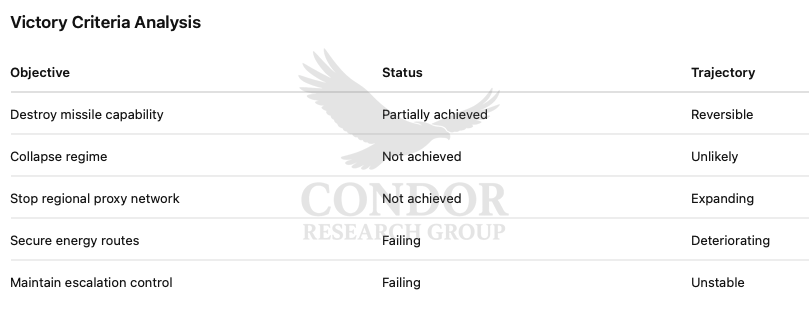
Probability Matrix (CRG Model)
All scenarios converge toward duration expansion, not resolution.
Scenario A — Rapid U.S./Israel Victory
- Probability: 15–25%
- Requirement: regime fracture (currently absent)
Scenario B — Controlled Strategic Containment
- Probability: 30–40%
- Outcome: Iran weakened but intact
Scenario C — Protracted Multi-Theater Conflict
- Probability: 35–50% (rising)
- Outcome: systemic drain on U.S./Israel position
CRG Strategic Conclusion
The U.S. and Israel are:
- Winning the war they started
- But losing control of the war it is becoming
This distinction is decisive.
Final Signal
Victory is no longer defined by: “Can Iran be damaged?”
But by: “Can Iran be forced into submission before the system expands beyond control?”
At present:
CRG Assessment:
That window is closing. The war will not be decided by who can strike harder,
but by who can remain structurally intact as the system expands.
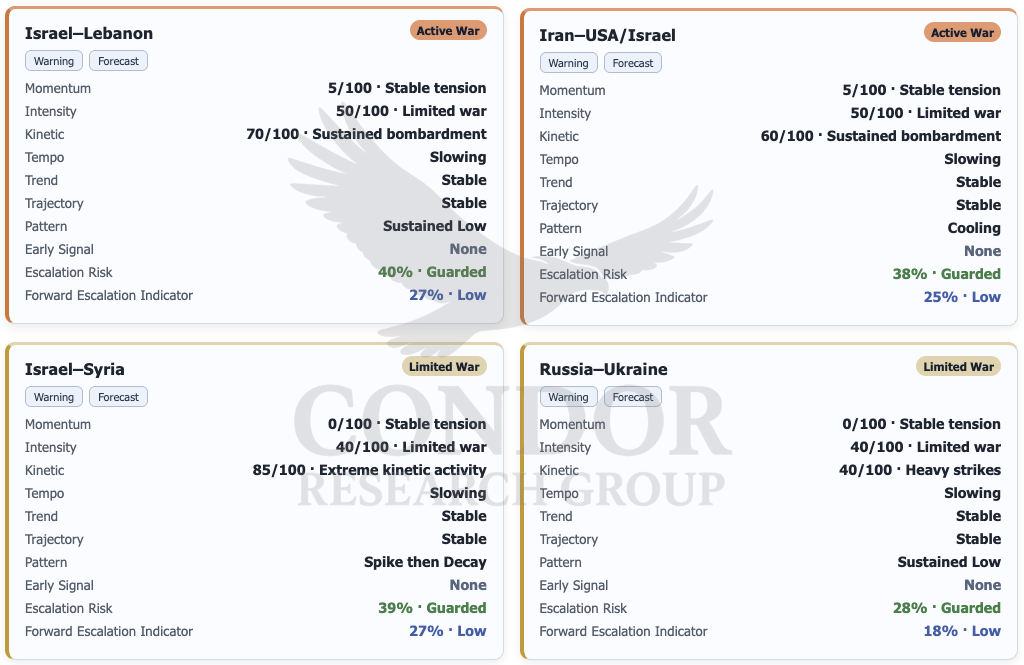
CRG Conflict State Comparison — Multi-Theater Snapshot (23 March 2026)
Relative positioning of Iran–USA/Israel against parallel active conflict systems
Document: CRG-INT-0326 — Iran War Outcome Probability: Illusion of Victory — Loss of Control Dynamics
Classification: Strategic Outcome Assessment
Revision Status: Final — Approved for internal CRG circulation, external academic reference, and web publication
Authorized By: Condor Research Group (CRG)
Division: Strategic Forecasting & Outcome Modeling (SFOM)
Original Draft Date: March 2026
Release Date: 23 March 2026
Version: CRG-INT-VER-A1-FINAL
Publication Note: Web release delayed; layout modified from raw analytical format