CRG-INT-ESC-0326/1: Strategic Gravity Shift — Middle East Escalation Now Dominates the Conflict Map
09/03/26 16:17
CRG-INT-ESC-0326
Strategic Gravity Shift — Middle East Escalation Now Dominates the Conflict Map
The latest signal from the CRG Escalation Monitoring Pipeline indicates a clear redistribution of global conflict gravity.
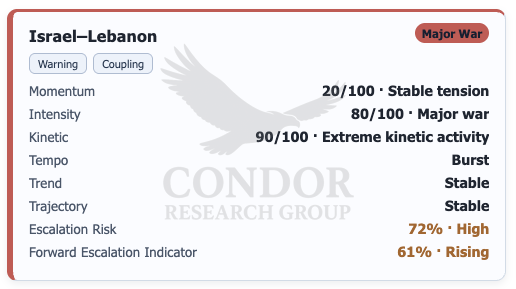
The Israel–Lebanon axis has now entered Major War classification (80/100) with extreme kinetic activity (90/100) and an escalation probability of 72%. The forward escalation indicator continues to rise, currently at 61%. In isolation, this might appear as a regional escalation.
In context, however, the picture is far more significant.
Across the global conflict grid, five of the eight priority conflicts now cluster around Israel and its regional operational environment:
- Israel–Lebanon — Major War
- Israel–Syria — Active War
- Israel–Gaza — Active War
- Israel–Yemen — Limited War
- Iran–USA/Israel — Limited War
This clustering effect represents a kinetic concentration event — a situation where a single state actor becomes the primary generator of escalation energy within the international system.
When kinetic intensity, operational tempo, and conflict coupling converge in this way, the result is not simply “multiple conflicts.” It becomes a regional war architecture.
The Dwarfing Effect
Measured against this cluster, other ongoing wars appear structurally diminished.
The Russia–Ukraine war, which previously dominated Western strategic discourse, now registers only 40/100 intensity within the CRG model; a Limited War classification with stable trajectory.
Its forward escalation indicator sits at 35%.
This does not imply that the war is resolved or unimportant locally.
It indicates something more structural:
Ukraine is no longer the primary escalation engine of the international system.
That role has shifted.
Structural Implications
The Israel-centric escalation cluster exhibits several characteristics associated with systemic destabilization:
1. Conflict Coupling
Multiple theaters are directly or indirectly linked through alliance networks and proxy structures.
2. Burst Tempo
Rapid operational surges rather than slow campaign cycles.
3. High Kinetic Density
Missile strikes, air operations, and asymmetric responses across multiple borders.
4. External Power Shadowing
Iran and the United States remain latent escalation anchors within the system.
The result is a conflict environment that can expand laterally rather than linearly.
Strategic Interpretation
The global conflict map has effectively bifurcated into two layers:
Layer 1 — High-Energy Escalation Zone
The Israel-centered Middle East theater.
Layer 2 — Residual Strategic Wars
Ukraine and other limited conflicts that continue but no longer drive global escalation dynamics.
In other words:
The international system is no longer oriented around Eastern Europe. It is increasingly oriented around Levantine escalation geometry.
Outlook
The current trajectory remains stable but elevated, meaning escalation pressure is high but not yet accelerating toward systemic war.
However, the CRG model indicates that further coupling events; particularly involving Iran or US assets, could rapidly convert the present structure from Major War cluster into regional systemic conflict.
For now, the signal is clear:
The strategic center of gravity of global conflict has shifted.
And it has shifted south.
Signal generated by the
Condor Research Group Escalation Monitoring Pipeline
Strategic Gravity Shift — Middle East Escalation Now Dominates the Conflict Map
The latest signal from the CRG Escalation Monitoring Pipeline indicates a clear redistribution of global conflict gravity.
The Israel–Lebanon axis has now entered Major War classification (80/100) with extreme kinetic activity (90/100) and an escalation probability of 72%. The forward escalation indicator continues to rise, currently at 61%. In isolation, this might appear as a regional escalation.
In context, however, the picture is far more significant.
Across the global conflict grid, five of the eight priority conflicts now cluster around Israel and its regional operational environment:
- Israel–Lebanon — Major War
- Israel–Syria — Active War
- Israel–Gaza — Active War
- Israel–Yemen — Limited War
- Iran–USA/Israel — Limited War
This clustering effect represents a kinetic concentration event — a situation where a single state actor becomes the primary generator of escalation energy within the international system.
When kinetic intensity, operational tempo, and conflict coupling converge in this way, the result is not simply “multiple conflicts.” It becomes a regional war architecture.
The Dwarfing Effect
Measured against this cluster, other ongoing wars appear structurally diminished.
The Russia–Ukraine war, which previously dominated Western strategic discourse, now registers only 40/100 intensity within the CRG model; a Limited War classification with stable trajectory.
Its forward escalation indicator sits at 35%.
This does not imply that the war is resolved or unimportant locally.
It indicates something more structural:
Ukraine is no longer the primary escalation engine of the international system.
That role has shifted.
Structural Implications
The Israel-centric escalation cluster exhibits several characteristics associated with systemic destabilization:
1. Conflict Coupling
Multiple theaters are directly or indirectly linked through alliance networks and proxy structures.
2. Burst Tempo
Rapid operational surges rather than slow campaign cycles.
3. High Kinetic Density
Missile strikes, air operations, and asymmetric responses across multiple borders.
4. External Power Shadowing
Iran and the United States remain latent escalation anchors within the system.
The result is a conflict environment that can expand laterally rather than linearly.
Strategic Interpretation
The global conflict map has effectively bifurcated into two layers:
Layer 1 — High-Energy Escalation Zone
The Israel-centered Middle East theater.
Layer 2 — Residual Strategic Wars
Ukraine and other limited conflicts that continue but no longer drive global escalation dynamics.
In other words:
The international system is no longer oriented around Eastern Europe. It is increasingly oriented around Levantine escalation geometry.
Outlook
The current trajectory remains stable but elevated, meaning escalation pressure is high but not yet accelerating toward systemic war.
However, the CRG model indicates that further coupling events; particularly involving Iran or US assets, could rapidly convert the present structure from Major War cluster into regional systemic conflict.
For now, the signal is clear:
The strategic center of gravity of global conflict has shifted.
And it has shifted south.
Signal generated by the
Condor Research Group Escalation Monitoring Pipeline